
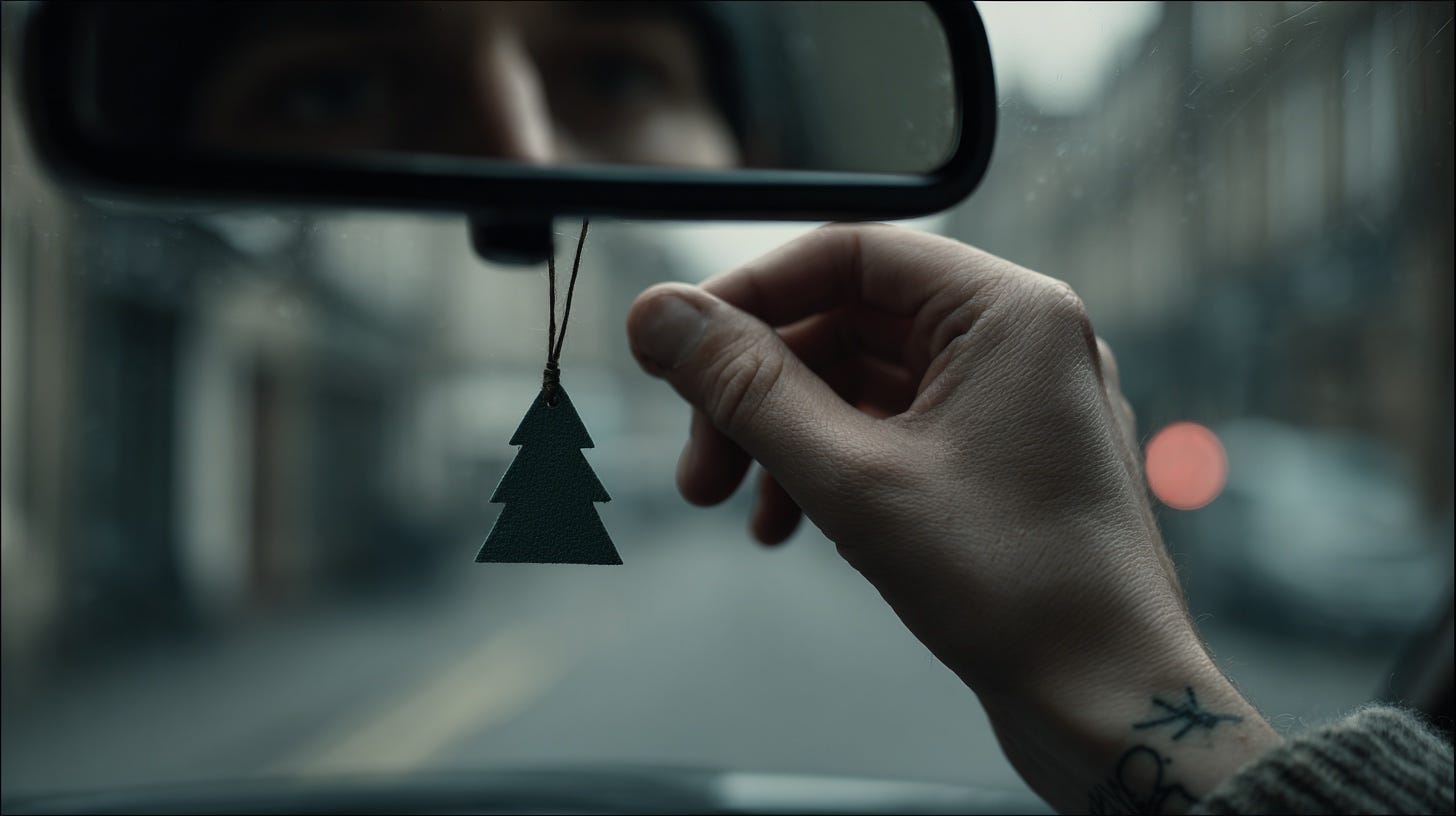
The air freshener was still on the string — pine, nearly gone. The car still smelled of it.
He knew where the key was kept. The seat was set for someone shorter and he’d left it.
The scanner was on the dash, bracket and wire, knob to the left of off. His knees were close to the wheel. He put both hands in his lap.
He’d been coming back since the week they let him out. Not every day — no pattern. Walking down Chatsworth Road, sometimes standing outside the workshop a few minutes. Today he’d taken the car.
He’d adjusted the mirror until he could see the road. He hadn’t moved the seat.
He'd parked outside the charity shop. In the window the oval frame held a photograph he'd been half-looking at for weeks — a man on a summer street, no one he knew. Opposite, the workshop roller door was down. It was the middle of the afternoon.
A patrol car came from towards town. He watched it. It went past the workshop, past the charity shop, past the car. It didn’t slow. He tracked it in the mirror until the road curved and it was gone.
He sat.
A delivery van double-parked outside the bookmakers. The driver made two trips with crates and drove off.
A woman passed with a buggy, a carrier bag on the handle, checking her phone. A boy on a bike came the other way too fast and clipped the kerb at the junction.
An older man walked slowly towards him — collar up, paper bag in hand. As he drew level with the window, the boy looked: the oval frame, the man on the summer street, the woman moving behind the counter. He looked away. The older man passed and was gone.
He hadn’t eaten.
His hand moved to the knob.
Same position it had always been — left of off, the slight resistance under his fingers. He turned it.
Static. Then squelch. Then the county dispatch frequency settling into shape: a unit to attend a concern for welfare on Newbold Road. Caller a neighbour, hadn’t seen her since Thursday, curtains still drawn at half ten. Unit acknowledged, four minutes out.
The unit arrived. The neighbour had a key. She’d been at her daughter’s, forgot to say. Everything fine. Confirmed. The call closed.
The channel moved on. A vehicle on Holywell Street — no road tax, someone to confirm when able.
He turned the volume down half a notch.

A boy in a borrowed car on Chatsworth Road. Both windows up. The police scanner on. He knows the voices by frequency, by the flat tone of routine. Today the call is about him.

The police came and went. Jan stood at the counter with both palms flat on the surface. Procedure finished. What didn’t finish was the girl’s face when she came back.

That evening, Keith told Sue what he’d seen through the roller door — the car, the girl, the volunteer at the counter. He described it the way he’d describe a fault. Sue asked the question he hadn’t asked himself.

A&E on a Thursday night. A nurse with a clipboard and questions designed to be answered yes or no. The form gets what the form needs.

A council admin worker processes safeguarding referrals. Forty-three seconds each. She keeps her own tally. At lunch, a man on the bench by the Crooked Spire says something she mishears.

Three days clearing her mother’s house. Every room done except the sewing room — the one that had always been closed. In the third drawer, a photograph of a man she doesn’t recognise. Her mother’s handwriting on the back.

The charity shop volunteer opens a donated bag of sewing things. At the bottom, wrapped in lining cloth, a photograph: a man on Chatsworth Road, 1987, a name on the back. The oval frame had been waiting behind the counter for two weeks.

An estate agent in his good suit, briefcase rather than the folder. A routine handover: clean title, vacant possession, keys on the table. The buyer picks up the Yale and says she thinks she might already have one. Same colour fob as her mother’s. Easy mistake. Bryan is already smiling when he says it.

A secondary school form tutor has been noticing one of her Year Ten students since October. Quieter than last year. Still attending, work still good, nothing the referral guidance has a category for. She stays late. Near the end of Megan's essay, a sentence she wouldn't have expected: What is left unsaid is also a form of speech.

Thursday morning. The square thinner than it used to be. An older man she knows by habit — damson chutney, coins never exact. "My wife used to put this on everything," he says. She waits for him to look at her properly. He doesn't.