

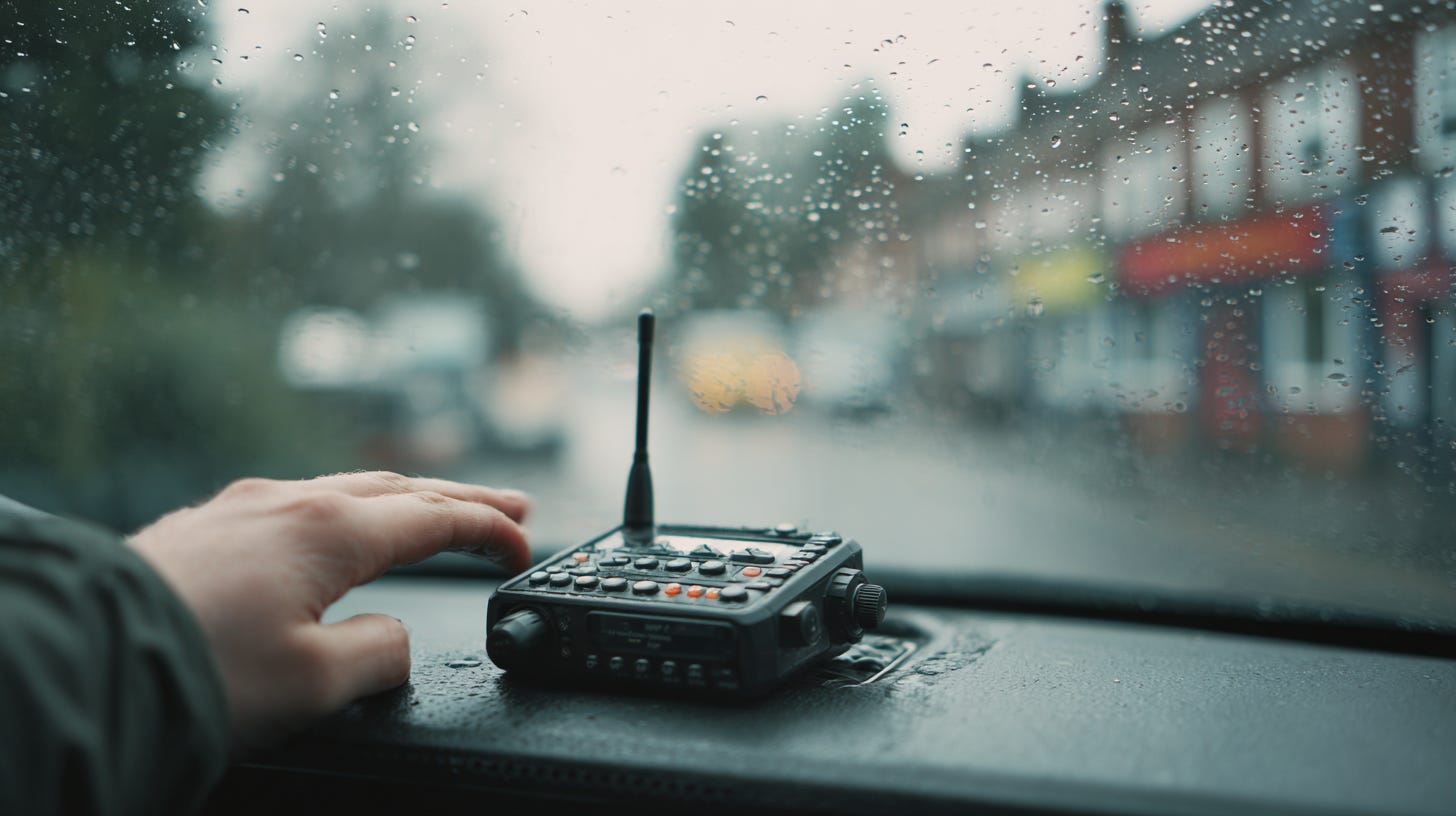
The car smelled of someone else’s air freshener — pine, the cheap kind that hung from the mirror on a string. It was her mum’s car. The tax was in her mum’s name. The seats were set for someone shorter.
He sat in the passenger seat with both windows up and the scanner on.
Derbyshire Constabulary. North division, Chesterfield patch. A woman’s voice reading a plate number, someone responding from Chatsworth Road, a pause long enough that he could hear the officer’s engine idling. Then dispatch again, flat and unhurried, sending a unit to Whittington Moor for a car alarm.
He turned the volume down half a notch. Not quieter — tuned. The frequency where the voices sat behind everything else, behind the workshop noise across the road, the air wrench, the local radio station competing through the roller door. At this volume the scanner was furniture. A room he carried with him.
The girl had gone back to the charity shop seven minutes ago. He hadn’t offered to go with her. She hadn’t asked.
He’d been listening for seven months. A mate’s older brother had one — said you could hear when they were heading somewhere, know to go the other way. But he never used it like that. He didn’t go the other way. He just listened.
He knew the difference between a voice heading toward something and a voice that had already arrived. The ones heading toward something had edges. The ones already there were flat. Quietest calls were the worst. No urgency. A road name, a number, a request for another unit. Those were the ones where someone was already on the ground.
Nine minutes. He checked the wing mirror. The charity shop was three doors down, past a vape place with a handwritten sign about nic salts. He could see the front window — the mannequin in a blouse that had been there since last week, and behind it, movement. A woman. Not the girl. The other one, the volunteer, the one who’d been behind the counter when they dropped the bag. He’d seen her through the glass when they first pulled up — sorting, pricing, not looking out. The kind of woman who knew the weight of what she was holding before she opened it. She was standing now, near the counter, not sorting anything. Just standing.
The door was shut. He couldn’t tell if the girl was still in there.
He turned the volume up. Not to hear better. To fill the car with something that wasn’t her being gone.
A dispatch call — anti-social on Holywell Street, two lads on the wall by the car park. The responding officer’s voice was one he recognised. Unhurried. The sort who’d talk to the lads first, give them thirty seconds to move. He mouthed the response code before it came. Got it right. He always got it right. He knew these people by their cadences, would never meet them, would never have to. That was the arrangement.
A new voice. Not a regular on this patch — a unit redirected from somewhere else, the cadence slightly off, like someone reading in a room they hadn’t been in before.
The voice gave a road name. His road. The one he was sitting on.
Something about a charity shop. A bag. Contents described by weight — a number he knew because he’d counted it that morning, pressing the scale with one finger to keep it steady. Then a cash amount, which was wrong by forty, but close enough that the air in the car changed.
Then “air pistol.” Then “police scanner.” Then “vehicle at a nearby workshop.”
His hand went to the volume knob. Stopped. The gesture he’d made five hundred times — reach, adjust, settle — wouldn’t finish. His fingers stayed on the knob without turning it.
The voice hadn’t changed. Same procedural grammar. Same flat dispatch cadence he’d spent seven months mistaking for something that had nothing to do with him. The call was about him and it sounded like every other call he’d ever heard, and that was the thing.
He turned the scanner off.
The silence was worse. The workshop radio across the road filled the space immediately — a song he half knew, played at the wrong volume for what was happening inside the car.
He turned it back on.
Adjusted the volume to where he always kept it. The comfort setting. The background-hum frequency where other people’s trouble arrived in order and stayed at arm’s length and never once turned around and looked at him.
But it had turned around. Same sounds, same voices, same grammar, and the meaning had shifted. Not a different frequency. The same one, heard from inside the call.
He straightened the rearview mirror. It didn’t need straightening. He put both palms flat on the dashboard, the way you’d steady a table someone had bumped.
Through the charity shop window the volunteer had moved. She was at the telephone now, the one on the wall behind the till, the old kind with a cord. She held the receiver the way his nan used to hold hers — with her whole hand, not pinched between shoulder and chin the way young people did. She was talking and not talking. Listening. Nodding at someone who couldn’t see her nod. When she put the phone down she stood with her hand on the receiver for a moment, the way you’d stand with your hand on a door you’d just closed on someone.
Then she went back to the counter and picked up something — a cloth, it looked like — and wiped the space where the knapsack had been. He watched her do it. Slow, thorough, the gesture of someone resetting a surface rather than cleaning it. She didn’t look toward the window. She didn’t know he was watching. She folded the cloth into quarters and put it under the counter and then stood with both hands flat on the surface, palms down, and he recognised the gesture because he’d just done it himself on the dashboard.
The girl came out of the shop. Not through the front door — through a side entrance he hadn’t noticed, between the charity shop and the vape place. She was walking fast. Not running. She knew not to run in Chesterfield, not past shop fronts, not when it mattered. Her face was doing something he’d heard a hundred times on the scanner but never seen: the voice of someone who had already arrived and was waiting for whatever came next.
She got in. Left the door open two inches, like the car wasn’t committed yet, like she might still get out.
“They called someone.”
He knew. He’d known for ninety seconds longer than she had. Ninety seconds in which he’d heard her described as “female juvenile” and himself as “male juvenile” and felt the categories land the way his mum’s recycling bins landed at the kerb on a Thursday morning — each one the right shape, ordinary, nothing worth opening.
He reached across and pulled her door shut.
Through the shop window the volunteer was still standing at the counter. She hadn’t moved. Another woman — shorter, older, carrying two mugs — appeared from the back of the shop and set one down beside her. The volunteer didn’t pick it up. She was looking at the door the girl had come through, but the girl was already gone, and the door was shut, and whatever the volunteer had seen in the girl’s face when she’d come back for the bag — the calculating look — she was keeping it. Not filing it. Keeping it.
She started the engine. The scanner was still on. The voices kept going — another call, somewhere else, someone else’s trouble arriving in order.
The girl pulled out onto Chatsworth Road and the charity shop slid past the passenger window and he didn’t look, but she did, and he felt her looking, and neither of them said anything, and the volunteer inside picked up the mug and drank from it and it was too milky, the way Margaret always made it, and she drank it anyway.

A boy in a borrowed car on Chatsworth Road. Both windows up. The police scanner on. He knows the voices by frequency, by the flat tone of routine. Today the call is about him.

The police came and went. Jan stood at the counter with both palms flat on the surface. Procedure finished. What didn’t finish was the girl’s face when she came back.

That evening, Keith told Sue what he’d seen through the roller door — the car, the girl, the volunteer at the counter. He described it the way he’d describe a fault. Sue asked the question he hadn’t asked himself.

A&E on a Thursday night. A nurse with a clipboard and questions designed to be answered yes or no. The form gets what the form needs.

A council admin worker processes safeguarding referrals. Forty-three seconds each. She keeps her own tally. At lunch, a man on the bench by the Crooked Spire says something she mishears.

Three days clearing her mother’s house. Every room done except the sewing room — the one that had always been closed. In the third drawer, a photograph of a man she doesn’t recognise. Her mother’s handwriting on the back.

The charity shop volunteer opens a donated bag of sewing things. At the bottom, wrapped in lining cloth, a photograph: a man on Chatsworth Road, 1987, a name on the back. The oval frame had been waiting behind the counter for two weeks.

An estate agent in his good suit, briefcase rather than the folder. A routine handover: clean title, vacant possession, keys on the table. The buyer picks up the Yale and says she thinks she might already have one. Same colour fob as her mother’s. Easy mistake. Bryan is already smiling when he says it.

A secondary school form tutor has been noticing one of her Year Ten students since October. Quieter than last year. Still attending, work still good, nothing the referral guidance has a category for. She stays late. Near the end of Megan’s essay, a sentence she wouldn’t have expected: What is left unsaid is also a form of speech.

Thursday morning. The square thinner than it used to be. An older man she knows by habit — damson chutney, coins never exact. “My wife used to put this on everything,” he says. She waits for him to look at her properly. He doesn’t.

An older man makes two mugs of tea. He picks up one, takes a paper bag from the kitchen table, and goes out. He walks through Brampton and down Chatsworth Road. He feeds the pigeons by the Crooked Spire until the bag is empty. At the market, the woman is already reaching for the jar before he asks.

He'd been coming back since the week they let him out. Not every day — no pattern. Today he took the car. He knew where the key was kept.