
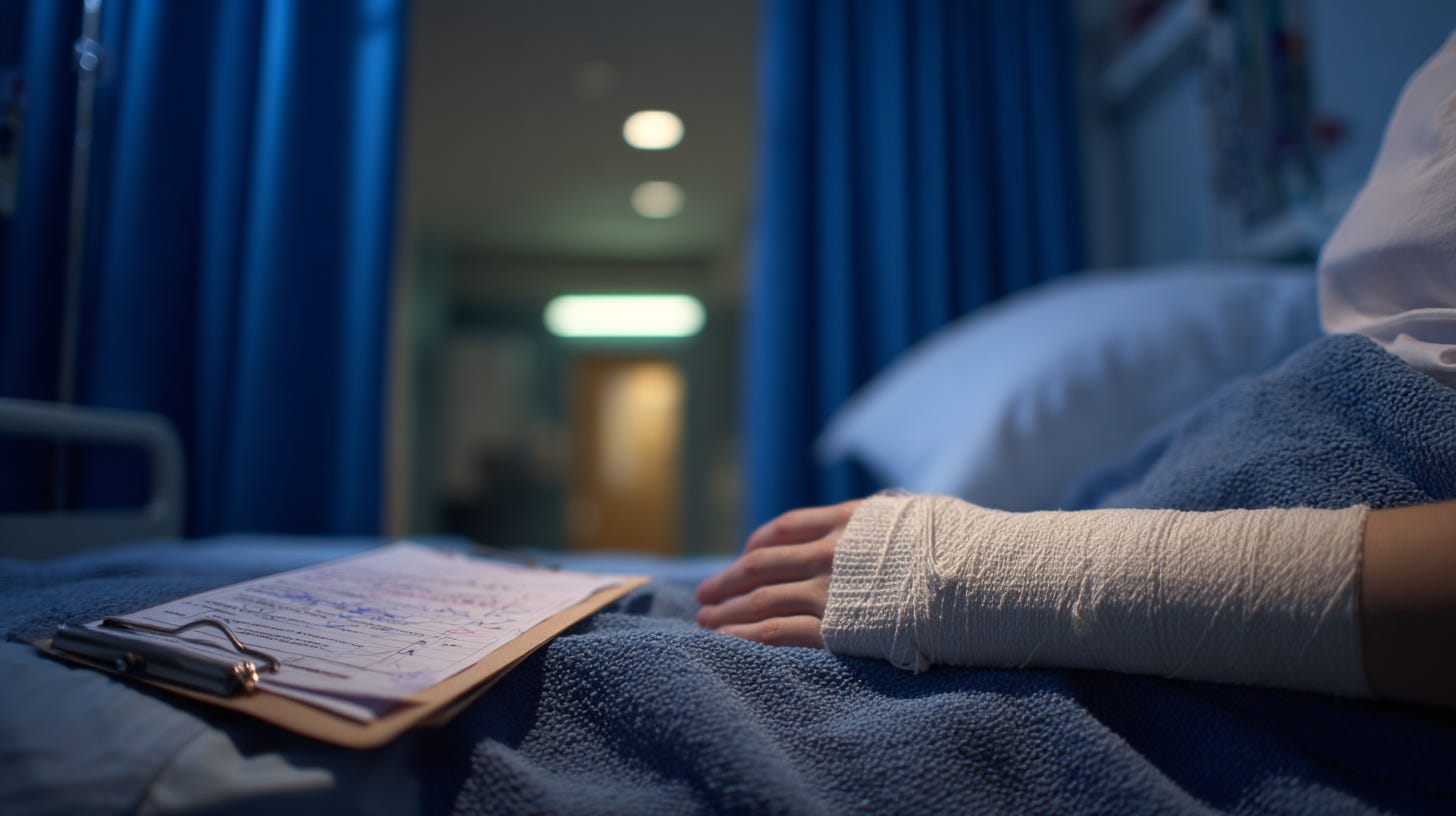
The wrist had its own pulse. Not the one the triage nurse had checked — the other one, the one that sat underneath the swelling like a second heartbeat, slower than hers, keeping its own time. Nadia held it in her lap with her good hand underneath, the way you’d hold something that might shift if you let go.
A&E on a Thursday night. She’d been here forty minutes. The waiting room was the one everyone in Chesterfield knew — the bolted chairs, the vending machine with the dent in the front panel, the triage window where a woman in scrubs called names without looking up. A man across from her was asleep with his chin on his chest. Next to him a woman was scrolling her phone with the brightness turned all the way up, the screen reflecting off the plastic chair back like a small white fire.
She watched the board. Her name wasn’t on it yet.
The steps outside the back door. The broken paving slab, the one she’d told herself she’d get someone to look at since September. She’d said it at triage. The nurse had written it down without pausing.
They called her through. A cubicle with a curtain that didn’t close all the way — the runner was missing a hook at the far end and the fabric hung slack, showing a strip of corridor. A different nurse this time, younger, quick hands. She examined the wrist, turning it in a way that made Nadia’s breath catch but not her voice. X-ray ordered. Someone would come back.
She sat. The corridor was audible through the gap in the curtain — footsteps, a trolley with a wheel that needed oiling, someone’s phone ringing four times and stopping. The strip light above her had a faint buzz, the frequency just below hearing, the kind you felt in your teeth more than your ears. She looked at the ceiling tiles. Counted the holes in one. Lost count. Started again.
She’d left the kitchen light on. She could see it — the yellow square of the window as she’d reversed off the drive, one-handed, the seatbelt pressing against the wrist in a way that made the twenty-minute drive feel longer than it was. The light would still be on when she got home. Nobody was going to turn it off.
A woman came through the curtain. Dark blue tunic, lanyard tucked into the breast pocket. She was carrying a clipboard and she sat down on the plastic chair opposite Nadia’s bed without being asked.
“I’m Sue. I’m one of the nurses on tonight. I just need to ask you a few routine questions — we do this with all patients who come in with this type of injury. Is that alright?”
Nadia nodded.
“Can you tell me who else lives at your address?”
“Just me.”
Sue wrote something. The pen moved without hesitation. “And are you currently in a relationship?”
“No.”
“Have you been seen at this hospital, or any other, for a similar injury in the last twelve months?”
“No.”
“Do you feel safe at home?”
“Yes.”
Sue looked at her. She held the pen above the clipboard without writing.
“That’s a paving slab you’ve been meaning to fix since September.”
“Since August, actually. September’s when I stopped noticing it.”
Sue’s pen touched the clipboard. Didn’t move.
“I drove myself here,” Nadia said. “With a broken wrist. Because it’s not an emergency. It’s just a thing that happened.”
Sue didn’t write anything. The pen was still above the clipboard. The corridor sounds came through the gap in the curtain — the trolley again, further away now, the wheel still needing oil.
“I’m going to note that you’d like to speak to someone from our support team,” Sue said. “They can call you, or you can call them. It’s your choice.”
“I don’t need to speak to anyone.”
“I know.” Sue wrote something on the form. “But the number will be there if you change your mind.”
She finished writing. She stood up. She said someone would be back with the X-ray results and that the cast would take about twenty minutes after that. She left through the curtain and the curtain swung and settled and didn’t quite close.
She looked at the gap in the curtain. She looked at her wrist. The swelling had its own colour now — not bruise-purple, not yet, but the yellowish colour of something deciding what it was going to become.
They put her in a cast. A young doctor who talked her through it like she was explaining something to a relative, gentle and slightly too loud. The plaster was warm going on and cold by the time she walked back through the corridor toward the exit, the cast heavier than the wrist, the wrist heavier than it had been when she’d arrived.
She passed the nurses’ station. Sue was there, writing. Not the form — something else, a different clipboard, a different patient’s life in a different set of boxes.
Nadia stopped.
“Thank you,” she said. Then: “It’s just a form.”
Sue looked up. Nadia was smiling.
“It’s just a form,” Nadia said again. She walked toward the doors. The automatic doors opened and she went through and they closed behind her.
Sue watched the doors settle. Then she picked up her pen.

A boy in a borrowed car on Chatsworth Road. Both windows up. The police scanner on. He knows the voices by frequency, by the flat tone of routine. Today the call is about him.

The police came and went. Jan stood at the counter with both palms flat on the surface. Procedure finished. What didn’t finish was the girl’s face when she came back.

That evening, Keith told Sue what he’d seen through the roller door — the car, the girl, the volunteer at the counter. He described it the way he’d describe a fault. Sue asked the question he hadn’t asked himself.

A&E on a Thursday night. A nurse with a clipboard and questions designed to be answered yes or no. The form gets what the form needs.

A council admin worker processes safeguarding referrals. Forty-three seconds each. She keeps her own tally. At lunch, a man on the bench by the Crooked Spire says something she mishears.

Three days clearing her mother’s house. Every room done except the sewing room — the one that had always been closed. In the third drawer, a photograph of a man she doesn’t recognise. Her mother’s handwriting on the back.

The charity shop volunteer opens a donated bag of sewing things. At the bottom, wrapped in lining cloth, a photograph: a man on Chatsworth Road, 1987, a name on the back. The oval frame had been waiting behind the counter for two weeks.

An estate agent in his good suit, briefcase rather than the folder. A routine handover: clean title, vacant possession, keys on the table. The buyer picks up the Yale and says she thinks she might already have one. Same colour fob as her mother’s. Easy mistake. Bryan is already smiling when he says it.

A secondary school form tutor has been noticing one of her Year Ten students since October. Quieter than last year. Still attending, work still good, nothing the referral guidance has a category for. She stays late. Near the end of Megan’s essay, a sentence she wouldn’t have expected: What is left unsaid is also a form of speech.

Thursday morning. The square thinner than it used to be. An older man she knows by habit — damson chutney, coins never exact. “My wife used to put this on everything,” he says. She waits for him to look at her properly. He doesn’t.

An older man makes two mugs of tea. He picks up one, takes a paper bag from the kitchen table, and goes out. He walks through Brampton and down Chatsworth Road. He feeds the pigeons by the Crooked Spire until the bag is empty. At the market, the woman is already reaching for the jar before he asks.

He’d been coming back since the week they let him out. Not every day — no pattern. Today he took the car. He knew where the key was kept.