
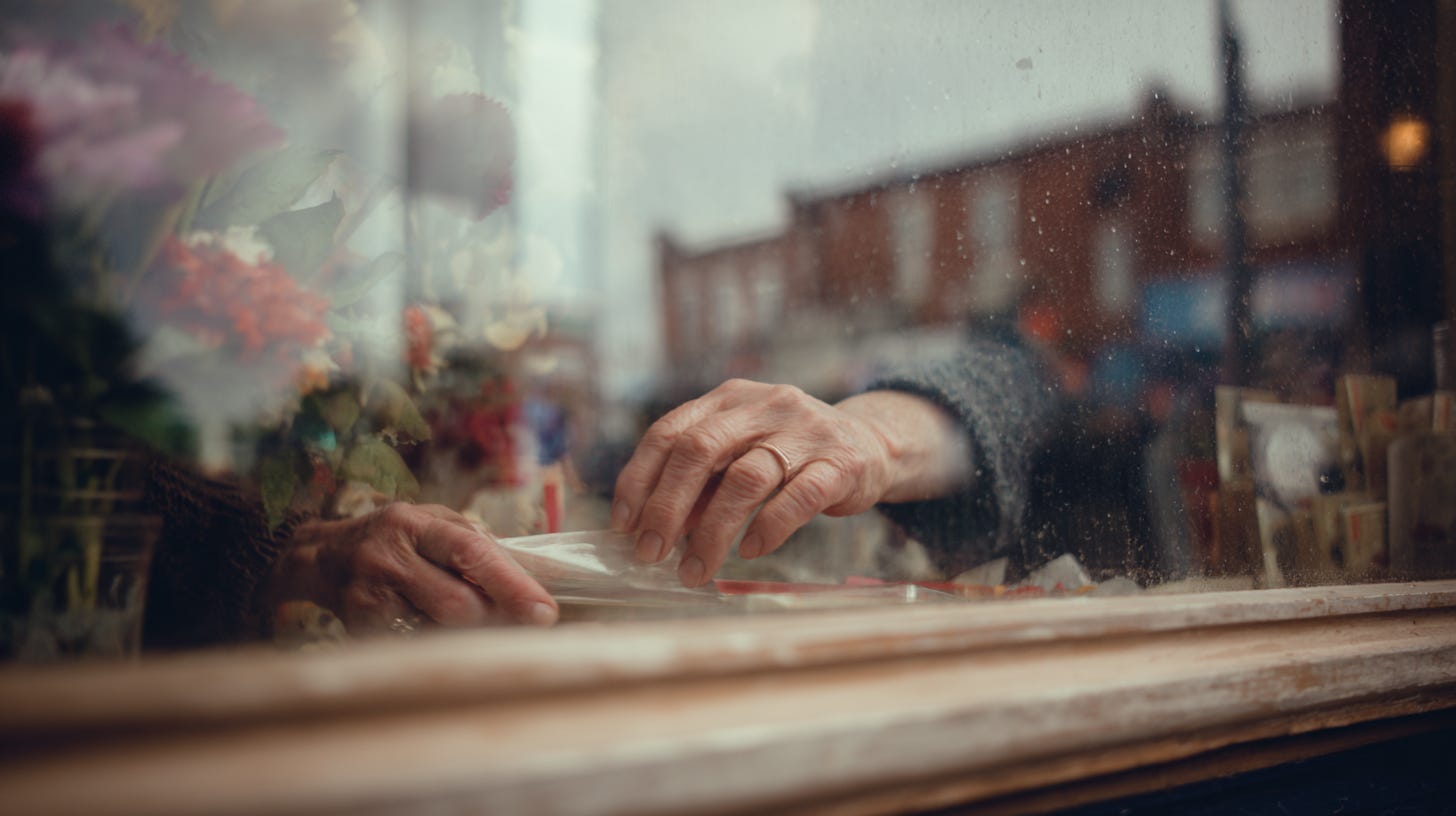
The frame had been behind the counter for two weeks. Mahogany, Victorian, oval — Margaret had priced it at twelve pounds, which Jan had crossed out and written eight, and then it hadn’t sold and she’d brought it through to the back. She was going to put it in the window once she found something to put in it.
The woman who came in with the bags was in her late thirties. She said that she was in a hurry, that she needed to be back before the estate agent arrived. Jan said they’d take whatever she had. The woman left four bags by the door and didn’t look at them when she went.
Three were clothes. Jan left those for Margaret. The fourth was heavier — she brought it through to the sorting table and opened it on her own.
Sewing things. She’d had a few of those lately, since the older women had started going. She worked through the top layer: a pincushion, a darning mushroom, a box of glass-headed pins. She priced as she went, making two piles — haberdashery shelf, rags bin.
Near the bottom, she found fabric samples folded into squares. She lifted the top one out and held it up to the light the way she always did, checking the weave, the weight. Pale blue with a small white print. Good cotton. She stood with it for a moment. Then she set it on the counter apart from the two piles and kept going.
A folded piece of paper that turned out to be measurements. Chest, waist, hip, written in a small careful hand. For a pattern, probably. She looked at the numbers, then put them in the bin.
The estate agent’s magnet she tossed in after. It missed and stuck to the side of the bin, the logo facing out. She left it.
The photograph was at the bottom, wrapped in a piece of lining cloth. She unwrapped it and set it on the table.
A man, middle-aged in the photograph. Standing on Chatsworth Road — she could see the shopfronts behind him and the edge of something that looked like a roller door. He was looking slightly off-camera, not at whoever was taking the picture.
She turned it over.
A date — 1987 — and a name in the same small careful hand as the measurements. *Alan.*
She looked at the bin. She looked at the handwriting on the back of the photograph. Then she went back to the front.
She looked at the frame on the counter.
Eleven years she’d been doing this. In that time she’d learned that most things had a use if you found the right category, and that the ones that didn’t were usually photographs. People couldn’t bring themselves to throw photographs away, even photographs of strangers. They donated them instead.
She took the back off the frame and fitted the photograph in. The oval suited it — the man’s face filled it without crowding. She put the backing on and carried it through to the front.
She put it in the corner of the window, facing out. The man on Chatsworth Road, facing Chatsworth Road. She stepped back. It was the right size for the frame.
Margaret was coming out of the back with a bag of clothes over one arm. She looked at the window display.
“Found something for it then.”
“Just now,” Jan said.
She went back behind the counter. The pale blue fabric was still on the sorting table, apart from the piles. Outside, a man in a cap was making his way along the pavement on the other side of the road, a paper bag in his hand. She watched him until he turned down toward the market.
She pulled the next bag toward her and opened it.

A boy in a borrowed car on Chatsworth Road. Both windows up. The police scanner on. He knows the voices by frequency, by the flat tone of routine. Today the call is about him.

The police came and went. Jan stood at the counter with both palms flat on the surface. Procedure finished. What didn’t finish was the girl’s face when she came back.

That evening, Keith told Sue what he’d seen through the roller door — the car, the girl, the volunteer at the counter. He described it the way he’d describe a fault. Sue asked the question he hadn’t asked himself.

A&E on a Thursday night. A nurse with a clipboard and questions designed to be answered yes or no. The form gets what the form needs.

A council admin worker processes safeguarding referrals. Forty-three seconds each. She keeps her own tally. At lunch, a man on the bench by the Crooked Spire says something she mishears.

Three days clearing her mother’s house. Every room done except the sewing room — the one that had always been closed. In the third drawer, a photograph of a man she doesn’t recognise. Her mother’s handwriting on the back.

The charity shop volunteer opens a donated bag of sewing things. At the bottom, wrapped in lining cloth, a photograph: a man on Chatsworth Road, 1987, a name on the back. The oval frame had been waiting behind the counter for two weeks.

An estate agent in his good suit, briefcase rather than the folder. A routine handover: clean title, vacant possession, keys on the table. The buyer picks up the Yale and says she thinks she might already have one. Same colour fob as her mother’s. Easy mistake. Bryan is already smiling when he says it.

A secondary school form tutor has been noticing one of her Year Ten students since October. Quieter than last year. Still attending, work still good, nothing the referral guidance has a category for. She stays late. Near the end of Megan’s essay, a sentence she wouldn’t have expected: What is left unsaid is also a form of speech.

Thursday morning. The square thinner than it used to be. An older man she knows by habit — damson chutney, coins never exact. “My wife used to put this on everything,” he says. She waits for him to look at her properly. He doesn’t.

An older man makes two mugs of tea. He picks up one, takes a paper bag from the kitchen table, and goes out. He walks through Brampton and down Chatsworth Road. He feeds the pigeons by the Crooked Spire until the bag is empty. At the market, the woman is already reaching for the jar before he asks.

He’d been coming back since the week they let him out. Not every day — no pattern. Today he took the car. He knew where the key was kept.