
The roller door had a sound when it hit the concrete that Keith could feel in his back teeth. Twelve years he’d been pulling it down and the sound hadn’t changed. The bolt, the track, the weather seal that had gone in the first winter and never been replaced. He knew the door the way he knew engines — by what was wrong with it and how long the wrong had been there.
He pulled it down at ten past five. The forecourt was empty. The Chatsworth Road traffic was thinning out the way it did on a Thursday — the school cars gone, the market traffic gone, just the buses and the people who didn’t have anywhere to be at a particular time.
The charity shop was shut. Had been since four. The lights were off but the mannequin was still in the window, the blouse catching the last of the light from the street. He’d been looking at that window all afternoon, on and off, the way you’d check a gauge you didn’t trust.
He locked the roller door and walked to the van. His hands smelled of engine oil and the soap from the dispenser in the back that never got the oil out, just moved it around. He drove home the way he always drove home — A61, Whittington Moor roundabout, left onto the estate. The radio was on. He didn’t change the station.
Sue was in the kitchen. He could tell from the hallway — the extractor fan, the particular sound of her moving between the cooker and the worktop in a space she’d been moving through for twenty-three years. She didn’t turn around when he came in. She knew the sound of him the way he knew the sound of the door.
“Tea’s in ten.”
He washed his hands at the kitchen sink. The oil sat in the creases of his knuckles the way it always did — the soap at home was no better than the soap at work. He dried them on the towel that hung from the oven handle and sat down at the table.
Sue was doing something with a pan. He watched her back. She was in her uniform already — the dark blue tunic, the lanyard tucked into the breast pocket the way the hospital made them. Night shift. She’d leave at half six, be on the ward by seven, home by half seven in the morning. He’d have the house to himself by the time the news came on.
He didn’t say anything for a while. She didn’t ask. This was how it went — he’d come home with something sitting in him and she’d wait for it the way you’d wait for a kettle. She always knew. Not what it was. That it was there.
“Police were on Chatsworth Road today.”
She didn’t turn around. “What for?”
“The charity shop. Bag of something. Two kids dropped it off and the woman called it in.”
“What was in it?”
“Don’t know. Police took it. Evidence bag.”
He paused. She waited. The extractor fan filled the gap the way the workshop radio filled the gaps on Chatsworth Road.
“There was a girl. Came back for the bag after the woman had already called. She went in through the side door — the delivery entrance, round the back. Came out the same way. Fast. Not running.”
Sue turned the hob down. Still didn’t face him. “How old?”
“Sixteen. Seventeen maybe.”
She nodded. He couldn’t see her nod but he could see the movement in her shoulders.
“She had a lad with her. Sat in the car the whole time. Passenger seat. Didn’t get out, didn’t go in. Just sat there.”
“And you watched all this.”
It wasn’t a question. He heard it the way he’d hear a timing belt that was a quarter-turn off.
“I was in the doorway. You can see the whole street from the doorway.”
“You can see the whole street from anywhere in that workshop, Keith. You’ve got the door up twelve hours a day.”
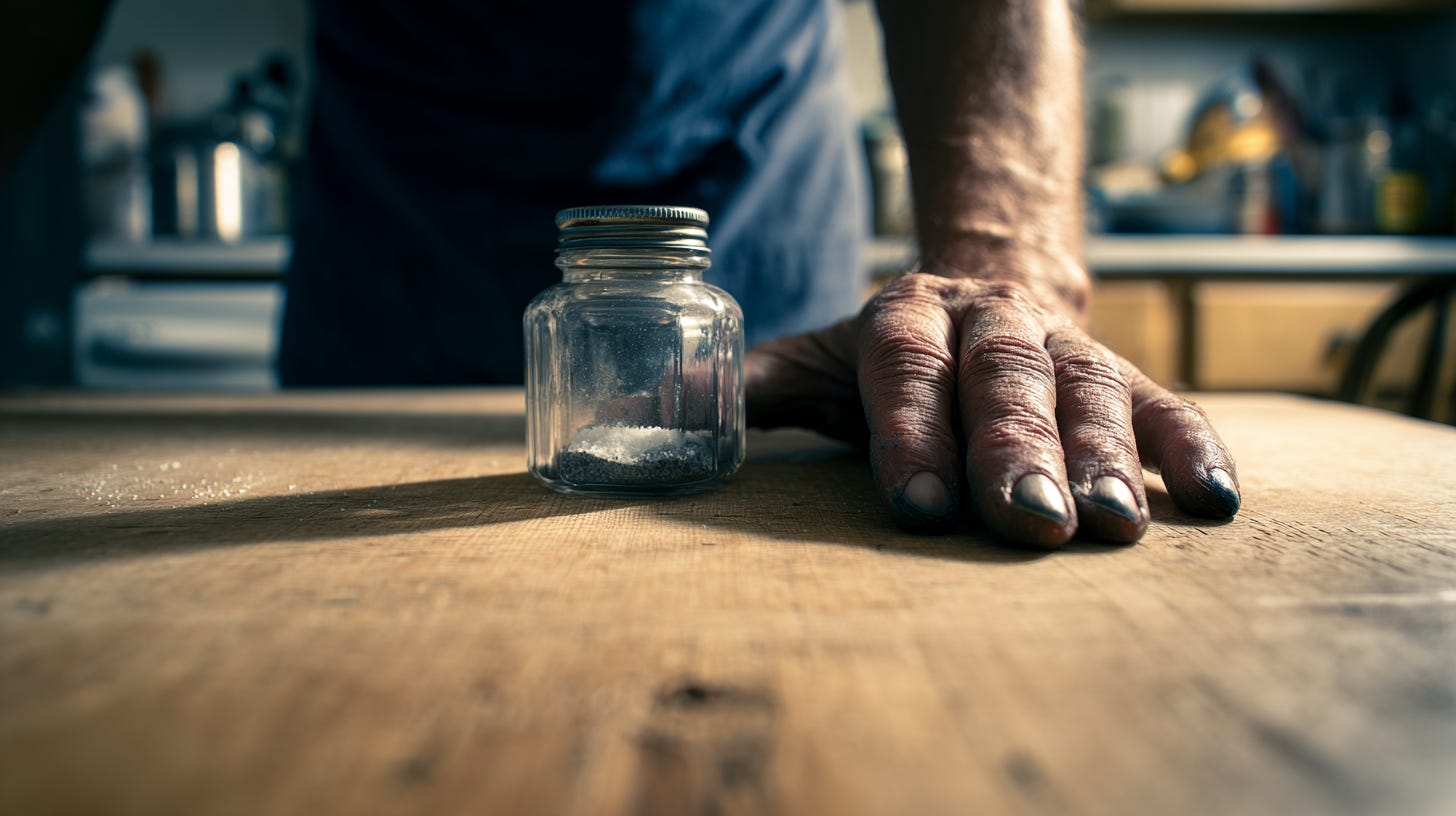
He picked up the salt cellar from the middle of the table. Put it down. Picked it up again. Turned it in his hand the way he’d turn a part he was checking for wear.
“The woman in the shop. After the police left. She just stood there. Behind the counter, not doing anything. Just standing.”
“Did you go over?”
“No.”
“Why not?”
He put the salt cellar down. “I don’t know her.”
“You’ve been across the road from her for twelve years.”
“I don’t know her name.”
Sue turned around. She leaned against the worktop with her arms folded and looked at him the way she looked at him when he was telling her about an engine and leaving out the part that mattered.
“What is it.”
“The lad in the car. He reminded me of someone.”
She didn’t say anything.
“He was just sitting there. Not on his phone, not doing anything. Just sitting in the passenger seat like he was waiting for something to be over. And when she came out — the girl — he reached across and pulled her door shut. From the inside. Like he’d been ready to do it the whole time.”
Sue unfolded her arms. She picked up the tea towel from the worktop and folded it, not because it needed folding but because her hands needed something to do, and he recognised the gesture because he’d just done it with the salt cellar.
“He reminded you of Danny.”
Keith didn’t answer. The extractor fan was still going. The pan was making the sound a pan makes when the heat’s been turned down but the contents haven’t caught up yet.
“Keith. He reminded you of Danny.”
“I didn’t say that.”
He looked at the table. There was a mark on the surface where Danny had gouged it with a compass when he was eleven. Sue had wanted to sand it out. Keith hadn’t let her. He couldn’t remember why. The mark was still there, the shape of a crescent moon, or a fingernail, or nothing in particular.
“He’s alright, you know,” Sue said. “He rang last Tuesday.”
“You didn’t say.”
“He rang while you were at work. Said he might come down for the bank holiday. Might.”
Keith knew what Danny’s mights meant.
Sue took off the lanyard and laid it on the worktop. Then she put it back on. She did this sometimes — a rehearsal of leaving before she actually left.
“I have to go in twenty minutes.”
He nodded.
She put a plate in front of him. Shepherd’s pie, the edges browned the way he liked them. She sat down opposite with her own plate and they ate without talking, the way they’d eaten without talking for twenty-three years.
She washed up. He dried. She put her coat on and picked up her keys and stood in the kitchen doorway the way she stood every night, half in and half out, the lanyard visible against the dark coat.
“Drive careful.”
“Always do.”
She left. He heard the car start, reverse off the drive, pull away. Then it was just the house. The extractor fan had stopped. The radio was still on, low, the same station that had been playing through the roller door all afternoon — a song he didn’t know followed by one he did, and the one he did sounded different here, in the kitchen, with Sue gone and the plate drying on the rack and Danny’s compass mark on the table catching the light from the bulb above it.
He went to the back door and opened it. The garden was dark. The air smelled of next door’s bins and someone’s woodburner three streets over. He stood in the doorway with his hands in his pockets, framed by the door the way he’d been framed by the roller door all day.

A boy in a borrowed car on Chatsworth Road. Both windows up. The police scanner on. He knows the voices by frequency, by the flat tone of routine. Today the call is about him.

The police came and went. Jan stood at the counter with both palms flat on the surface. Procedure finished. What didn’t finish was the girl’s face when she came back.

That evening, Keith told Sue what he’d seen through the roller door — the car, the girl, the volunteer at the counter. He described it the way he’d describe a fault. Sue asked the question he hadn’t asked himself.

A&E on a Thursday night. A nurse with a clipboard and questions designed to be answered yes or no. The form gets what the form needs.

A council admin worker processes safeguarding referrals. Forty-three seconds each. She keeps her own tally. At lunch, a man on the bench by the Crooked Spire says something she mishears.

Three days clearing her mother’s house. Every room done except the sewing room — the one that had always been closed. In the third drawer, a photograph of a man she doesn’t recognise. Her mother’s handwriting on the back.

The charity shop volunteer opens a donated bag of sewing things. At the bottom, wrapped in lining cloth, a photograph: a man on Chatsworth Road, 1987, a name on the back. The oval frame had been waiting behind the counter for two weeks.

An estate agent in his good suit, briefcase rather than the folder. A routine handover: clean title, vacant possession, keys on the table. The buyer picks up the Yale and says she thinks she might already have one. Same colour fob as her mother’s. Easy mistake. Bryan is already smiling when he says it.

A secondary school form tutor has been noticing one of her Year Ten students since October. Quieter than last year. Still attending, work still good, nothing the referral guidance has a category for. She stays late. Near the end of Megan’s essay, a sentence she wouldn’t have expected: What is left unsaid is also a form of speech.

Thursday morning. The square thinner than it used to be. An older man she knows by habit — damson chutney, coins never exact. “My wife used to put this on everything,” he says. She waits for him to look at her properly. He doesn’t.

An older man makes two mugs of tea. He picks up one, takes a paper bag from the kitchen table, and goes out. He walks through Brampton and down Chatsworth Road. He feeds the pigeons by the Crooked Spire until the bag is empty. At the market, the woman is already reaching for the jar before he asks.

He’d been coming back since the week they let him out. Not every day — no pattern. Today he took the car. He knew where the key was kept.