
The tea was too milky. Margaret always made it too milky — two sugars, half the mug milk, like she was making it for a child. Jan held it with both hands and didn’t drink it.
The police had been and gone. Twenty minutes, a form, a bag in a clear evidence sleeve. The officer had been young — younger than the girl — and had asked the questions in the order they came on the form, which wasn’t the order they happened in. Jan had answered them in the right order anyway. She’d worked retail for eleven years before the shop. She knew how to answer questions that were organised wrong.
Margaret was in the back room, sorting. She’d been sorting since the police left, which meant she was waiting for Jan to say something. Jan could hear her separating hangers — wood from plastic, the sound as specific as someone dealing cards.
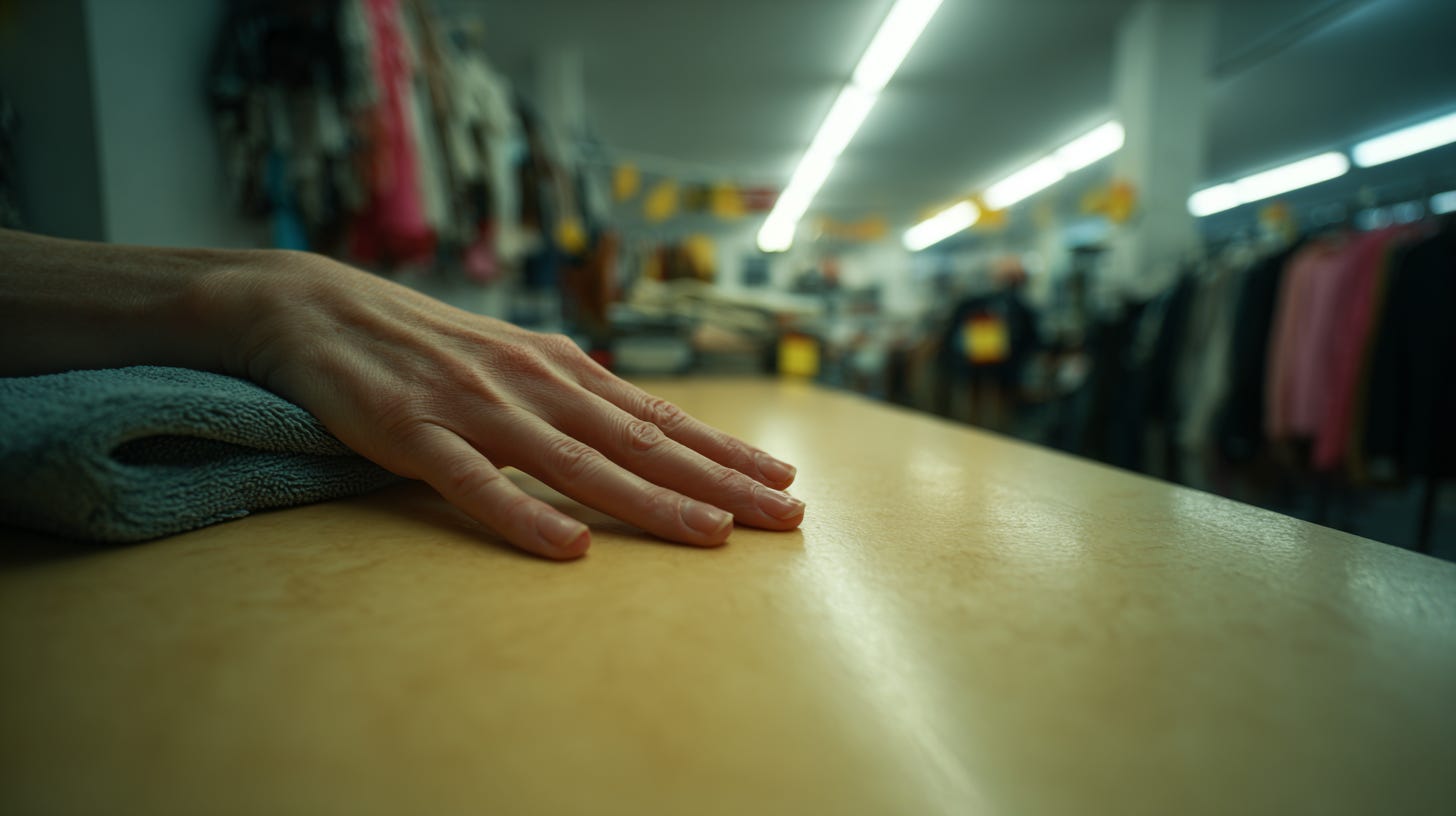
The counter was clean. Jan had wiped it twice. The first time was habit — every transaction ended with the cloth, the way every sentence ended with a full stop. The second time was because the first time hadn’t worked. The surface was the same as it had been that morning, before the girl and the boy and the knapsack and whatever it was the knapsack had cost her to hand over. Formica doesn’t hold things. That was the problem.
She picked up the cloth from under the counter and folded it again. It was already folded. She put it back.
Through the window she could see the workshop across the road. The mechanic — she’d never learned his name — was standing in the doorway wiping his hands on a rag. He’d been out there when the police car pulled up. He’d watched it the way everyone on Chatsworth Road watched police cars: long enough to know it wasn’t for them, then back to what they were doing. Except he hadn’t gone back. He was still looking toward the shop, or toward where the car had been, the empty space three doors down where the girl had parked her mum’s Corsa with the aerial that needed replacing.
Jan turned away from the window.
The form had asked for a description of the items. She’d said: a clear bag containing plant material, a small handgun — she’d called it a handgun and the officer had written “air pistol” without correcting her — and a quantity of cash. She hadn’t mentioned the scanner. She hadn’t known what it was. A black box with an antenna, the size of a brick, sitting on top of everything else like it belonged there. The officer had named it for her: police scanner. She’d written it down on the form the way she’d write a price on a tag — the letters too small for what they meant.
The girl had come in at half two. Alone. Carrier bag, not the knapsack — just clothes, the folded kind, the kind that come out of drawers not wardrobes. Jan had priced them in the back room while the girl stood at the counter looking at the jewellery in the locked cabinet, not touching it, just looking. Nothing unusual. The girl had said thank you and left through the front door.
She’d come back forty minutes later. Not through the front door.
The side entrance was for deliveries. It opened onto the gap between the shop and the vape place — a passage barely wide enough for the cages the donation bags came in. Customers didn’t use it. Customers didn’t know it was there. The girl had come through it fast, already talking, saying the bag had her mum’s things in it, she’d changed her mind, could she have it back. Her face was level. Controlled. The kind of controlled that takes practice.
Her daughter could do that face. Could do it at fourteen, could do it at twenty, could do it the last time Jan had seen her, eighteen months ago, in the doorway of this shop, saying she was just passing, saying it the way you’d say it if you’d driven forty minutes to get there and didn’t want anyone to know.
Eighteen months. Jan hadn’t counted. The number had just been there one morning, like something she’d priced in her sleep.
She’d given the girl the bag back. Of course she had. You don’t keep someone’s things when they ask for them. But she’d already opened it in the back room and seen what was inside, and she’d already called the police from the phone on the wall, the old one with the cord that the charity kept because it didn’t need charging and worked when the internet went down. She’d held the receiver the way she always held it — the way her mother had held hers — and given the address and described the bag and said she’d keep it behind the counter.
The girl had taken the bag and left through the side entrance again. Not the front door, not past the window, not past the boy in the car who Jan could see in her peripheral vision, sitting in the passenger seat, not moving.
Jan’s daughter had been the same. Kitchen door, never the front. Back stairs, never the landing.
She picked up the phone. Put it down. Picked it up again and dialled a number she didn’t need to look up. It rang four times and went to voicemail and the voice was her daughter’s voice from three years ago, before the new phone, before the silence, and Jan listened to the whole message — “leave a message after the tone, unless you’re selling something, in which case don’t bother” — and hung up without speaking.
She put her hand on the receiver and stood there.
Through the window the mechanic was pulling the roller door down. Not all the way — halfway, the position he left it in when he went to get his lunch. She’d seen him do it a hundred times. Today he stopped with the door at his chest and looked across the road again, directly at the shop window, and she thought he was looking at her but he was probably looking at the police car’s absence, the way you’d look at a space where something had been.
He let the door down the rest of the way. It hit the concrete with a sound she could hear from inside the shop, through the glass, a low clang that had no business carrying that far.
Margaret came out of the back room with a pricing gun and a bin bag of shoes.
“You alright?”
“Fine.”
Margaret looked at the mug. “You haven’t touched your tea.”
Jan picked it up and drank. It was cold now, and too milky, and she drank it anyway, and Margaret went back to the shoes, and Jan stood at the counter with both palms flat on the surface and the cloth folded under the counter and the phone on the wall behind her and the roller door shut across the road and the space where the knapsack had been and the girl’s face.

A boy in a borrowed car on Chatsworth Road. Both windows up. The police scanner on. He knows the voices by frequency, by the flat tone of routine. Today the call is about him.

The police came and went. Jan stood at the counter with both palms flat on the surface. Procedure finished. What didn’t finish was the girl’s face when she came back.

That evening, Keith told Sue what he’d seen through the roller door — the car, the girl, the volunteer at the counter. He described it the way he’d describe a fault. Sue asked the question he hadn’t asked himself.

A&E on a Thursday night. A nurse with a clipboard and questions designed to be answered yes or no. The form gets what the form needs.

A council admin worker processes safeguarding referrals. Forty-three seconds each. She keeps her own tally. At lunch, a man on the bench by the Crooked Spire says something she mishears.

Three days clearing her mother’s house. Every room done except the sewing room — the one that had always been closed. In the third drawer, a photograph of a man she doesn’t recognise. Her mother’s handwriting on the back.

The charity shop volunteer opens a donated bag of sewing things. At the bottom, wrapped in lining cloth, a photograph: a man on Chatsworth Road, 1987, a name on the back. The oval frame had been waiting behind the counter for two weeks.

An estate agent in his good suit, briefcase rather than the folder. A routine handover: clean title, vacant possession, keys on the table. The buyer picks up the Yale and says she thinks she might already have one. Same colour fob as her mother’s. Easy mistake. Bryan is already smiling when he says it.

A secondary school form tutor has been noticing one of her Year Ten students since October. Quieter than last year. Still attending, work still good, nothing the referral guidance has a category for. She stays late. Near the end of Megan’s essay, a sentence she wouldn’t have expected: What is left unsaid is also a form of speech.

Thursday morning. The square thinner than it used to be. An older man she knows by habit — damson chutney, coins never exact. “My wife used to put this on everything,” he says. She waits for him to look at her properly. He doesn’t.

An older man makes two mugs of tea. He picks up one, takes a paper bag from the kitchen table, and goes out. He walks through Brampton and down Chatsworth Road. He feeds the pigeons by the Crooked Spire until the bag is empty. At the market, the woman is already reaching for the jar before he asks.

He’d been coming back since the week they let him out. Not every day — no pattern. Today he took the car. He knew where the key was kept.
What a great story.... now I have to wait to find out if there is a continuation... :)