

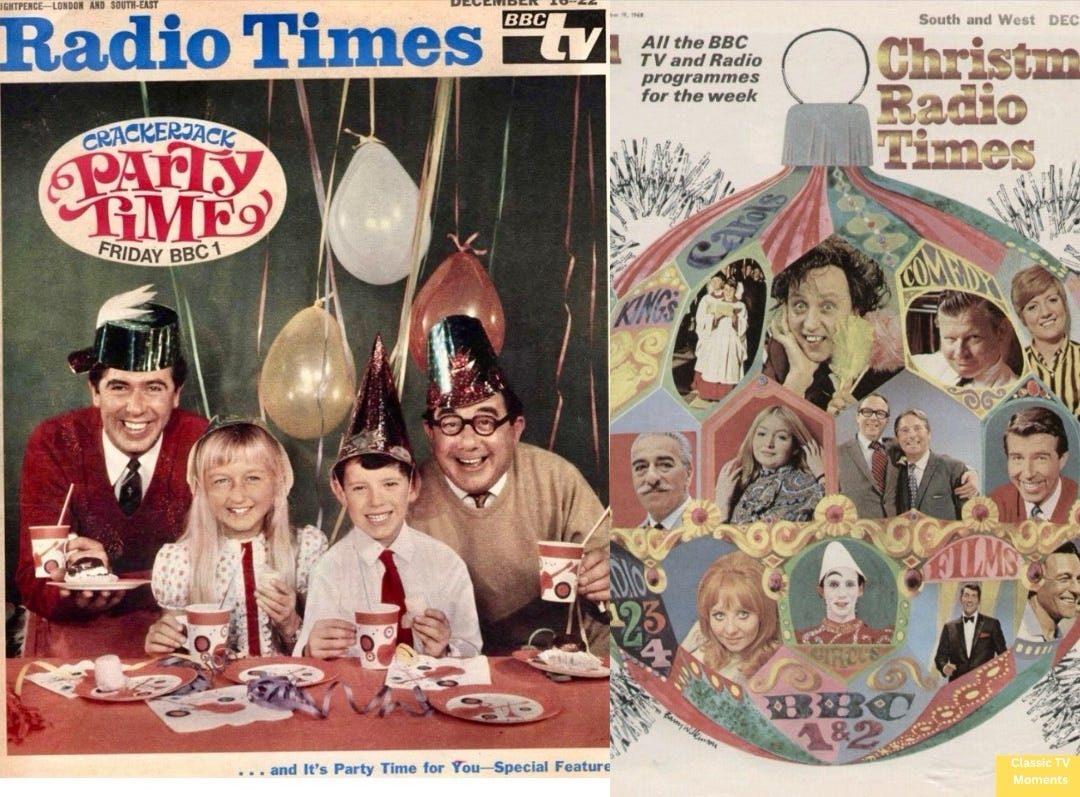
The bumper Christmas editions of the Radio Times and TV Times came in thick volumes — two weeks of back-to-back schedules in single issues. I was six, almost seven. One of my brother’s school friends was over, and seeing me perusing through the well-thumbed pages, he asked me what I was hoping to watch. I recited my ‘must see’ schedules: programmes by day and time, guest appearances, brief summaries of plots, notes on which episodes were not to be missed. I did not understand until much later that this was unusual.
He was older. He listened.
Then he picked up the magazines and began to test me.
What he discovered was that the things I wasn’t interested in had not been absorbed. The football, the racing, the variety performances that didn’t reach me — not there. Everything else was available and accurate. He noted this with a tone I couldn’t quite place. Not impressed, exactly. Registered.
I didn’t know what to do with the way he looked at me. I filed it somewhere and didn’t go back to it for decades, until we reconnected after my brother died, and he mentioned it. He said he’d thought about it sometimes. I didn’t tell him that I had too, in whatever way a seven-year-old thinks about something that doesn’t yet have language.
There are easier explanations. I was a sickly child — weeks spent indoors, working through every book in the school library when the other children played outside. Older siblings, much older, whose world I was oriented toward — their music, their conversations, their way of being adults I studied without meaning to. Both explanations are true. Neither accounts for where the attention went when no one was asking for it.
In the evenings, I knew which footstep on the stairs was whose. I knew the difference between a silence that was simply quiet and one that was waiting. I was not afraid, exactly. I was paying attention.
My dad managed a supermarket. When school was out, going to work with him was our answer to day care — hours in stockrooms and on the shop floor, watching him in his element. Some of his employees were not much older than my siblings. He had a way with young people who had run out of luck — gave them chances, gave them time. A few of them treated him like someone worth worshipping.
My mum asked questions when I came home. Had he seemed different. Had he said anything. Had I noticed.
I did not know what she was afraid of, exactly. I knew what kind of question she asked.
I noticed because I was asked to notice. Then I noticed before I was asked.
I carried that from nine to seventeen. Then my mother died, and there was no one left to ask me what I had noticed.
The task ended. The listening did not.
Decades on, I notice things before I am asked to.
I catch the register of a voice from the other room. I know before I am told when something has shifted. I keep one channel always open. It is quick. Sometimes it is right. Other times it is simply running, the way something runs that has been running since before you knew it could be turned off.
For a long time I did not know that unreasonable deadlines were negotiable. I did not know that failure was an option. I accommodated before I was asked. I anticipated and adjusted. The same system. The same open channel.
I used to call this sensitivity. Attentiveness. Reading a room.
Even when no one asked, some part of me kept listening. I did not know that what had felt like intuition was residue — the remainder of something that learned to pay attention because attention was the only leverage a nine-year-old had.
My brother’s friend, testing me from the Radio Times. What I filed away was not the performance — the accuracy, the recall, the thing worth noting. What I filed away was the look: the moment before he named it, while he was still deciding what it was.
Sometimes I am still there, waiting for the look to decide.
Yes, I related to the attention to details too.
It led to unique observations, that other people didn't have.
As I'm sure you well know.
I remember when I started working in "adult jobs," as a teen. The "older," more senior adults would ask me questions. I didn't mind, I was ready to give them an honest answer, but I always thought before answering.
One of them said, "I see you thinking before you answer," noting the pause.
He said that meant I was a "deep thinker."
I liked that remark. I started wearing it like a badge.
Because it was true.
I spent a lot of time thinking about things that other people don't pay attention to.
I've always been that way.
As I noted earlier, it created observations that others didn't have.
Other people like to label that as "introverted."
But, to me, that label carries a connotation, emotional baggage that I don't want.
It creates a self-imposed feeling that I can't Inreract with others (like in public) in a "functional" way.
That implies dysfunction!
Since I didn't start seeing myself that way, I didn't have the baggage to carry.
Later, as I developed experience as a maturing, learning teen, in different situations, I got an opportunity to "speak publicly," that is, to a group.
That situation normally and rightfully carries a "fear" for everyone. Everyone has that "fear" before their first experience.
But after getting through it, it also brings confidence.
So, I got the experience, and since I didn't carry the baggage of"dysfunctional in public," I also EARNED the confidence that came with it.
I survived a "public speaking" experience.
And I didn't die, get humiliated, or other negative outcomes.
With the confidence that I EARNED, came other opportunities to speak to groups.
I got better, and noticed that I was energized by it. And people liked it.
That led to more opps, more likes, more good energy.
It fed on itself!
I could be funny and informative; and people LIKED my unique observations. My perspectives.
That led to me being willing to voice those perspectives, because I wasn't "afraid if what people would think of me."
After a lifetime of experience that wasn't limited by self-imposed restrictions, due to wearing a "label," I now have what anyone would call a "well-rounded" personality.
I'm not afraid of any situation. Any "uneasiness" I might have is easily put aside. And by now, few are really "new" to me.
THAT, by itself, brings a great deal of confidence... that everyone sees.
When people meet me for the first time, or see me in public, know they are viewing a CONFIDENT man, who is confident in any situation -- even if I don't know WTFb is going on!
And that makes it easier to think things through, measure my response, and often "emerge as a hero" because I kept my cool and navigated through a difficult situation, perhaps even a disaster.
(I also worked in Emergency Management and gained experience as an Incident Commander, and became known as "always keeping a cool head" in even the most perplexing scenes.)
So, the point here is to not burden yourself with "meaning of things," which generally leads to "labelling" yourself or situations!
👍
(I hope that's useful!
Find me here: https://jeffro55.substack.com )
I totally related to the attention to details!!!