

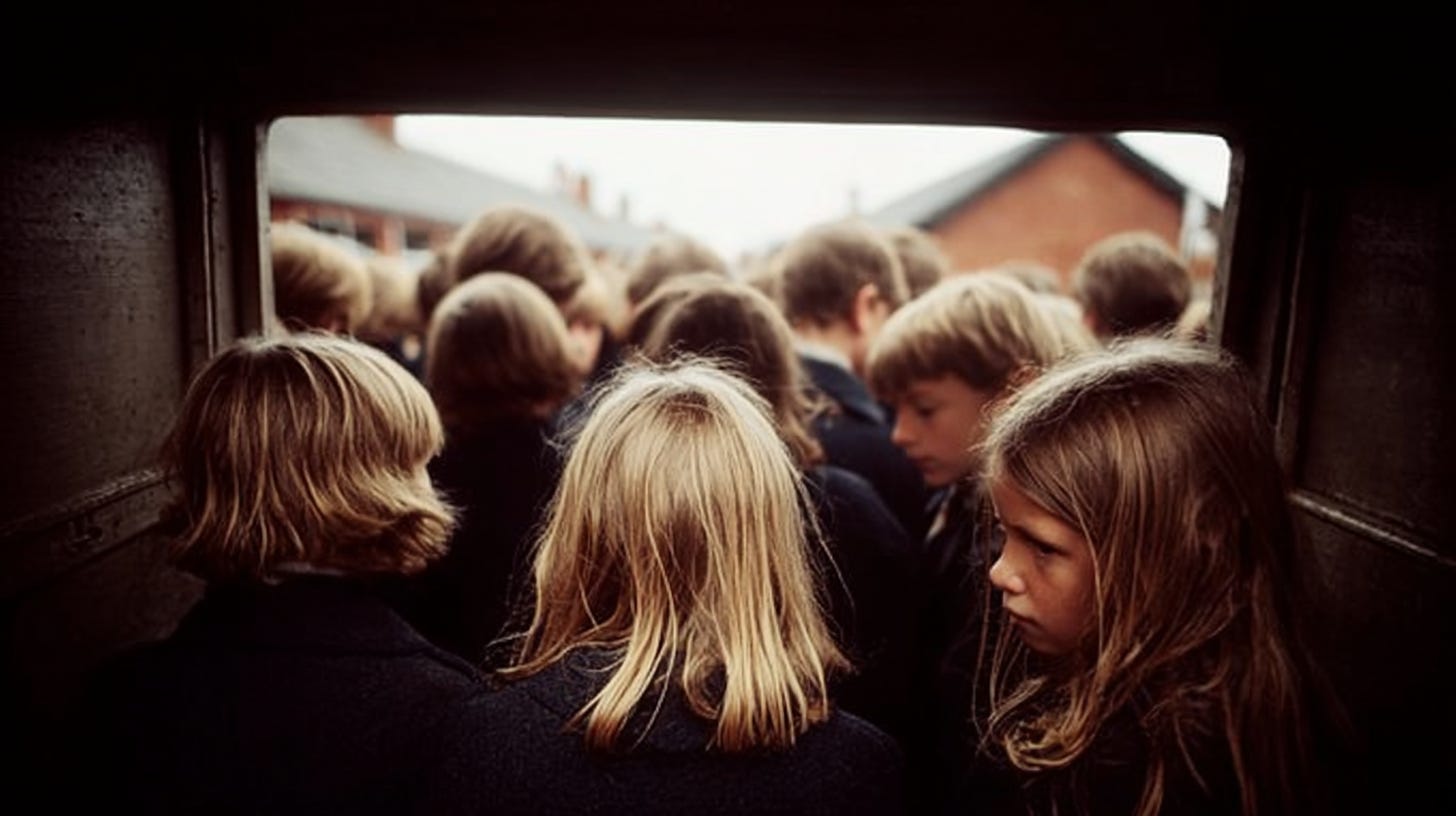
I know three routes home from school. The direct one, down Chesterfield Road, where they’ll be waiting. The fields route, through the estate, out by The White Hart — I lose them there, but tear my trousers on the wire. The long way, past where the old pit used to be, out onto Hepthorne Lane, up Station Road. Forty minutes. Safe.
I tell my mum I fell in the playground.
She works it out eventually. Comes home one evening and says: I’ve been talking to a woman at work. Her son used to have the same trouble. He started doing judo. Nobody bothers him now.
I want to ask: did he also fall in the playground? But I don’t.
She finds a class, the same one that the woman’s son goes to, and his dad is the judo master. A wooden hut off Derby Road — probably a former scout hut. Same smell of damp coats and rules. We wait outside in the cold for them to arrive. Inside: a changing room partitioned by someone who’d read about carpentry once. The main floor is three inches of mat, edge to edge. Before you step onto it, you bow.
I like that. The bowing. A floor with rules.
By November, the nurses at Chesterfield Royal know me by name.
Left index finger. Right big toe. Middle finger, same story. They splint me, send me home, suggest I consider a safer hobby.
On the way home I stop at my mum’s shop. Show her the strapping. She looks at me for a moment, then asks the customer if that will be all. Judo, to her, is still working.
Carl Douglas is everywhere by now. Every radio, every corner shop, every kid in the yard doing slow-motion kicks in their Gola trainers. I have two new belts and four fractures.
There’s one in every year. Ours doesn’t do his own work.
He puts the word out on a Tuesday: Budgie’s going to get it on Thursday. It travels the way those things travel, arriving at me secondhand, already fact. I spend two days working out the geometry of the bus lane. Three buses stop there at three-forty-five. Only one will take me home, but the others would at least keep me safe. Two hundred kids. If I’m out before the bell’s done ringing, I can get to the stop first.
I almost make it.
The Bully, it turns out, is unwell. This is how I learn that his Minion exists — pre-Despicable Me, when the word still had teeth.
The Minion is wearing a school blazer two sizes too big — the kind that parents on a budget hope that their kids will grow into. He squares up to me in the middle of the bus lane. The ring forms without anyone asking.
Fight. Fight. Fight.
I put my hand up.
— Before we go any further, I say. There’s something you should probably know. I’ve been doing judo. My body is a weapon.
A pause. Then he laughs. Then everyone laughs. Then he stops laughing and moves towards me.
The blazer, I notice, has lapels.
The first throw you learn in judo is Ogoshi. The hip throw. Move in, turn, take the lapels, twist. In the hut this works because the person you’re throwing knows how to fall. And because there is mat.
Two things were different in the bus lane. He didn’t know how to fall. And there was no mat, only concrete.
I grabbed his lapels. I turned. He went.
There was nothing slow-motion about it.
I’m not sure I was thinking. I remember the look on his face when he left the ground — surprise, then something worse — and then he put his arm down to stop himself, and I heard it.
His forearm was bent at an angle it shouldn’t bend. He was screaming. Crying. Everyone standing completely still.
They parted. I got on the bus.
I sat by the window and watched the stop disappear. Held everything in — hands, breathing, face — all the way home. When I got through the door I sat down and cried.
I was thirteen. I had two belts and four fractures.
The next day, I was bullied again.

Part 1: Three routes home from school. The direct one, down Chesterfield Road, is where they'll be waiting. By November the nurses at Chesterfield Royal know him by name. Carl Douglas is everywhere. Two belts. Six fractures. Then the Minion appears in the bus lane in a blazer two sizes too big, and the lapels are exactly the right height.

Part 2: Vehicle engineering, 1974. A lawnmower engine on the bench, an inch-and-a-quarter bolt. The Bully recovered from the bus lane and came back with a different plan. He positioned himself behind. Started whispering. Then he kneed me. I turned to hit him. I forgot I was holding the spanner.

Part 3: Judo, autumn 1974. A floor with rules. Brown Belt Steve was the master’s son, close to black, and he wanted you to know it. He started picking me to demonstrate on. A fraction of a second too long before the release. Just enough to hurt. Then one Saturday morning, in the changing room, he unrolled his belt.