
You Just Missed Hannah Gordon
Some afternoons you spend listening to someone else's records.

“You just missed Hannah Gordon.”
He says it through the bandage. There’s a wad of something white packed under his nose — a tampon, near enough — and two half-moons coming up under his eyes. Julie’s already across his private room, perched carefully on the edge of the bed, careful of the face. I stand at the end of it with grapes nobody asked me to bring.
Hannah Gordon. On the telly that month, Thursday nights, the wife in his dad’s programme. The whole country watching her, and she’s been here, in this room, an hour before me.
Julie wants to know was she lovely. Steven says she was lovely. I look at the water jug, the get-well cards stood up in a row with names I don’t know on them, and I put the grapes down where they won’t be seen.
Ten days later, me and David are meant to be in Sheffield.
It’s a thing I do. Bus into Chesterfield, train to Sheffield, walk up to the hospital, and they give you a little room, ten pounds and — the first time — a quiet word about the magazines in the cabinet, if you need a hand. I book the early ones so I miss games. I told David like it was nothing, which is how you make a thing sound like nothing, and he said he’d come. His first. My third.
We don’t go.
We’re up till four with the Red album and then the Blue one, the gatefolds open on the floor like wings, David doing the harmonies. It’s the old house. Dad isn’t there much. He runs the supermarket now the way you’d run from something — first one there, last to leave — and we pass on the stairs at half five, me coming in off the night, him going out to the day, and neither of us says anything, because there’s nothing that would fit on a staircase.
So the train goes without us.
We go and see Julie and Jane. Julie’s bored and announces that she’d like to go and see Steven. We don’t put up much of a fight.
The car still has L-plates on it. I haven’t passed. You’re meant to have someone beside you who has; instead it’s David in the back and Julie up front, and neither of them’s passed either. She likes that I drive, and I like that she likes it. So I drive her to him. She does her lip gloss in the little mirror on the passenger visor all the way, and I take the long road round by the pit so it lasts a bit longer.
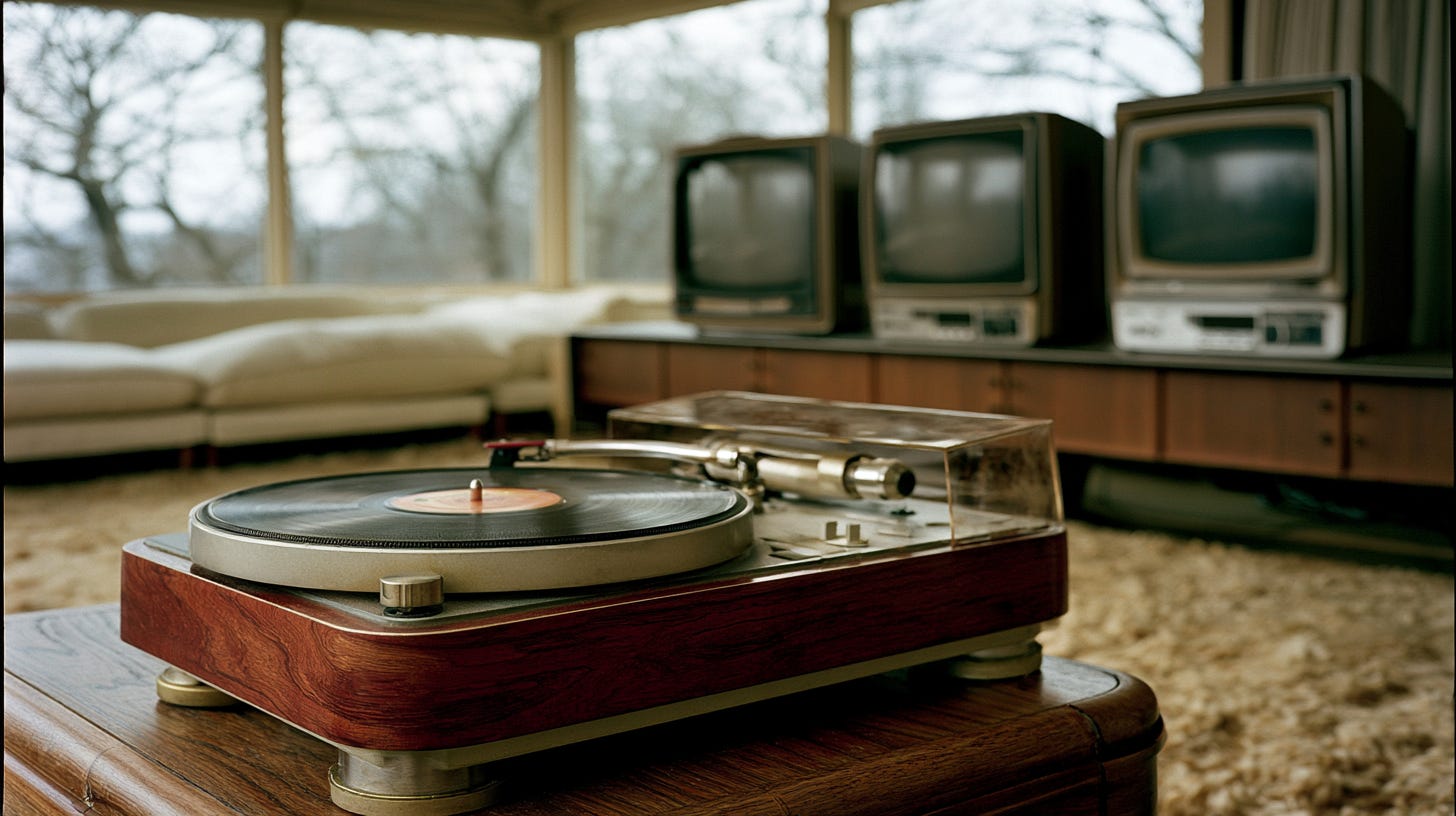
His house is a surprise, and it’s all on one floor — a ranch, low and long like something off an American programme, nothing like ours. The front room could swallow three of ours. Sofas you could lose a person down the back of. And along the wall, the hifi and the televisions and the video machines, stacked like he’s recording the moon.
“What’s all that for,” I say.
“In case Dad’s on two channels at once,” Steven says.
The bruises are going yellow now. Still a little plastic guard taped over the nose. He puts a record on — Zeppelin, then the Who — afghan coat, guitar-player’s hands — and it’s all wrong, all big and brown and important, none of the fast cheap furious stuff Julie brings with her.
And then they’re on the carpet.
Not doing anything you could name. Rolling, laughing low, her hair gone into the deep pile of it — biscuit-coloured, the kind you could lie in — Steven careful of his nose and Julie careful of nothing at all. Me and David on the far sofa with the music coming down on us like weather.
David looks at the televisions. I look at the televisions. Three of them, all off, all black, the four of us in them if you counted — smeared, leaning.
The side runs out. The needle lifts itself, the arm swings back, and nobody gets up to turn it. The room just sits in the click of it — that soft knock the deck makes, over and over — while the two of them carry on in the quiet like the record’s still going.
I could have been in Sheffield by now. The little room and ten pounds and the whole thing done.
The arm clicks. David picks a bit of fluff off his knee. We sit there, the pair of us, listening to a record that’s stopped.