

Some stories come from memory. Others come from habit. This one sits where the two are hard to separate.
What Needed Doing
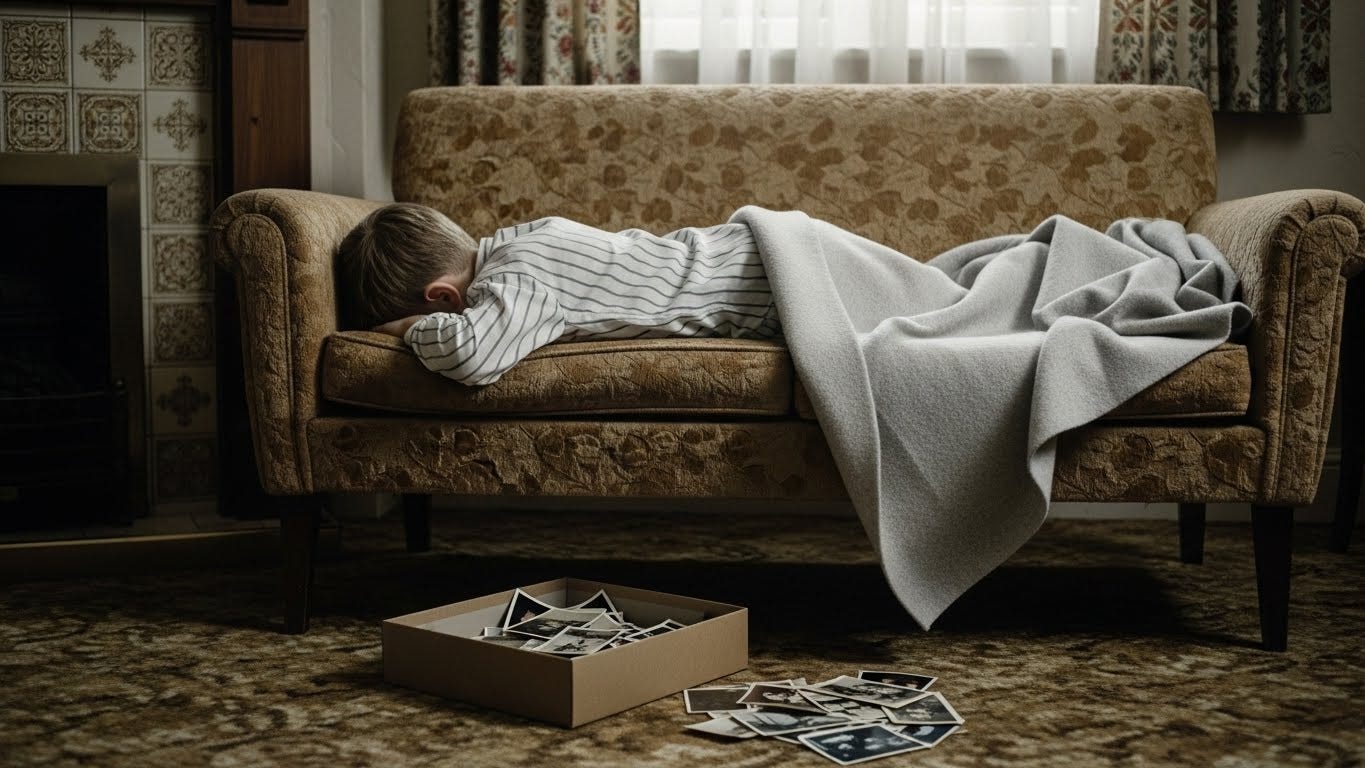
When he was five, his mother gave him a cardboard box of old photographs to keep him occupied. He’d started infant school a few weeks earlier. She had gone back to work the same week. Then he got ill. Scarlet fever, they said. He had to stay at home. She had to take time off work.
The doctor came once and stood in the hallway rather than sitting down. He spoke to her, not to the boy. Afterwards, the sheets were changed more often. Windows were kept open, even when it was cold.
He lay on the settee with a blanket pulled up to his chin.
The box was heavy, the sides bowing slightly. Inside were loose prints, brown envelopes, negatives in paper sleeves. When he lifted them out, they slid against one another. He noticed the smell first.
He wanted to know who the people were. Where they were standing. What had happened just before the picture was taken. When she came in to check on him, he held one up and asked.
She answered. Sometimes she told a story. More often, she answered and stood for a moment, then said she needed to get on.
Most of the people were already dead.
Some questions kept her talking.
Others didn’t.
When she said she needed to get on with things, he went back through the pile and found something she hadn’t mentioned yet: someone half-cut by the edge, a name pencilled on the back, a detail that opened the story again.
When they stopped looking at the photographs, it ended.
Later, on his own, he told himself the stories again. Slowly. In the order he remembered them.
He replayed them carefully.
The boy starting infant school had been a relief. The house had been smaller with him in it all day. Her body had felt smaller too. When he left in the mornings, there was room again. Time that moved.
She had counted the days. The uniform laid out. The shoes polished the night before. She had started work the same week he started infant school. The job was nothing special, but it was hers. She liked leaving the house with somewhere to go. She learned the bus times. Learned how long it took to walk from the stop without hurrying.
At home, there were things she did because they needed doing. Meals. Washing up. Keeping the place in order. Other things did not come as easily.
He had brought the books home just before he got ill. His first library books. They were thin and stiff, with pale covers. He read them again and again. When he was tired, he turned the pages slowly, careful not to crease them.
As the days passed, he began to worry about the return date. It was stamped inside the front cover. He mentioned it to his mother when she came in to check on him. She said she would sort it out.
She rang the school. They said they didn’t want the books back. They said the books would have to be destroyed.
He asked if he could keep them. She said no. They couldn’t stay in the house.
She took them from him.
After that, he no longer had them. He did not ask again.
She said she needed to get on with things, and this time he didn’t ask another question.
The photographs went back into the box. One corner of the lid lifted. He pressed it down. She moved about the kitchen. The kettle. A cupboard door. Nothing was wrong.
He stayed on the settee, the blanket still pulled up to his chin. When the house settled, he opened the box again. Quietly.
He took the photographs out one by one and laid them across his lap, arranging them into an order that made sense to him.
When he was done, he left them where they were.
She came back into the room. She didn’t say anything. She gathered the photographs and put them back into their original order, quick and exact, as if straightening something that had slipped. Then she closed the lid and set the box aside.
He watched her hands.
He did not try to stop her.
Sometimes he would look at a photograph and hesitate, as if the effort no longer quite matched the return.
He still asked questions. Not new ones. Small ones. Where someone had gone next. What happened after.
Her answers shortened. Sometimes she said she wasn’t sure. Sometimes she said she needed to get on.
After that, he asked less often. When he did, he didn’t press. He took what he was given and stopped there.
The photographs stayed in the box. When he lifted the lid, he didn’t reach straight in. He closed it again.
Nothing happened after that.
His father left before he was awake and came home after he was asleep. That was how the days were arranged. Sometimes, in the morning, the boy noticed the door was locked the way it was when his father was away. Sometimes, at night, he listened for sounds that didn’t come.
On Sundays, his father was there. He sat with the paper spread across his knees. Sometimes he lifted the boy onto the arm of the chair and pointed things out, small things that didn’t need explaining. The boy leaned into him and stayed still.
The boy learned not to ask for more than was being offered.
Later, she noticed he asked less about the photographs.
Less persistent.
The box stayed closed longer than usual. She moved it once, to hoover, then didn’t put it back where it had been.
There were other things to get through.
She turned back to what needed doing.
Hi Jeffro,
Thanks for the feedback. I'm a Brit, and while I've been living in the US for over 30 years now, my recent writing has somehow wandered back to British terms and spelling. In the UK, kids start school the first term after their 5th birthday, and they go to infants school, or the infant class within a broader junior school (elementary, lasting until they get to 11).
As to why he (I.e. me) didn't get to keep the books, it reflects the way that parents of that time just automatically respected authority figures, and did exactly as they were told.
As for the style, I didn't want to write it as a memoir, nor over-fictionalize it. What I wanted to do was record what happened, and to try and see things from my mother's perspective.
Looking forward to checking your work out!
It happened yet again! I'm on my phone, tried to leave a comment, and right before I post it ...it simply disappears! Oh, well.
Robert, I'm wondering if you might be interested in my recent post, "What was lost between generations."
Its here: https://jeffro55.substack.com