
We’ll Call You Back From the Office Phone
A note on a sophisticated scam — and the one rule that shuts it down

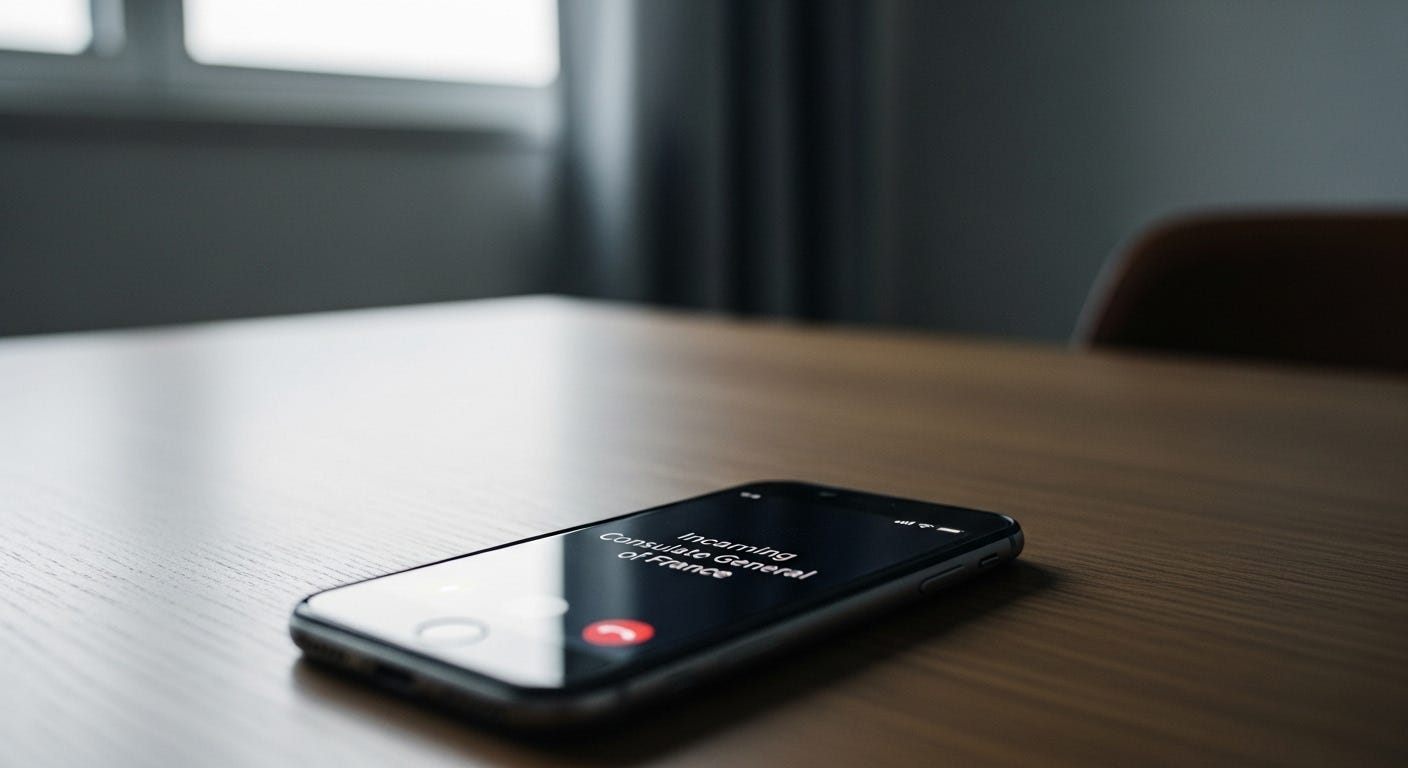
I’m sharing this because it was convincing enough to make me pause — and I don’t pause easily.
Earlier this afternoon, I received a call from a woman who said she was calling from the Consulate General of France. She told me she was contacting me about an “urgent matter.”
The number was unfamiliar. The caller ID did not display the consulate.
I told her plainly that I didn’t recognize the number and didn’t know who she was. She responded without missing a beat:
“I’ll call you back from the office phone.”
A moment later, my phone rang again.
This time, the caller ID displayed Consulate General of France.
That was the moment it shifted from odd to unsettling.
She explained that a French phone number — one I’d never heard of — had allegedly been registered in my name and used for fraudulent activity in several French cities. Complaints had been filed. An investigation had been opened.
I told her the truth: I hadn’t been to France in six years, and I’d never had a French phone number.
She said I needed to either appear in person at the French Consulate in New York — over a thousand miles from where I live — or immediately speak by phone with French authorities to make a statement.
I said I was happy to cooperate, but only after receiving something in writing.
That’s when the pressure began.
Each time I asked for written documentation, the answer was no.
Each time I suggested they send a letter, or have French authorities contact me formally, the answer was no.
Instead, the call was escalated — again and again — to alleged “supervisors.” Each transfer happened instantly. No hold. No delay. Same tone. Same script.
At every stage, the message was the same:
Stay on the phone. Comply verbally. Act now.
I offered reasonable alternatives:
send the information in writing
have the matter referred to U.S. authorities
contact me formally if there was a legitimate complaint
None were accepted.
When I declined to provide my mailing address over the phone — pointing out that if a phone number had truly been opened in my name, they would already have my details — the call ended.
No money was requested.
No personal information was given.
And that’s important, because this was clearly phase one.
This wasn’t a sloppy robocall or a poorly written script. It was calm. Procedural. Bureaucratic-sounding. And technically convincing.
It relied on:
caller ID spoofing
layered authority (“supervisors”)
urgency without specifics
fear of consequences
and, most critically, a refusal to allow independent verification
The goal wasn’t money — not yet.
The goal was verbal compliance.
Once you accept authority on the phone, the rest comes later.
Here’s the rule that matters, and it’s the reason the call went nowhere:
Real government and legal authorities put things in writing.
They don’t refuse documentation.
They don’t threaten consequences by phone.
They don’t discourage verification.
And they don’t require secrecy or urgency.
If someone tells you they can’t send anything in writing until you cooperate, that’s not sensitivity — it’s the tell.
If this ever happens to you, there’s a single sentence that shuts it down:
“I don’t conduct legal or governmental matters by phone. Please send any correspondence in writing.”
Say it once.
Stop talking.
If they persist, repeat it once and hang up.
No explanations. No arguments.
I’m sharing this not because I was close to falling for it, but because I can see how someone reasonable could be caught off guard — especially when caller ID appears legitimate and the tone is calm rather than threatening.
Caller ID can be faked.
Authority can be staged.
Paper trails don’t lie.
If this helps even one person slow down, insist on process, and avoid being pressured into compliance, it’s worth sharing.