

The Turn Not Taken
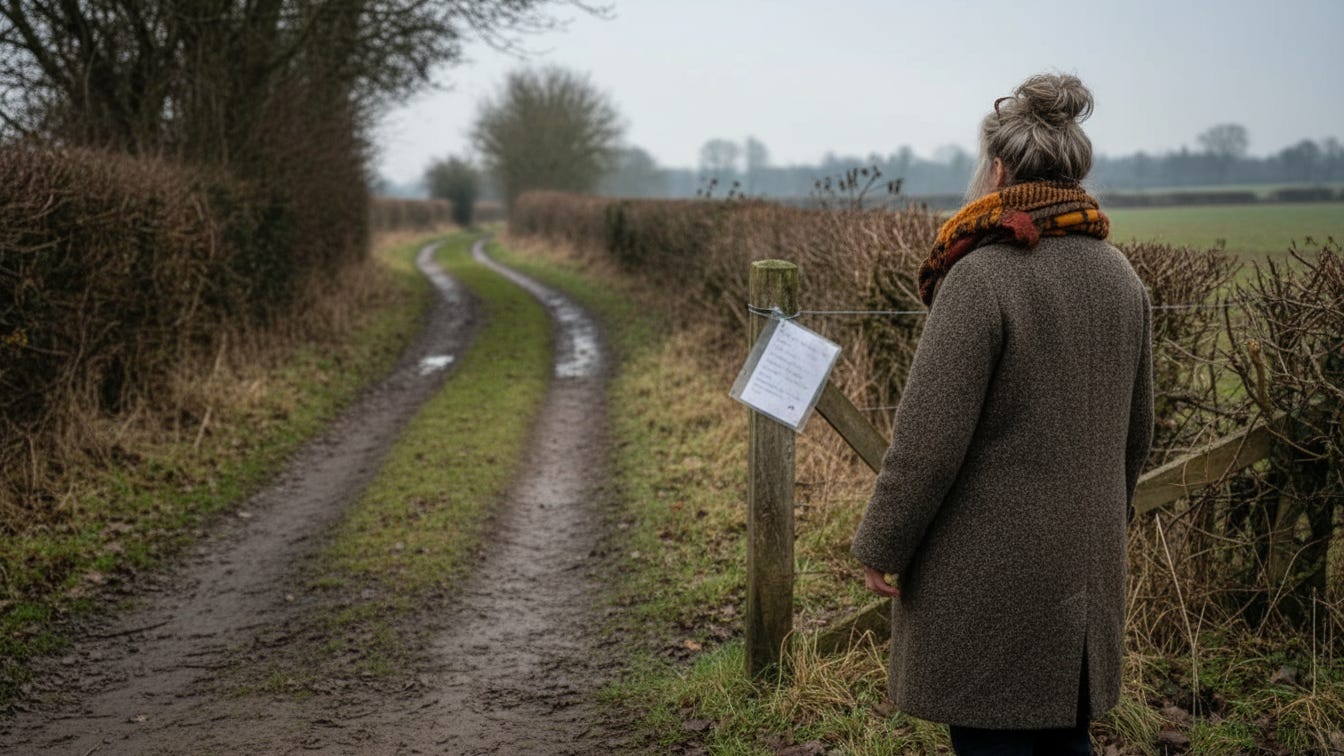
It began with a laminated sign cable-tied to a fence post where the footpath narrowed and split.
The arrow pointed left.
The words Diversion — safer route had been printed in a municipal blue that implied permission without offering proof. No council crest. No date. The cable ties were new.
Maggie noticed it because the fence post was not part of the path.
She stopped. Her dog did not pull. The lead slackened naturally in her hand.
The left path was wider and smoother. The right was older, narrower, worn into the ground by years of unremarkable feet. Maggie had taken it often enough to remember where the stones loosened after rain.
A man behind her slowed, read the sign, and followed the arrow without comment. His shoes were clean. His pace quickened once he committed.
Later that morning, the sign stood straighter. Someone had adjusted it.
By midday, the left path carried more traffic than it could comfortably hold. Walkers stepped aside for one another with careful politeness. Dogs shortened their leads. A cyclist dismounted and walked the bike through, eyes down.
No one mentioned the right path.
Audrey Crenshaw paused beside Maggie the following afternoon, reading the sign as though it might respond to scrutiny.
“Well,” she said. “That’s sensible.”
Maggie nodded once.
Reginald arrived later, boots clean, hands clasped behind his back. He studied the cable ties, the fence post, the angle of the arrow.
“That post isn’t rated for signage,” he said.
Maggie did not reply.
By the third day, a second cable tie had been added. It was looser than the first. The sign listed slightly.
Grass on the right path lifted at the edges, relieved of its regular pressure. After a light rain, a thin line of water ran along its centre, cleanly channelled.
The right-hand path had never needed permission.
Maggie stopped at the bend where the path narrowed and did not explain herself.
Her dog paused. Sat. Looked up at her once.
Two women approaching slowed. One glanced at the sign, then at Maggie. They exchanged a look that did not ask permission but seemed to wait for it anyway.
One woman took the left path.
The other hesitated, then stepped onto the narrow track, lifting her foot higher than necessary to clear the first stone. She did not look back.
By the weekend, the sign had faded unevenly. The laminate clouded where the sun struck it longest. Someone had removed the second cable tie. Someone else replaced it, misaligned.
No official notice appeared.
When Lynn asked if the path was muddy, Maggie said, “It’s narrower.”
Rain came overnight. The wider path pooled where the ground dipped. Footprints pressed dark into the mud.
The narrow path carried the water away.
Maggie passed the sign the next morning without stopping.
Case #39: The Turn Not Taken
Observation: Path diverted at the stile. No signage posted. No objection recorded.
Outcome: Some followed. Some did not. Both routes remained open.