

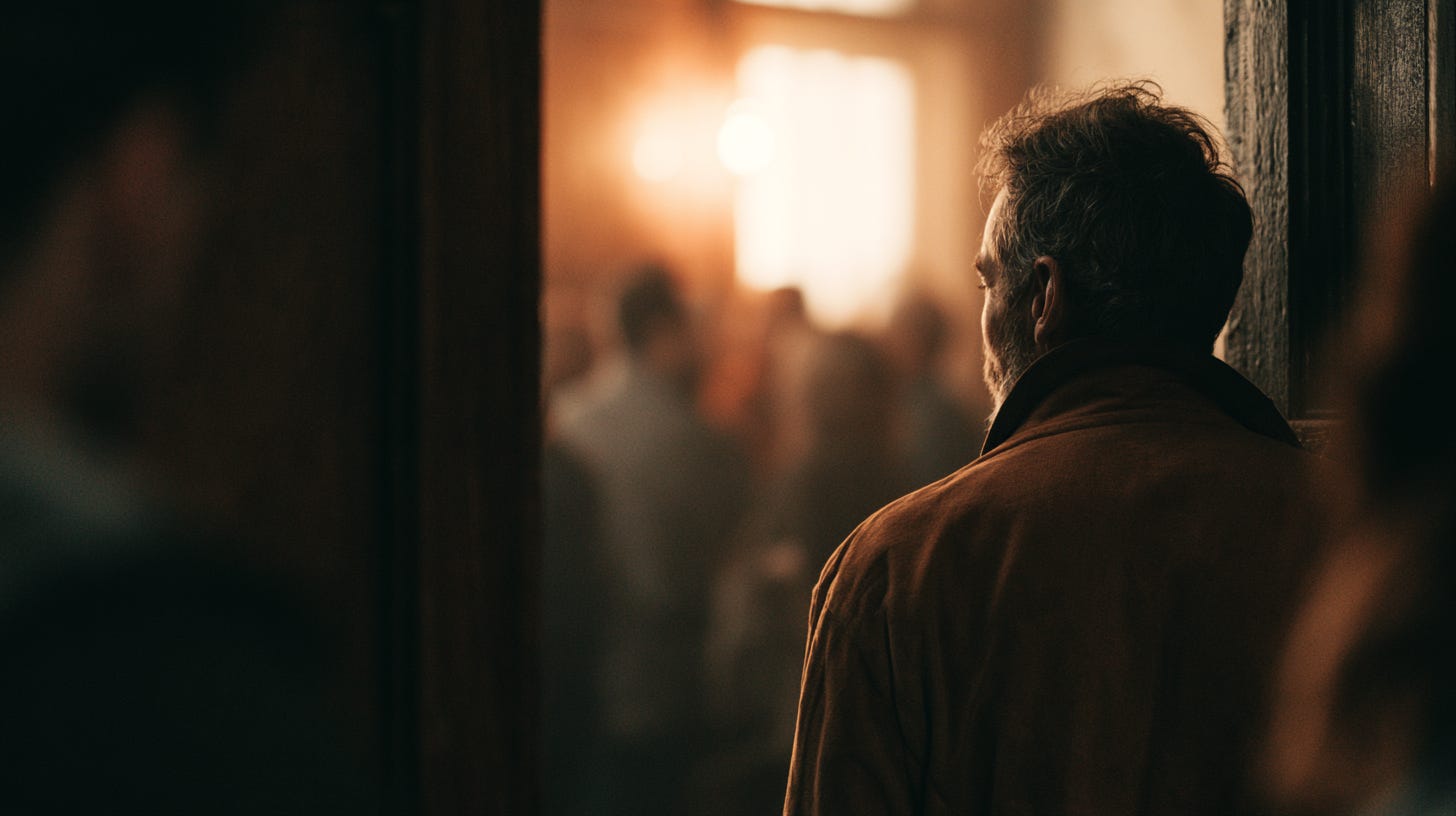
I took the Myers–Briggs test many times over the years, and it always came back the same: ENFP. Extravert. Intuitive. Feeling. Perceiving. A campaigner, it said. A person who lights up the room. Once, it came back INFP. I decided that one was wrong.
I was not always good at rooms.
As a child I was sometimes brought together with other children — kids from school, neighbours’ kids, kids my parents thought I should know. I would go. I would try. I did not really understand the world they were playing in. Toy garages. Forts. Action Men arranged in formations that meant something to them and nothing to me. I could tolerate a board game, something with rules and an outcome. But the unstructured play of childhood — I never found the entrance to it. I had toy cars too. I lined mine up.
When I was seven, the school told my parents my reading age was thirteen. They added it was probably higher than that, but that was as high as the scale went.
I put this down to having older siblings, to being sickly, to the weeks indoors that turned me towards books instead of playgrounds. All of those things were true. None of them was the whole story.
When I was old enough to go to things voluntarily — discos, youth groups, church groups — I went. And stood at the edges.
Close enough to catch the current of the conversation, not close enough to be part of it. Waiting for a gap. Wanting to interject myself and unable to make the move.
It was like standing on a high diving board and not being able to make yourself jump. The longer you stand there, the further down the water looks.
Drama gave me the keys.
I found I could play someone else. Someone who entered rooms without hesitation, who spoke first, who took up space without apology. The character was not me. The character was confident in a way I was not, at home in a world I had never quite belonged to.
The role stuck.
Not all at once. Not consciously. But something in the repeated inhabiting of a different posture began to transfer. I learned, by pretending, what it felt like to arrive somewhere and not stand at the edge of it.
I stopped standing at edges.
When I was seventeen, my mum died.
I did not want to be the kid everyone felt sorry for. I did not want to be around the people who knew her, who had known her long illness. I reinvented myself as a punk. I loved the music and the energy — genuinely, not as cover — but what I loved most was the escape. The makeup, the hair dyed a different colour almost every week, the army surplus and jumble sale finds and curated pieces in shocking colours.
It let me be seen without being known.
Later, as I joined the corporate world, I found myself being tracked as a potential future leader. We were brought together every quarter, from all across the UK — two days of intense networking, skills development, presentations. I remember being nervous before I had to present, the old height under my feet, and then telling myself: it’s just a part you can play.
It worked. It always worked.
The company was investing in my development. It was also polishing the performance. Teaching me to enter faster, stay longer, make the role fit better.
I was learning in other rooms too.
After my marriage ended, dating again in a different country for the first time in decades, I was called out for not meeting someone’s eyes. I would say something like — *oh, I was just noticing your earrings* — and then, privately, commit to doing better. Not wanting to be caught the same way twice.
I learned to hold someone’s gaze badly first, with a cover story, then well enough that it stopped requiring thought.
Now I arrive and something starts.
I read the temperature before I’ve taken my coat off. I find the person who needs finding. I remember the name, the detail, the thing mentioned in passing three months ago. By the time I’ve been somewhere an hour, I know where the edges are — who’s holding something, who needs drawing out, where the conversation wants to go.
The room goes well. I go home.
For decades, the ENFP result confirmed the person I thought I had become. Sociable. Warm. Energising. I held that the way you hold something that has always been yours — without examining it, because why would you.
But it had not always been mine. I had made it mine, over years, through drama and grief and quarterly leadership sessions and dating again and every room I had ever talked myself into entering.
Then I started to notice the other thing.
The jaw unclenching on the way home. The bone-level tiredness after a night that had gone well by every measure, that I had genuinely enjoyed, with people I genuinely liked. Not because anything had gone wrong. Because something needed to decompress that I hadn’t known was compressed.
I had always assumed everyone felt this.
The INFP result, filed away as an anomaly, started to feel less like a mistake.
I am not sure when I first noticed the fluency had become visible to me.
Midsentence, sometimes. In full flight — story landing, table laughing, warmth real and circulating — I would feel the machinery of it, smooth by then, almost silent.
The warmth was real. The interest was real. The connection was real. What had been learned was the expression of it — the fluency, the timing, the way of being in a room that made people feel met.
The child who understood rules better than rooms was still there. I had built, around him, someone who could walk into a room and make it go well.
Drama started it. Grief gave it urgency. Repetition made it look like nature.
I can walk into almost any room now and find my footing. I can sit with someone I’ve just met and make them feel, by the end of it, that they were interesting — because they were, because I find people interesting, and because I became extraordinarily good at letting them know it.
I do not need to pretend it was effortless.
What it costs is also real. Coming home tired from something good is not ingratitude. It is the body accounting for effort it was not asked about. The system does not ask permission.
It still reaches the room before I do.
The test called it extroversion.
What it caught was fluency. A particular kind of learned attentiveness that presents, from the outside, as someone who loves being in rooms — and does, and is also tired when they leave.
Both true. Both mine.
I used to call this personality.
I did not know fluency could be mistaken for nature.
Before I Had a Name for It is a six-part essay series about self-understanding arriving late — and what you do with it.


Thank you so much for sharing these feelings! This is how I feel having Autism and having to mask in public or social situations where I can’t unmask. It perfectly sums it up, and it’s always so hard finding words for things like this!