

When I was at college, there was a young guy who raced around Wolverhampton dressed as a cowboy. He wore a picture of a television test card around his neck and stopped people to tell them what was on that evening. Everyone knew him. Everyone adjusted their pace. He was considered harmless.
I didn’t think much about it then.
Test Pattern comes from looking back at that memory more carefully—not to explain him, but to notice what gathered around him, and what happens when that kind of presence is quietly removed.
Test Pattern
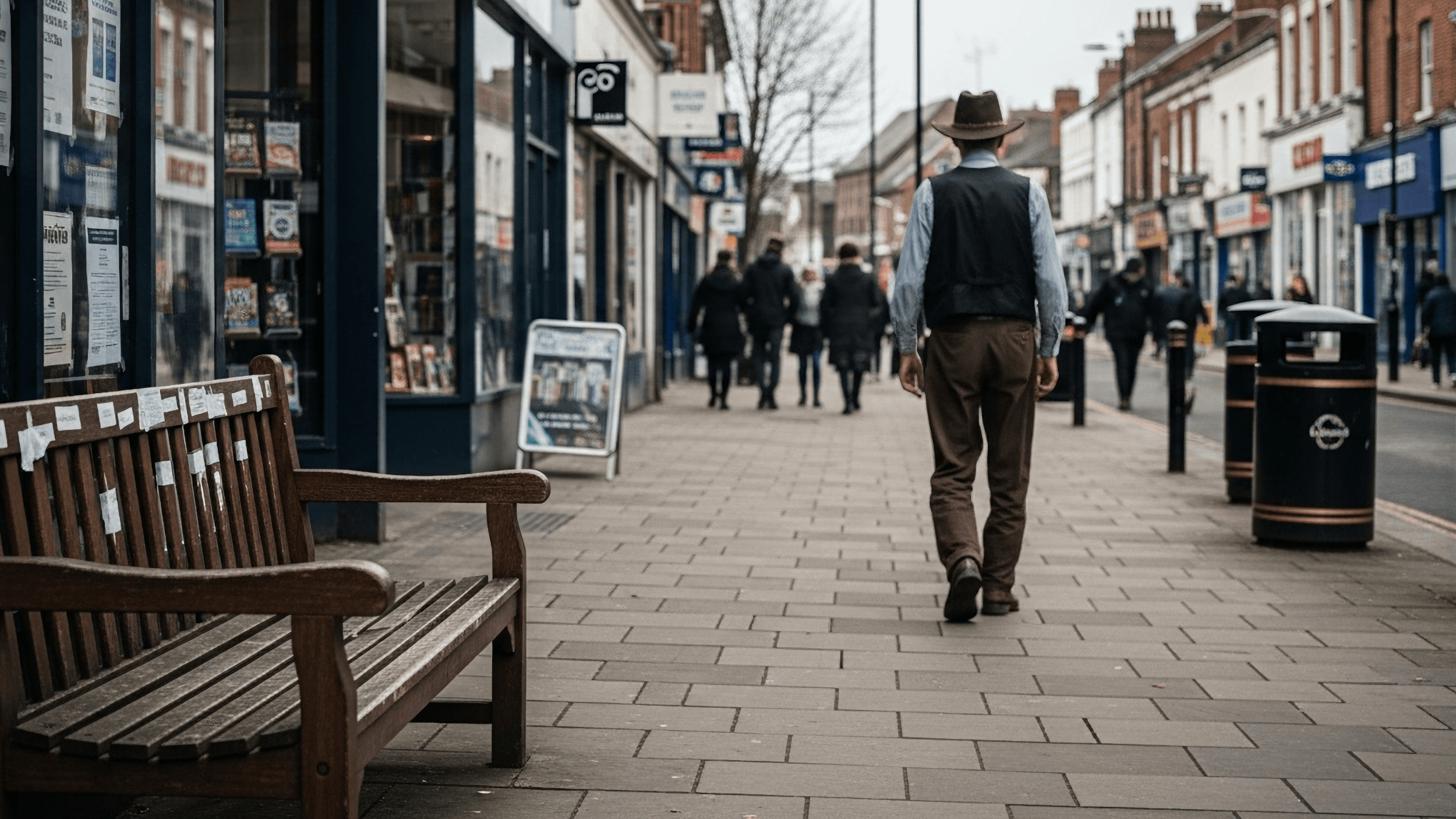
He came past the library just before noon, moving faster than the foot traffic without appearing rushed. The hat was the first thing people noticed—creased felt, too large for the season—and then the vest, the belt with its twin holsters, the plastic grips catching light. The photograph hung flat against his chest, swinging only when he slowed to readjust it.
It was a TV test card. Faded. The edges worn from handling. A child pointed once, then was pulled along.
He stopped beside the bench where the council notices had been taped and re-taped so many times the wood was stippled with paper scars. He planted his feet, checked a folded sheet in his hand, and spoke.
“BBC One. Seven-thirty. Panorama. ITV at eight. Drama.”
His voice carried, not loudly, but with a clarity that slipped between conversations. He didn’t look at anyone in particular. He finished the list, nodded once, and moved on.
People made room without thinking about it. Someone laughed. Someone else said his name—not his actual name, just the one everyone used—and shook their head. A woman with a takeaway cup stepped sideways to avoid the photograph as if it were damp.
By the time I reached the steps, he was already halfway down the street, stopping again at the chemist’s corner.
He did this every day. Not always the same route, but close enough that shopkeepers learned to leave space. He never blocked a doorway. He never repeated himself. If someone interrupted him, he waited until they finished and then resumed where he’d left off, as if nothing had happened in the meantime.
That evening, the six o’clock news ran long. A segment was cut. The weather appeared twice, the second time without sound.
No one mentioned it.
The next day he came through earlier. I heard him before I saw him, the list shortened, sharpened.
“Channel Four. Nine. Documentary.”
Someone said, “All right, mate,” in the tone used for dogs and street performers. Someone else said, “Leave him be.”
That phrase travelled easily. It settled wherever it was placed.
Outside the post office, a man asked him what was on later. The cowboy paused, glanced at the paper, and answered. The man nodded, thanked him, and then—almost immediately—looked embarrassed, as if he’d broken a rule without knowing it. A woman tugged his sleeve and whispered something. They moved away.
At the crossing by the bakery, the lights stuck on red. Cars idled. People gathered, checking phones, shifting bags. The cowboy stopped short of the curb, finished his list, and waited. When the green figure failed to appear, he frowned—not theatrically, just long enough to register—and folded his paper away.
That night, the programme the man had asked about did not air. Something else filled the slot. It was competent, forgettable. The listing corrected itself online by morning.
On Wednesday, two council workers intercepted him near the underpass. They stood with him while he spoke, nodding, one of them smiling too often. When he finished, they asked him to move along. He did. The photograph knocked lightly against one of the high-vis jackets as he passed.
He did not return to that spot.
People commented on the quiet. Someone said it was good not to have him rushing about. Someone else said he’d probably got bored. The phrase harmless was used twice.
By Thursday, the photograph had been replaced. Same string. Different image. Still bars, but newer, sharper. The colours were wrong—too saturated—but no one said so.
He announced later that day than usual. I watched from the bus stop as he adjusted the string, tested the balance, and spoke.
“BBC Two. Eight. Special.”
The word special landed oddly, as if it belonged to a different sentence. A man laughed and mimed applause. The cowboy waited until the laughter subsided before continuing.
At eight o’clock, the channel went dark. A message appeared apologising for technical difficulties. It vanished after thirty seconds. The programme resumed, already in progress.
On Friday, a child followed him for half a block, repeating the names of channels in the order they’d been given. The cowboy did not turn. At the corner, the child was called back sharply. The list stopped.
I noticed then how people adjusted their routes. A half-step to the left. A pause that wasn’t quite waiting.
He passed me outside the library again. The photograph was torn at one corner. He flattened it, glanced at his paper, and began.
I could have asked him what was on. The question formed, complete, and then dissolved. It wasn’t fear that stopped me. It was the sense that the exchange had already been decided, that my part in it was to keep still.
Across the street, a van reversed and beeped. The sound cut through his voice, cleanly enough that he stopped and waited for it to finish. He resumed exactly where he’d left off.
Later that afternoon, he was stopped near the square. Not by council this time. By a man in a jacket who spoke quietly, close to his ear. The cowboy listened, nodded once, and handed over the folded paper. The man unfolded it, smoothed it, and frowned.
They stood there longer than usual. People slowed. Someone raised a phone, then lowered it.
When the cowboy moved on, he did so without the paper.
That evening, the listings were wrong across three channels. Not catastrophically. Just enough that people noticed. A quiz replaced a repeat. A film started late. The complaints line was busy.
On Saturday, he came without the photograph.
The string still hung around his neck, pale against the vest. He reached up once, as if to adjust something that was no longer there, then let his hand fall. He spoke from memory. The list was shorter. He did not check any paper.
At the chemist’s corner, someone stepped into his path. Not aggressively. Just close enough to interrupt.
“Mate,” the man said, smiling. “There’s an app for that.”
The cowboy waited. When the man finished, he nodded and moved half a step to the side. He completed the list and went on.
That night, the town watched what it usually watched. Or thought it did. The sound dropped out during the closing credits of a drama. A caption appeared apologising, then disappeared.
On Sunday morning, I stood by the library steps longer than I needed to. People came and went. The bench was empty. The notices curled at the corners.
He did not appear.
By afternoon, someone said they’d seen him near the ring road. Someone else said he’d been taken in. No one was certain. The phrase leave him be surfaced again, applied retroactively.
That evening, the listings were correct.
I watched anyway, noticing the colours, the timing, the way the image seemed to settle a fraction later than it should have. When the screen cut to black, I stood to turn the set off and found myself pausing, just briefly, as if there were something else to listen for.
Outside, the street held its shape. The bench by the library remained empty, not vacant in the way unused things are, but simply unoccupied—as if it would have obliged, had it been asked.