

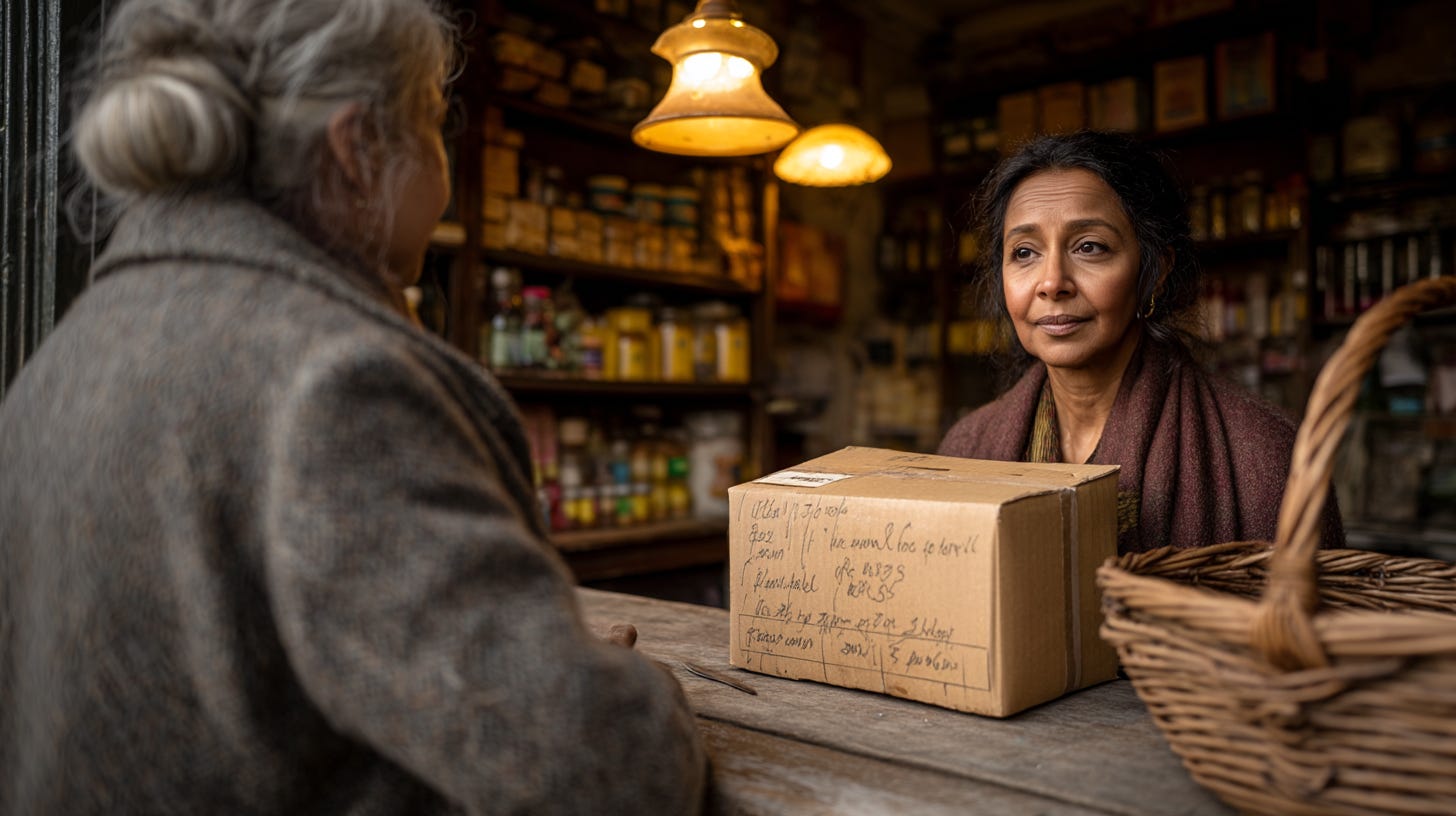
Maggie came in for fig bars on a Thursday and found a box on the counter.
The shelves were where they should be. The bell rang once. Meera was restocking the ginger biscuits with her earbuds in, one shoulder keeping the step ladder steady.
Mrs Patel stood behind the till with a cardboard box between her hands. It was the size of a bread bin, taped shut, handwriting on the side in black marker: “STOCKROOM — TOP SHELF — A.W.”
“I found this,” Mrs Patel said. “Behind the boiler casing. The plumber moved it.”
Maggie set her basket on the counter.
Dog waited by the door. His nose moved once toward the box, then away.
“It’s a time capsule,” Mrs Patel said. “I’m going to bring it to the WI.”
Maggie looked at the label on the side of the box. STOCKROOM — TOP SHELF — A.W.
The village hall smelled of tea urn and dry radiators. Mrs Patel had set the box on the table at the front, and propped a card against it in her own handwriting: A. Williams — stockroom box.
She cut the tape with a pricing knife. The cardboard opened stiff, resisting at the corners where damp had set and dried again. Inside, the contents were wrapped in newspaper—the Derbyshire Times, November 2019. Below the date, a headline about roadworks on the A515.
Three tins of barley sugar, labels faded. A pair of reading glasses, one arm repaired with electrical tape. A rubber band ball—each band the same width, wound tight. A credit ledger from the 1990s, entries in a hand that wasn’t Mrs Patel’s.
And at the bottom, a piece of card. Handwritten, black felt-tip. “BACK IN 5 MINS.”
Mrs Patel set each item on the table as she unwrapped it. The barley sugar tins she placed in a row. The glasses she opened once, then closed. The rubber band ball she turned in her hand and set down. The 1990s ledger she didn’t open.
The sign she held flat on the table. The card was soft at the edges, thumbed smooth. The ink had faded unevenly—the B and the 5 pressed darker than the rest.
Netta picked up the sign before Mrs Patel finished speaking. She read it, turned it over. The back was blank. “Five minutes,” she said. She set it down.
Audrey had a form. “The parish archive accepts ephemera by appointment. I can arrange a Tuesday.”
Enid looked at the box and then at Mrs Patel. “It was put away for a reason,” she said. “Perhaps it should go back.”
Lynn picked up the rubber band ball, turned it once, and set it down without speaking. She touched the electrical tape on the glasses arm, briefly, then withdrew her hand.
Reginald examined the 1990s ledger. He turned a single page. Closed it. “Good hand,” he said.
Mrs Patel nodded at each one. She aligned Audrey’s form with the edge of the table, then moved it aside. She looked at the card she had written, then at the sign.
She picked up the sign. She held it with both hands, thumb along the bottom edge.
Then she began repacking the box. The form. The barley sugar. The glasses. The rubber band ball. The ledger. All back in the newspaper.
The sign stayed in her hand.
Meera watched from the back row, one earbud loose in her hand.
The sign was under the till by closing, beside the current credit ledger.
Maggie was at the counter with her basket. The fig bars were still in it. She paid in exact change. Mrs Patel gave her the receipt—printed, no scribbled thank you—and Maggie walked out.
The bell rang. Dog stood and followed.
At home, she opened the grey notebook.
Casefile #60: Stocked, Not Shelved
Observation: Box opened. Contents handled. One item not returned.
She closed the book.