
Stitched
On wandering threads, quiet refusals, and truths that don’t stay put.

Stitched
It began, as village mysteries rarely do, with something that kept refusing to be finished.
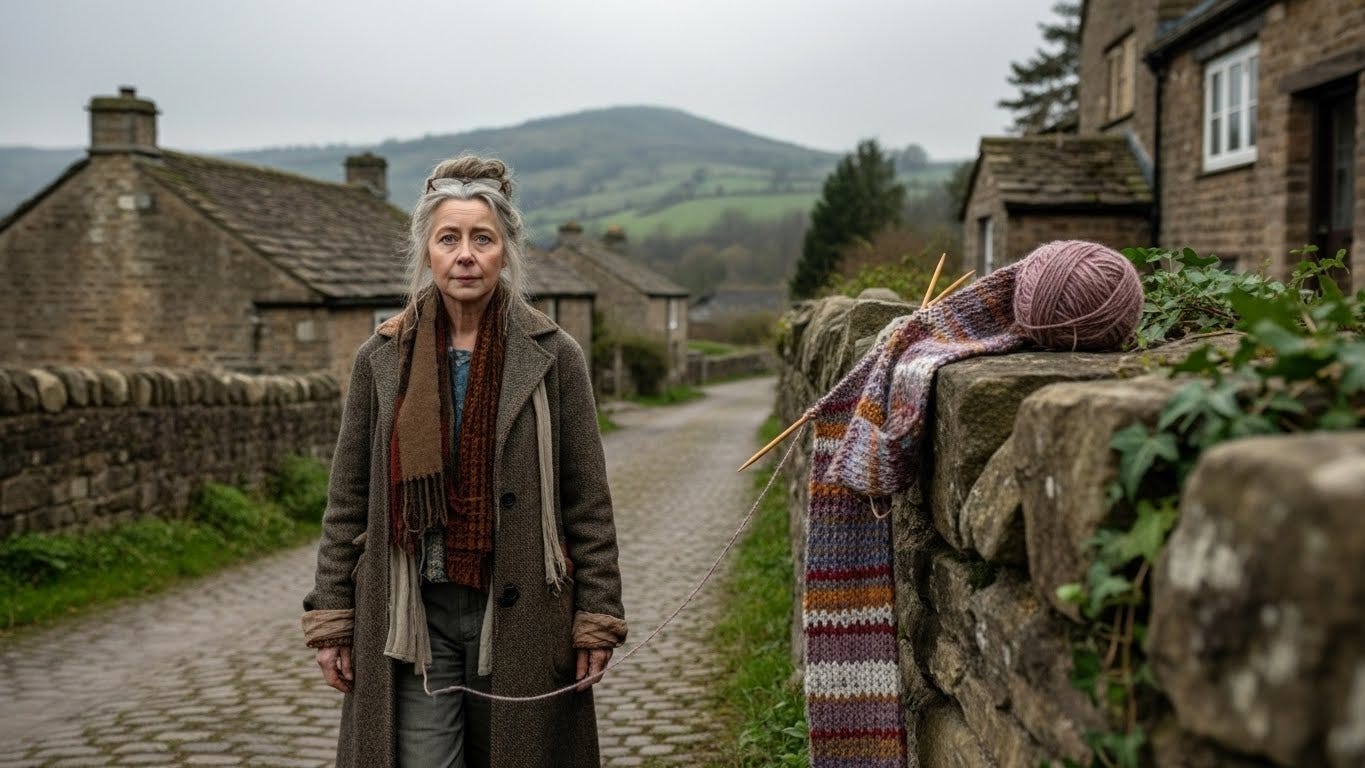
A scarf appeared on the WI noticeboard one Tuesday — looped around the pinboard like a politely strangled snake. Tartan-adjacent, but not committed. Soft wool, already pilling. Two needles still threaded through the live loops, as if the knitter had been called away by tea or judgement and never returned.
By Wednesday it had shifted. In the bakery now, coiled beside the Eccles cakes, shedding a faint dust of fibres over the glass. One crumb clung to the wool — honest, if nothing else. Dot insisted it couldn’t possibly be a hygiene risk because wool was “practically medicinal.” Audrey prepared a statement anyway.
Thursday: the bench outside the allotments. The scarf trailed just enough to be caught delicately by the ivy. The dog nosed the fringe and sneezed, then, after a beat, sneezed again. Maggie noticed a single loosened loop no one else seemed to see; she didn’t touch it.
Friday, Audrey announced, would be Audit.
“Lost Property Audit,” she clarified, in case the wrong kind tried to muscle in. Netta called the scarf “a gift-in-progress.” Reginald muttered about chain of custody. Maggie said nothing. She noticed the loops had slackened again, as if the thing were unravelling of its own accord.
On Saturday, the scarf returned to the noticeboard. Two inches gone, a ladder of absence where a pattern had once pretended confidence. Someone had wrapped the loose yarn around the pin and tucked it in quietly.
Sunday, a newcomer stopped. Coat too thin. She almost reached to touch the scarf but didn’t. Resisting is a kind of knowing.
Her boy — maybe eight — pointed and asked if it was art.
She called it vandalism, then apologised at the end of the word.
By Monday, the scarf had migrated again. Bench by the bus stop this time, arranged along the slat with the needles pointing east. Nell sat there, spiral notebook tucked into her elbow as if it were shy.
“Did you knit?” she asked.
“Once,” Maggie said.
Nell looked at the scarf the way she sometimes looked at her own pages, air-stroking rather than writing. Some record by notating; some by abstaining. Both count.
When Tuesday came round, the scarf had achieved a kind of notoriety. Audrey declared it “improper.” Netta produced a sachet of herbs labelled For Tangled Things and tucked it between the loops. Reginald remarked, as if to himself, “Drop too many stitches and you lose the line.”
“Or you find something else,” Maggie said.
The scarf kept moving. A circuit of the places where notice happens. Always with some alteration: a thread snagged in the same ivy curl, a faint grease mark from the Eccles cakes. Once, a single dark hair clinging to the wool, memory of a military barber still in the roots. She didn’t pull it free.
She thought of projects she’d abandoned mid-row. Sweaters, poems, conversations. She’d believed in completion once. Now the word felt like a locker combination she’d forgotten.
In the evening she made tea and let it cool. The dog sighed under the table. She didn’t pick up the scarf. That felt important.
Audit day again. Lost property spread across the trestle table with the gravity of customs inspection. Umbrellas, gloves, three travel mugs. And the scarf, centre stage.
“Evidence,” Audrey said.
“Ideally receipts.”
“Intent,” Netta offered, without irony.
No one claimed it. A young mother brushed the end, unravelled another inch. “It already is,” Maggie said, though no one had asked.
When the hall emptied, the scarf remained, left like a guest no one had the nerve to ask to leave. Maggie lifted it, placed it across her forearm as if it had chosen her for a while. She straightened one corner out of habit — then stopped.
Back home it lay on a chair, needles pointing north now. It breathed quiet into the room like a third presence. She didn’t repair it. She held it a while, then set it down again.
The kettle clicked off. She didn’t pour.
Outside, the ivy climbed the downpipe towards a conclusion.
The scarf returned itself to the world the next morning, draped over Maggie’s garden wall like a cat cooling its belly in the shade. Last she’d seen, it had been on the kitchen chair. She hadn’t put it there. The needles pointed west again.
Nell came by. “It’s longer,” she said. “Feels longer. Maybe I just want it to be.”
“Do you ever finish anything?”
“Sometimes I stop before I ruin it.”
Audrey, passing, said, “If you have the scarf, it should be registered.”
“With whom?” Maggie asked.
“The appropriate authority.”
Reginald suggested, not quite joking, that perhaps there ought to be a knitting quorum.
By dusk, it was back inside. Not the sofa. Not the chair. Folded on the kitchen table in a way that wasn’t hers. A fragment of ivy rested on top — heart-shaped if you were sentimental. Maggie was not.
She placed the scarf in the drawer with envelopes, spare batteries that never fit anything, guesthouse keys she had never returned. Things neither lost nor in use — held until the right hour made itself known. Or didn’t.
The dog rested his head on her knee. The wool carried weight like a promise.
She put the kettle on and, this time, she poured.
Later she opened her grey notebook, flipped past biscuit diplomacy, jam fraud, floral profanity, one entry she referred to only as York. She wrote:
Case #34: Stitched
Observation: An unfinished object resists conclusion by travelling.
Outcome: Witnessed. Held.
Additional note: Unfinished isn’t the same as lost. Ivy keeps its hold whether or not the row is finished
She tapped the page once. Then closed the book.