

Stayed in Her Seat
It began, as village outings sometimes do, with a clipboard angled just so.
Netta Flinn had organised everything: Buxton, matinee, an Edwardian revival with parasols and predictable morals. There were laminated sheets with arrows. A phone number to ring only “in the event of emergency,” which meant never. The driver nodded, loaded the sandwiches and shawls, and set off without fuss.
Ten miles on, past the lay-by where the view opens if you stand on tiptoe, he tapped his sheet. “Crucible Theatre, Sheffield. Matlock Contemporary Theatre group.” He said it as if reading a weather report.
A ripple moved down the aisle. The name Buxton had been said so often it felt like a booking in the bones. Sheffield sounded like something done to you.
“Turn back,” Audrey Crenshaw said, in the voice reserved for the unpleasant but necessary.
“Not possible,” the driver replied, cheerful and immovable. He lifted the envelope of tickets as if that settled the matter. “These are mine to deliver. The Crucible.”
Netta looked stricken. “But our seats—Row J—Buxton—” She ran out of nouns.
Reginald poured tea into the lid of his thermos and declared city catering unreliable. He had facts about curtains and the correct use of intervals; he deployed them when provoked.
“Is it safe?” someone asked, meaning not the theatre.
Maggie refolded her scarf. The neatness did not help.
The Peak District roads did what they do best: bent without hurry, gathered rain, carried them east whether or not they approved. Wires began to underline the sky.
Audrey rehearsed a revised schedule in a voice that dared contradiction: no wandering, meet at the foyer doors, back on the bus before dusk. A bag of barley sugars travelled down one side and up the other as if sugar could sweeten the route. Netta’s ribbon marker stuck out at an angle she didn’t notice. Reginald poured tea into the lid of his thermos and muttered about Sheffield steel, as if the facts might fortify him.
By the time they saw signs for Hathersage, the hills had softened; by the time the bus edged past terraces and takeaways, a layer of resignation had settled like condensation on the windows.
Sheffield announced itself with scaffolding and temporary traffic lights. The Crucible reflected the sky back at them in glass. Posters with hard fonts and shadowed faces stared outward. The group, unused to the pace of pavements with buses in them, clustered in twos and threes. In the glass Maggie saw them doubled—cardigans and handbags, a moving flock inside and out.
“This cannot be Wilde,” Netta whispered, and seemed to blame the posters for it.
Inside, the foyer smelled of coffee and varnish. The usher counted their tickets and smiled in a way that suggested this was not the first mistake to arrive in a tidy envelope. “You’re on time,” he said. “House is open. Contemporary piece.”
The words contemporary piece moved through the group like a draft. Maggie folded her programme once, then again. The paper knew how to obey.
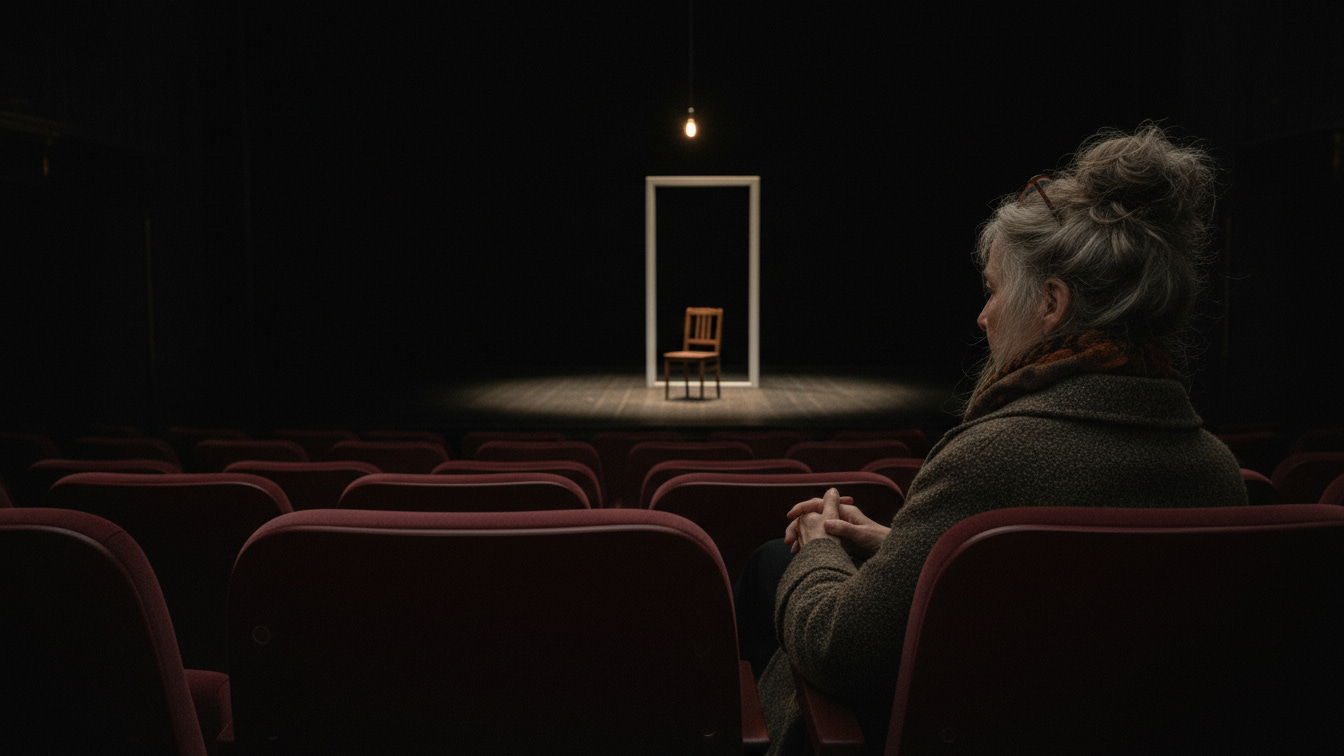
The auditorium was spare. No curtain. A stage lit as if nothing could be concealed. One chair. A doorframe. A single bulb with a dry heat that could be felt even at a distance.
“Budget cuts,” Audrey murmured, because saying nothing would have been agreement.
The lights shifted. A woman walked in carrying a suitcase that dragged a little, as if it held something that could not be unpacked. She set it down and then, not trusting the decision, lifted it again. Sat, stood, waited as if for someone else to move her. Her silence said more than dialogue would have managed.
A voice from the wings asked, “Do you intend to explain yourself?”
“Not today,” she replied, without looking up.
Maggie’s fingers settled on the folded edge of her programme until a pale welt rose along her thumb. It was not the actress’s face or age that caught at her but the gestures: the leaving before staying, the staying before leaving. A life arranged around doors.
Scenes unspooled without apology. The suitcase opened to papers that were read without sound and put back, torn, then smoothed as if that might heal them. A scarf was lifted and wrapped, then slid from the shoulder and left where it fell, a small absence shaped like fabric. The woman stood inside the frame of a door that opened onto nothing and placed her hand where a handle should have been. She did not turn it.
A tram bell sounded once through the glass. No one on stage moved.
Around Maggie, protest rustled and then gave up. Reginald unwrapped a sweet and held it still in his palm. Netta leaned forward, the programme clutched as if for protection. Audrey’s lips pressed together in a verdict that would keep until interval.
“I said what I could,” the woman said. “The rest stayed unwritten.”
Maggie’s breath shortened, then evened. The bulb swung a little on no wind at all.
At the interval the foyer reassembled itself around teacups and complaint. Audrey itemised offences with a precision that suggested evidence: lighting, staging, the absence of curtain. Reginald explained the proper use of curtains as if doctrine required restating. Someone located a biscuit and passed it with the air of first aid.
Maggie stood with a hand on the crash bar of the exit. Air edged in. A steward glanced over. She let the door seal itself.
The second half pressed on. The actress laughed once, bravely, and the laugh caught on the air like something overheard rather than offered. The suitcase took a last journey from one square of light to another. When it was set down this time, it stayed.
House lights rose without music. For a moment the room was caught between worlds, unsure whether to applaud or keep watch. Applause began thin, then grew. A few stood, perhaps to ease a knee. Maggie did not move her hands. A young usher looked down the row and looked away.
Outside, the evening had advanced while no one was watching. Rain thickened until it hid in the air. The group restored itself to useful talk: wrong tickets, the council, the lateness of trams, the injustice of cities. The bus waited with its engine running and its windows already fogged from other people’s stories.
Maggie walked a pace behind. Their words reached her as if through water.
On the road home, conversation thinned with the dark. The thermos made its round under Audrey’s supervision, poured into lids with care intended to prevent accidents of any sort. Reginald tipped his hat forward and pretended sleep. Netta looked at the postcard she had not bought and put the idea of it away.
Maggie leaned her temple against the glass. The reflection that looked back was part window, part night, a name half on either side. Somewhere outside Bakewell she opened the grey notebook, its spine softened by years. She wrote a line not long enough to be a sentence and let the page hold it. The book closed with the sound a door makes when it has learned how to behave.
The bus turned where it always turned. The hills resumed their shape.
Casefile #43: Stayed in Her Seat
Observation: Wrong tickets. Steel city, not spa town. The stage spoke what she keeps unwritten.
Outcome: Stayed in her seat.
Note: Not all turns belong to you.
She tapped the page once, then set the notebook down.
The day went dark without fuss.