
She Spoke First
On what’s offered, what’s taken as given, and the quiet certainty of leaving a moment as it is.

Late yesterday afternoon, while out walking Wolfie along in downtown St. Pete, I had one of those small, unexpected moments that settle in your chest before you’ve even worked out why. A woman with an oversized flower in her hair — perfectly matched to her outfit, impossible not to notice — stepped toward me and pressed a small folded slip of paper into my hand. I somehow knew the spirit of it before I looked down. I thanked her, and she told me that she loved me. As I reflected on the moment later, my mind went straight to WWMD — What Would Maggie Do? How would she meet someone standing on a market-town High Street offering tenderness so simply?
And if you’re wondering WDRD — What Did Robert Do: this Derbyshire lad doesn’t quite have Maggie’s reserve. Let’s face it, I cracked open years ago and have long embraced my inner softie. I accepted both the paper and her words with an open heart and gave the same back. What follows is how that encounter might have unfolded in Maggie B’s universe.
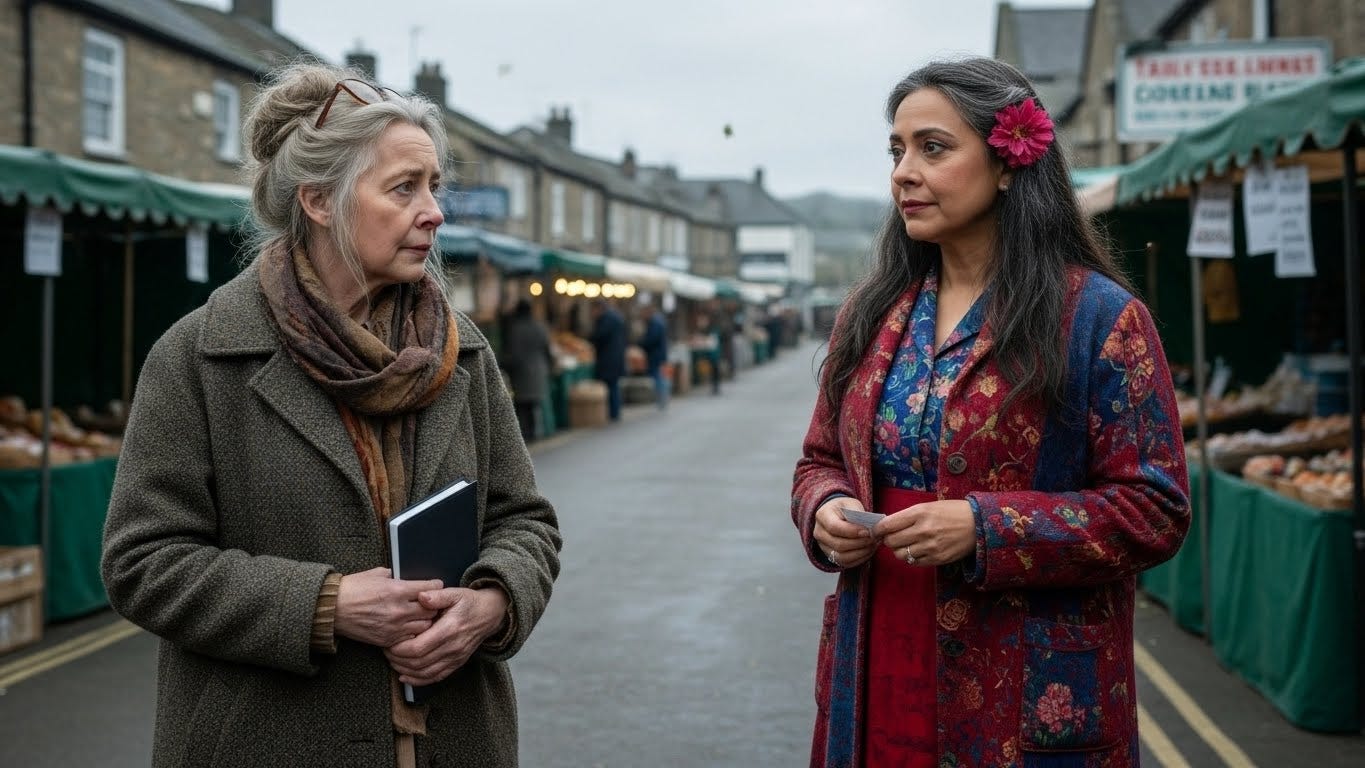
She Spoke First
It began with the way the woman paused on the High Street.
She stood just beyond the greengrocer’s awning, where the wind funneled between the bakery and the charity shop and made paper signs behave like living things. She was not browsing. She was not waiting in the manner of people who wished to be noticed as waiting. A single flower had been set into her hair with quiet care. Her clothes carried more colour than the day seemed to expect, though nothing about her asked for attention. Maggie noticed the flower first.
Market day had begun to loosen its grip. Stallholders were packing away: boxes first, then tarpaulins, then the last remaining items that no one wanted at full price. A man selling soap had reduced his lavender to “whatever you’ve got on you” and looked offended when offered exact change. Somewhere near the square a child wailed, not from injury but principle alone.
Maggie walked with the dog at her knee, lead slack. Dog understood the route without instruction. They had come into town for stamps and tea, and the mild theatre of other people’s errands. Maggie carried a bag with a loaf inside; its warmth pressed faintly through the paper, leaving her hand smelling faintly of yeast.
She was halfway past the greengrocer when the woman moved.
Not dramatically. Not apologetically. She stepped into Maggie’s line as if it had been meant for her all along.
“Excuse me,” she said.
Her voice was calm. Not timid. Not bright.
Maggie stopped.
Up close, the flower’s edges were softened. The woman’s face held the same quality—kept, understated. Her calmness sat easily, as though she had done this sort of thing before, even if the street had not. She offered the folded slip of paper without ceremony.
“I wanted you to have this,” the woman said.
Maggie took it. The paper was thin, ordinary, warm from a pocket. Not a leaflet. Not a petition. Simply a thing, offered.
“Thank you,” Maggie said.
The woman’s mouth curved slightly, careful not to change the moment.
“I love you,” she said.
The words arrived without negotiation. Not dressed up. Not made safe. She said it as if it were a statement of weather.
Maggie felt the instinct rise—match the shape, return the currency, smooth asymmetry. She did not. She held the moment as given.
Her face did not change. She nodded once, minimal but counted.
“Thank you,” Maggie repeated. Only the phrase she had that did not bend the moment into performance.
The woman did not flinch. She looked as if she had offered something she was willing to have accepted in whatever form it arrived.
“Have a good day,” the woman said.
Then she stepped back into the street’s flow, past the stalls with the bruised pears, the man selling secondhand scarves, and the café where someone was always scraping a chair across the pavement. She did not look back.
Maggie lingered a second longer. Dog sat, understanding there had been an exchange with rules he did not need to know.
A gust lifted a greengrocer’s price sign and slapped it against the apples. Ordinary time resumed.
Maggie put the paper in her coat pocket without opening it.
At the butcher’s queue, a woman in front asked for mince, then changed her mind for sausages, then apologized. The butcher said, “No worries.” Maggie watched a line of condensation creep down the glass, then disappear when someone wiped it without meaning to.
She paid and crossed the square.
Near the fountain—dry this time of year, though still ringed with coins from habit—she heard her name.
“Maggie.”
Audrey Crenshaw stood by the noticeboard, posters rolled under her arm, pen tucked in her hair. She looked as if interrupted mid-correction.
“Maggie.”
Maggie stopped.
“Audrey.”
Audrey’s eyes flicked to the dog, then back. Her gaze returned to Maggie.
“I was just coming from the bank,” Audrey said. “I heard you.”
Maggie did not ask what she had heard. Did not offer an opening for explanation.
Audrey leaned in slightly. “That woman,” she said. “The one with the flower. She said—”
“I know what she said,” Maggie replied evenly.
Audrey’s mouth tightened.
“Well,” Audrey said, “it’s not… common.”
“No,” Maggie said.
“It’s the sort of thing that causes talk,” Audrey continued. “People will misunderstand.”
Maggie watched a pigeon attempt to land on the fountain rim, fail, and try again with a kind of stubborn dignity.
“Perhaps,” Maggie said.
Audrey stared. “Did you know her?”
“No.”
“And you said—”
Maggie did not move.
“Well,” Audrey said briskly. “It’s… odd.”
Maggie looked at her.
“There are children about,” Audrey added. “And people. People who don’t… understand.”
Maggie let the sentence sit.
“What would you like me to do?” Maggie asked.
Audrey shifted. “I’m only saying, if someone approaches and says that, consider responding in a way that doesn’t… inflame.”
“I said thank you,” Maggie said.
Audrey’s eyes widened. “That’s what you said?”
“Yes.”
“Well,” Audrey said, “I suppose that’s… neutral.”
She adjusted the posters slightly out of alignment.
Maggie did not reply.
“I’m just trying to avoid unpleasantness,” Audrey said quietly.
Maggie nodded once.
Audrey walked toward the parish hall. Maggie stood a moment longer, then continued toward the hills.
Dog tugged once more firmly, Maggie slowed to match him. A delivery van passed too close; its side mirror hummed. She waited. Dog’s ears flicked; he shifted weight almost imperceptibly.
A gust lifted a greengrocer’s price sign and slapped it against the apples. Ordinary time resumed.
Maggie reached into her coat pocket. She paused. Hand hovering, letting the moment stretch—dog settled at her feet, the van now gone, the lane quiet except for distant coins clinking in the fountain. Then she unfolded the slip of paper.
Two quotations were printed, one above the other: on love, kindness, planting in another’s heart without asking to see it grow. Words earnest, slightly polished, not remarkable.
Maggie refolded the paper, slightly offset from the original crease. She did not know why.
At home, she made tea. The kettle clicked off. She poured, watched the colour deepen, then set the cup aside.
Later, she opened her grey notebook.
Casefile #38: She Spoke First
Observation: A stranger placed a flower like a decision and offered a printed slip as if it were nothing. She said a sentence too large for the street and did not ask for it back.
Outcome: Received. Not matched.
Additional note: The town attempted to file the incident; the record remained unchanged.
She tapped the page once. Closed the notebook. The house settled into night sounds. The wind moved along the lane, worried at the hedge. Somewhere, a notice remained slightly crooked.