

Eight had said they were coming. At the bottom of the hill, on the first morning, there were four of us.
Nobody mentioned the others.
Andy. Johnny. Hicksy. Me. The old colliery site sat below the school — just a pit pond now, the rest of it overtaken by scrub and long grasses nobody cut. We’d built what we called a den. Loose branches over a rough frame. Just enough to suggest something.
I’d stopped at the Co-op on the way. School bag over one shoulder. Bacon. Eggs. A loaf. The girl on the checkout eyed me suspiciously, and I told her that we had cookery class first thing. I got on the bus, got off at school, and walked toward the gates. Then turned.
We were reading Lord of the Flies in English. Nobody mentioned the book.
The first day, the den still looked like a den.
By the second, bacon had become a problem.
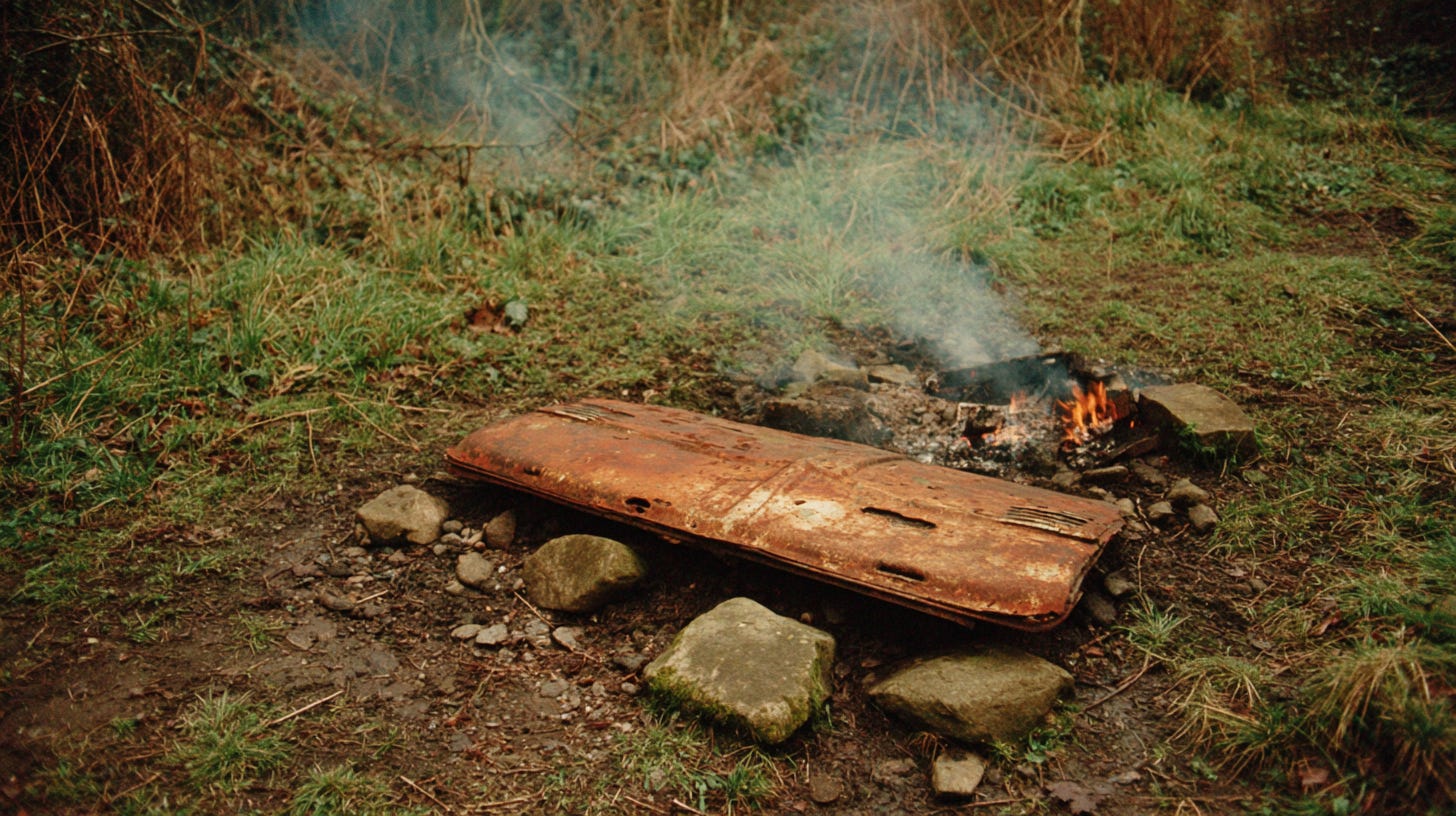
None of us had thought to bring a pan. We had food and an open fire and a gap between them we couldn’t close. We sat looking at bacon and eggs and a loaf and a fire until Hicksy walked off into the scrub and came back with a car door.
Old one. Interior stripped out. Just bare metal.
We built the fire under it and waited. First the paint burnt off — long minutes of thick chemical smoke that none of us named. Then the surface heated. Then it got properly hot.
We cooked the bacon on it. Cracked eggs that ran in odd directions across the uneven surface and had to be chased. Held bread against it for toast that was dark on one side and soft on the other.
It tasted of effort and paint and school not starting without us.
We ate it anyway.
After eating, there was just the day.
We walked the perimeter of the pit pond. Skimmed stones. The water was dark and gave nothing back. We talked about what we’d do differently tomorrow and didn’t. By day three, the routine had settled: cook, eat, drift, wait for the cross-country runners, hide.
Every couple of hours, we heard the footsteps. The school’s long-distance route passed close enough that we went flat and stayed quiet until the sound faded up the hill. Three, four times a day. By the end of the week we’d stopped needing to tell each other. We just went down.
When the last runners had gone, Hicksy did the car horns from “Footsee” under his breath — badly, always badly. We laughed the first few times.
We had pictured more running.
Mostly, we sat in a den that smelled of paint smoke. Most of the things we could think of doing needed money, tools, or somewhere else to be. We came back every morning.
The others had said yes and stayed clean. We came back smelling of it.
On Top of the Pops, there had been no group for “Footsee.” Just the Wigan Casino dancers, bodies doing the job of a record. They improvised. The B-side was called “Seven Days Too Long.”
By Friday, nobody laughed at the car horns.
We took longer to answer each other. Arguments stopped at the first word. Silences stayed where they were. By day five, the funny things just sat there.
We’d talked about going another week. On the last morning, nobody mentioned it.
I could only do this because my mother was in London.
She was ill. Every three months: the Royal Free, Hampstead, a bag packed by the door. While she was away, I stayed with cousins. Relatives who asked fewer questions.
She would have smelled the smoke on me. She would have come close to say goodnight. She would have known.
I knew the date she was coming back.
The last morning, I walked down the hill one more time. Sat with Andy and Johnny and Hicksy. Cooked what was left on the car door — the fire not quite hot enough, the eggs not quite right, the bread overdone on one side.
We ate without ceremony.
Not one of us questions the car door as pan idea , how did we get to 65?
We probably got to 65 because of all the everlasting chemicals we ingested that week. 😊
At the time, I remember us all thinking that it was the most brilliant idea ever!