

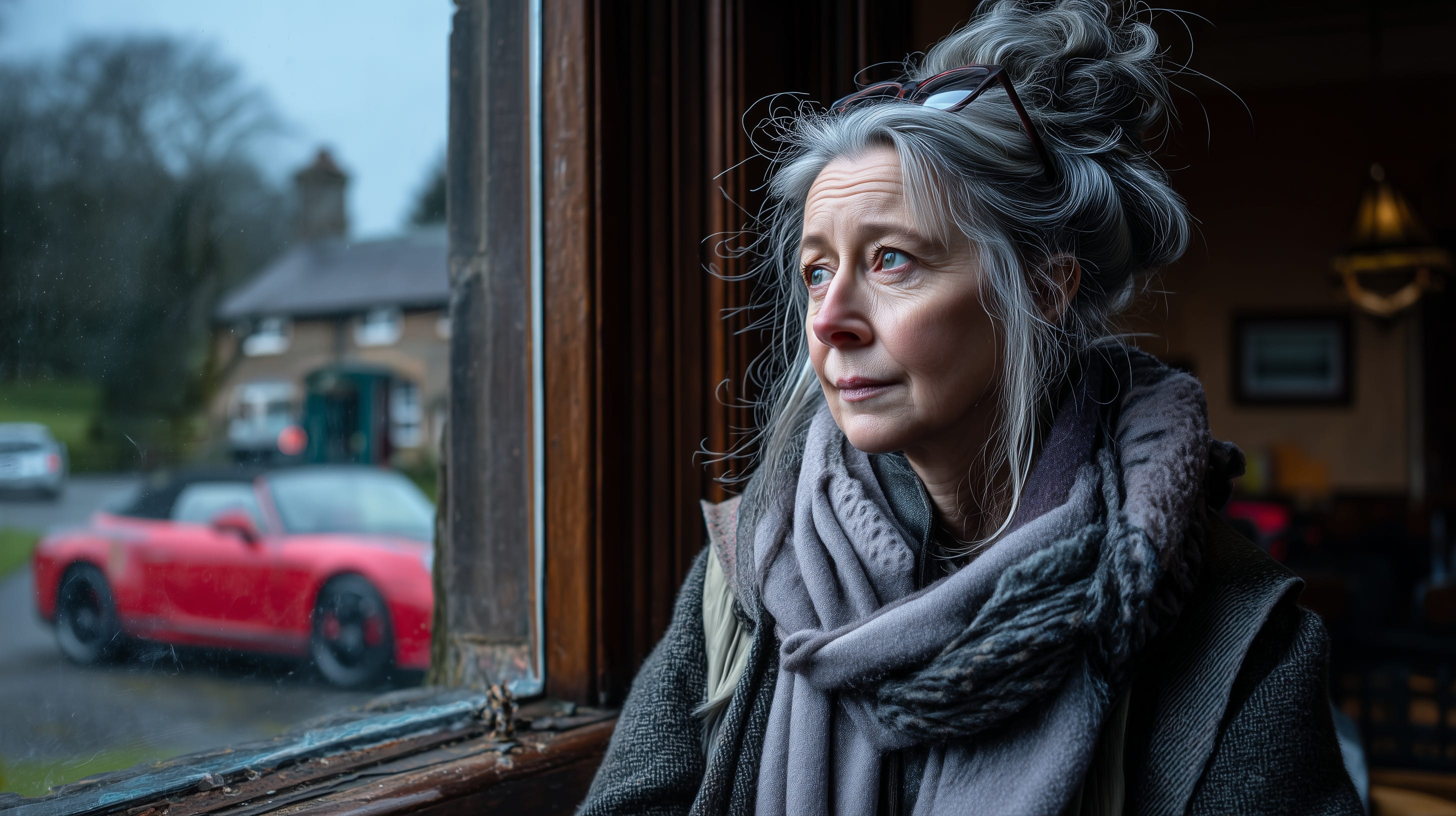
On Thursdays the red convertible appeared at precisely three-fifteen, as if it, too, observed Institute time. It idled by the hall with a polite purr, only red in a village that preferred hedge green. People said a great deal about it while pretending to discuss the weather.
By three-thirty the Women’s Institute was assembled: cardigans, committee faces, and a tray of ginger snaps. Audrey Crenshaw stood with her clipboard at the trestle table where the minutes took shape. She had added a new subheading: Car Park Conduct.
“We are not the French Riviera,” she said, which was true on several counts.
Netta Flinn raised a biscuit. “Shame,” she said. “I’ve a hat that would thrive.”
Reginald Smythe-Harrington positioned himself by the noticeboard, spine at attention. “I averted my eyes,” he announced. “One must protect the young man’s honour.”
“What young man?” Dot asked, although she had already seen him and disapproved of his haircut.
“The one in the convertible,” Audrey said. She did not use Lynn Braithwaite’s surname. When the Institute wished to diminish you, it trimmed your name back to the root.
Maggie sat at the end of the table with her notebook open and an unsharpened pencil laid across it. Through the high window she saw the car: clean, a soft gleam on the bonnet. A young man leaned against the door, hands in pockets, posture neat. Lynn stood beside him in her usual armour of earrings and a scarf that refused to match anything on purpose.
“That parcel,” Audrey said, tapping the air as if evidence hung there, “was exchanged openly.”
“It was a lunch,” Netta said. “Or a sock project. Brown paper’s famously versatile.”
“It was an envelope last week,” Reginald said, squinting. “And once a jar. I repeat: honour.”
Maggie wrote: Parcel — brown — repeated. She did not write the village’s conclusion.
When Lynn came in, the conversation changed shape without changing volume. It was a trick the hall had learned years ago. Lynn walked to the table, placed a small jar among the biscuits, and said, “Quince. I overachieved.”
“Thank you,” Audrey said, as if fruit might harbour scandal, and made a note: Donation (quince).
“Any other business before we begin?” Audrey asked, though business had plainly begun long ago.
“The car,” someone said, and let the rest arrive silently.
Audrey pursed the minutes into order. “Yes. We’ve had comments — external — regarding... displays.” She did not look at Lynn. She looked at the word Decorum as if it might enforce itself.
Netta reached for the jar. “Rule One,” she said. “Be kind.”
“That won’t be necessary,” Audrey said.
Reginald coughed. “I should record the registration —”
“No,” Audrey said quickly, then recovered. “Not in the minutes.”
They proceeded to ordinary matters. Subscriptions balanced. The raffle prizes were confirmed: a hamper, a watercolour, and the usual argument about whether a voucher was a proper object (it wasn’t, until it was donated; then it became tasteful). The kettle clicked and hissed. No one drank the tea they poured.
At the window, the red car waited without impatience. The young man handed Lynn a flat parcel wrapped in brown paper and string.
By Saturday, the red convertible had acquired three different owners — all of them the same young man.
Maggie, walking Dog to the butcher’s, stopped by the noticeboard. Beneath the Pilates flyer, a photograph from years ago had yellowed: a school portrait of a boy maybe twelve, smiling the brave smile chosen for official notices. Foster Placement Appeal — 1999. The edges had feathered.
Later that afternoon she took the long route past the old post office. The convertible was tucked there, half hidden by the hedge. Lynn and the young man were lifting a box into the boot, their movements unhurried. A sheet caught the wind and landed at Maggie’s feet.
She picked it up. County Social Services — Foster Care Archive Request. Name: Callum Webb. Reference: Braithwaite (1998–2001).
Lynn looked over, startled. “Oh,” she said, and held out her hand.
Maggie passed it to her.
“You won’t hear anything interesting in that file,” Lynn said lightly.
“I already haven’t,” Maggie said.
The young man — Callum — smiled a little. He held his mouth the same way.
“Thank you,” he said.
Lynn added, “We’re... sorting.”
“Good,” Maggie said. Dog sneezed at the tyre.
On the walk home Maggie recalled Lynn once saying, *A house can be too quiet, until it isn’t.* She’d thought it was about a dog.
The next Thursday, Audrey arrived early and taped to the door a laminated notice: Community Car Park — A Guide to Considerate Use. The font tried very hard to be friendly.
Netta read it and said nothing.
The meeting began in the usual way, with apologies from those who had not come and apology-shaped faces from those who had. The convertible pulled in as it always did. Callum lifted folders from the passenger seat. Lynn tucked a small parcel under her arm. They did not hurry.
“Evidence,” Audrey whispered.
Reginald produced a photograph from the fête showing Lynn and Callum carrying a box together, heads bent toward the same joke. “This demonstrates proximity,” he said.
Maggie looked at the photo, then at the old noticeboard picture. He held his mouth the same way.
“Before we descend,” Netta said, “why not ask?”
“That would be intrusive,” Audrey said.
The kettle clicked.
The door opened. Lynn came in, parcel still under her arm, keys steady in her hand. She looked at the notice, then at the faces. She set the parcel on the table.
“For the raffle,” she said.
“Thank you,” Audrey replied, selecting the word as if from a drawer.
“And while we’re being public,” Lynn went on, smoothing the brown paper, “he’s my foster son.”
“He’s doing his adoption application,” she said. “I’m helping. That’s the whole story. The car’s his. The earrings are mine. You may divide your concern accordingly.”
She smiled — not unkindly — at Reginald. “And you may keep the photograph. It’s a good one.”
Reginald straightened, released. “A fine lad,” he said, surprised by how much he meant it.
Netta folded the laminated notice twice, then twice again. “Rule One,” she said quietly, “be kind.”
Audrey studied her clipboard, then wrote nothing, which was progress.
Lynn left before tea could confuse the matter with hospitality.
Motions passed briskly. The quince jar remained unopened.
Maggie stepped outside into low afternoon light. Callum stood by the car, hands in pockets, posture polite.
“She told them?” he asked, not as a challenge.
“She did,” Maggie said.
“Good,” he said, and his shoulders eased.
“She’ll make a fuss of the paperwork,” Maggie said.
“I know,” he said, smiling. “She kept every school report.”
“She would,” Maggie said. “There’s a drawer for everything.”
He touched the car roof.
“Thank you for not —” he gestured toward the hall.
“It’s a hobby,” Maggie said. “Not mine.”
He laughed, brief, and drove away at the proper speed.
A week later, the red car returned early. The hall was empty, the notice on the door peeling at one corner. Lynn stood by the boot with a plant and a box of mugs. Callum lifted another box — folders, their spines labelled in a tidy hand. He wore a tie.
“Panel today?” Maggie asked.
“Forms,” he said.
“Everything is,” she said.
Lynn placed the plant in the boot and stepped back. “He’s going to be the sort who reads instructions,” she said.
“On alternate Tuesdays,” he said. “I learned from the best.”
She hugged him, brief and practical. He returned it with care.
Dog, appearing uninvited, sniffed his shoelaces.
“Good luck,” Maggie said.
“Thank you,” he said.
He got in the car and waved. The engine purred. The red slipped behind the hawthorn and was gone.
Lynn exhaled. “He was twelve,” she said, and stopped.
The gate at the end of the car park clicked shut.
Lynn opened the parcel she’d left for the raffle. Inside were two mugs: *Mum’s Tea* and *Callum’s Brew.* She smiled at them.
“I didn’t tell them,” she said, “because they’d have made it smaller.”
They went inside. The kettle clicked into purpose. The mugs waited on the table.
By the time the others arrived, the convertible was gone. Reginald paused at the door. “I’ll repaint the lines next week,” he said, to no one.
“Use the right white,” Netta told him.
Audrey pressed the notice’s peeling corner flat. In the minutes she wrote: Car Park Conduct — Rule One: Be Kind.
Someone brought cake. Rumour cooled, unremarked, like tea left to consider its options.
That evening Maggie sat at her table with her notebook and a pencil newly sharp. She turned the pages, leaving space where it felt deserved. She did not record the debate or the notice. She wrote.
When she finished, she left the corner blank for a moment, a courtesy.
Then she wrote the figure and closed the book.
---
Casefile #56 — Rule One: Be Kind
Thursday. Women’s Institute, Lower Tissington. Item raised: car park conduct. Red convertible. L. Braithwaite: foster placement, C. Webb (1998–2001). Adoption application in progress. Raffle donation: two mugs. Notice laminated.
1999.