
Paths Not Yet Taken
On waiting spaces, small shifts, and the choices that stay with us.

Twenty-eight hours from door to door, across continents, time zones, and terminals, left me thinking about airports the way Maggie sees everything: places where people reveal themselves without meaning to.
It felt right to let her walk through one.
Paths Not Yet Taken
It wasn’t that Netta Flinn was afraid of flying, exactly.
She was afraid of everything that came before it.
“The thing is,” Netta said, as the train slowed on approach to the airport station, “I don’t distrust the pilot. I distrust the escalators. And the machines. And the people who say ‘pop your bag on the belt’ like it’s nothing.”
Maggie, who had never yet met a belt she trusted either, nodded.
“You’ve survived Lynn’s printer and Reginald’s compost spreadsheet,” she said. “This will be nothing in comparison.”
Netta laughed, then covered her mouth as though airport security might hear through the carriage.
She was travelling to Oslo for a quilting retreat: three days of workshops, demonstrations, and the sort of competitive courtesy only British women of a certain age could manage. Her suitcase, which she insisted was “hand luggage, really,” looked large enough to conceal a small, compliant adult.
The train pulled into the station beneath the terminal. Passengers rose in the choreography of people pretending not to race for the doors.
“Right,” Maggie said, lifting her bag — small, cross-body, chosen because it left both hands free for balance and steadying others. “Passport, boarding pass, common sense. Two of those will get you through security.”
“Oh, don’t make me laugh,” Netta said. “My photo is awful. I look like I’ve just been asked a maths question.”
“Excellent,” Maggie said. “That’s the correct expression. It reassures them you’re not having too nice a time.”
They stepped onto the platform and joined the steady river of travellers heading for the escalators into Departures. The smell of coffee drifted down from somewhere above; the automatic doors sighed open and closed as if tired of the responsibility.
Inside, everything was glass, light, and distant announcements. Netta gripped the handle of her suitcase with one hand and Maggie’s elbow with the other.
“Just tell me if I start to spin,” she said.
“If you start to spin, I’ll sit down and let you orbit.”
Netta let out a nervous giggle that caught in her throat.
At the check-in desk, a young man with hair like a cautious hedgehog scanned her passport, printed a tag, and pronounced everything “spot on” in the flat tone of someone whose mouth had stopped taking requests. Netta looked so relieved Maggie half expected her to curtsy.
“See?” Maggie murmured as the suitcase disappeared along the conveyor. “Accepted by the machine gods. It’s the only belt today I’ve trusted.”
“I hate that bit,” Netta whispered. “What if it goes to Barcelona?”
“Then you’ll improvise with local tea towels.”
Security was next. The queue moved in hesitant bursts. People tugged at zips and removed belts with the solemn air of small, reluctant offerings. A child climbed briefly into a tray before being redirected by a parent who looked like they’d quite like to join him.
Netta clutched her clear plastic bag of decanted liquids as though it contained her entire reputation.
“Is this too much?” she asked again. “Do you think it looks aggressive?”
“It looks perfectly submissive,” Maggie said. “If anything, I’d worry it lacks ambition.”
At the barrier where companions must peel away, Netta’s fingers tightened.
“You’re sure you don’t mind waiting? Just until I’m through? It’s silly, I know, but if something goes wrong—”
“If something goes wrong,” Maggie said, “you’ll be surrounded by people whose job it is to put it right. I’ll be here, having a perfectly nice time not taking my shoes off in public.”
Netta blinked hard, nodded, and stepped forward.
As she placed her tray on the belt, she glanced back. Maggie lifted a hand — palm out, a wave small enough to say I see you without suggesting drama.
Netta mouthed thank you. Then the line carried her forward into the archway that beeped periodically, like a heart monitor.
Maggie waited until she saw Netta gathering herself on the far side, visible again. When their eyes met across the gap, she gave a brief nod. Netta mimed a deep breath, patted her chest twice, and then — with the air of a woman stepping onto a private stage — vanished into the terminal beyond the barrier.
It would have been the most natural thing to leave then: follow the signs back to the station, board the next train, and return to her ordinary day.
Instead she stood still in the wide concourse before security, letting the terminal’s hum settle around her like weather.
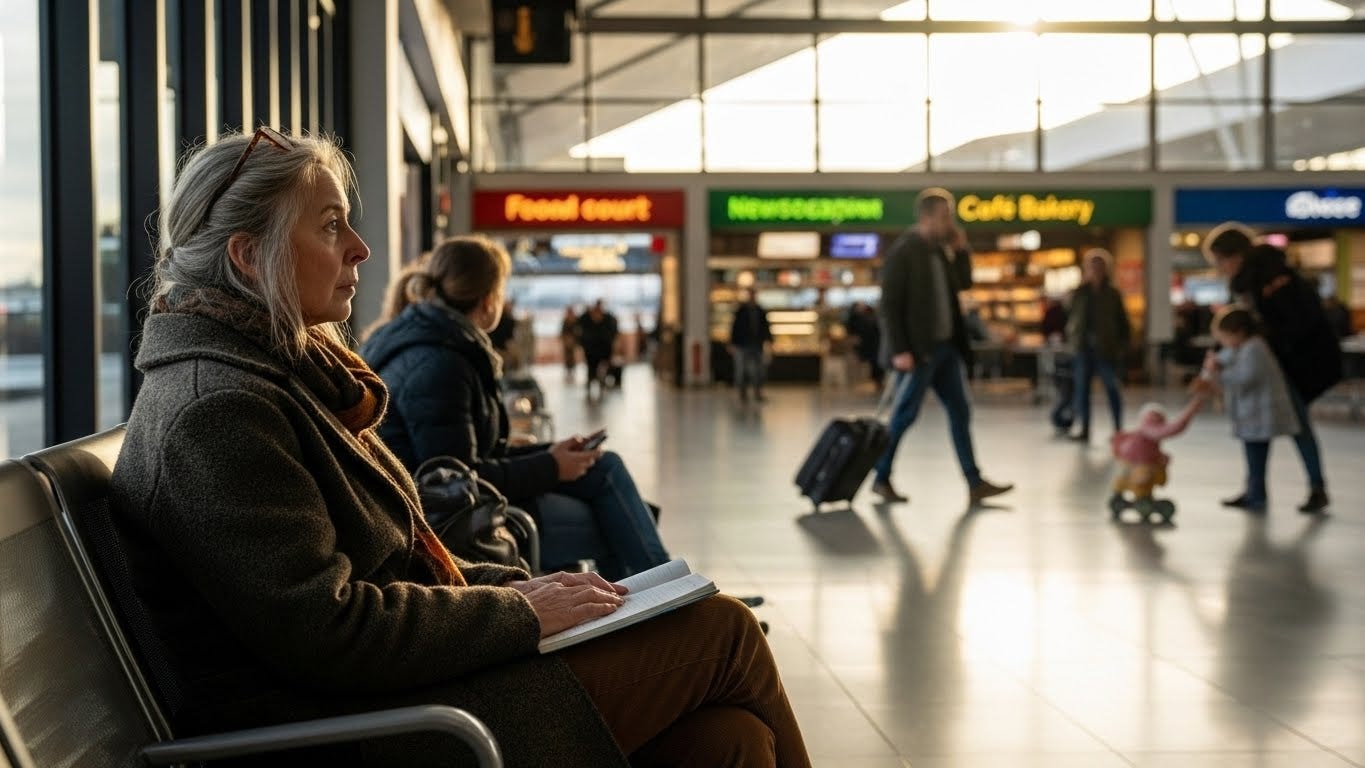
The public seating opposite the check-in zones offered a clear view of the high windows and the departure board that flickered with delays she wasn’t involved in. People waited there in various stages of readiness — some travelling, some lingering, some unsure.
She chose an end seat. End seats gave you one fewer side to defend.
The glass beside her was warm under her palm where the low sun rested. Outside, aircraft sat in tidy lines, noses angled away as if pretending not to listen.
Inside, the draftless air of a building designed to keep bodies moving. Somewhere beneath them, another train arrived — a faint vibration passing through the floor like a shared pulse.
She slipped her notebook from her bag and opened to a fresh page.
Case #35: Paths Not Yet Taken
Location: Manchester Airport, Departures Concourse
Status: To Be Determined
She uncapped her pen, waited — then wrote.
There was always a moment when she wasn’t sure whether she was inventing a case or recognising one the world had already prepared.
Across the aisle, a young couple sat with an empty seat between them. The woman twisted a tissue into narrow ropes, unwinding and rewinding until the fibres frayed. The man leaned forward, elbows on knees, hands hanging uselessly.
“I didn’t know leaving meant leaving everything,” the woman said, not quite quietly enough.
The man winced. “I didn’t, either.”
Concourse: Couple sitting apart. Retreat underway; words lagging behind.
Near the windows, an older woman sat alone with a boarding pass softened to silk at the edges. Her small case waited upright before her, handle extended — ready, though she was not. She checked the screen, then her ticket, then her watch, triangulating something not yet admitted.
Window bank: Passenger with ticket but no forward motion.
Near a pillar, a man paced a short figure-eight beside the charging points, murmuring into the air.
“Listen, I shouldn’t have said that… No, that’s not it… Okay. Start again. I’m sorry I—”
An announcement blurred the rest. He resumed pacing.
Perimeter: Man practising remorse. Phrasing unsteady; outcome doubtful.
On the floor nearby, a small boy rolled a toy car along the line where carpet met skirting. The wheels produced a soft churring. His mother’s hand drifted along his back as she reread the same page of a picture book, eyes unfocused before the last line.
The car veered into the aisle. Maggie nudged it back. The boy looked up, grinned, and returned to his private motorway.
“Thank you,” his mother murmured.
“Hazards of the open road,” Maggie said.
Concourse floor: Child imitating aircraft noise; mother imitating calm. Both competent.
From overhead came another announcement:
“We’re sorry to announce a further delay to the 15:40 flight to Malaga…”
Irritation rippled through the concourse. Fingers typed complaints to unseen recipients.
The agent at the check-in desks sagged at the shoulders for precisely three seconds before straightening again.
Staff fatigue evident; replacement unlikely.
The sunlight crept toward Maggie’s feet, a pale rectangle sliding across the floor. Dust drifted in the bright band between chair legs and window.
Time, when she checked, had arranged itself without her.
She turned a page. Something slid halfway free — a corner of paper she recognised.
A list she had written weeks earlier:
Paths Not Yet Taken
— Overnight train to Edinburgh
— Evening drawing class
— Saying yes to the walking group
— Visiting the coast in winter
— Keeping the allotment but not the cabbages
None were crossed out.
Her thumb travelled the margin.
“Excuse me, love,” a voice said.
The same agent now stood in the concourse, smile slightly frayed.
“Not waiting on the Malaga flight, are you? They’re sending folks to the assistance desk if they fancy stretching their legs.”
“Oh, no,” Maggie said. “I’m not going anywhere.”
He hesitated, unaccustomed to ground-level honesty.
“Well. If you need anything.”
“I’ll let you know.”
People gathered their belongings, their irritations, their half-spoken arguments. The couple rose without touching. The apology-rehearser pocketed his phone. The boy protested until his mother promised he could drive the car the full length of the next seating area.
The older woman did not move.
The concourse thinned to a gentler murmur. Sunlight reached Maggie’s lap.
Then, without drama, the older woman stood. Not toward security.
Toward the check-in zone.
A screen above Desk 42 now showed:
BELFAST.
The woman approached slowly, paused, tucked her softened boarding pass into her handbag with a small, decisive nod, and took a seat near the queue forming for domestic departures.
Window bank (former): Passenger chooses a different direction. Honest pivot. No witnesses.
Dust drifted again in the bright band between her and the window.
Maggie turned back to her list.
For a long moment she simply looked at it: each line a doorway she’d walked past.
Underneath, she wrote:
It isn’t too late.
She hesitated before the last word, listening for its weight. Then tore the page along the perforation, folded it twice, and slipped it into her coat pocket.
Something in her settled, almost imperceptibly.
She left the notebook open on her lap.
On the tram — terraced houses, a scrapyard, empty stadiums — the rhythm of the carriage reminded her faintly of the morning train: that steady, almost-forgotten sense of being carried somewhere she hadn’t yet named.
She picked up her pen again.
Conclusion:
No crime. No culprit.
One observed change of heart near the check-in zone.
Evidence suggests people choose when they’re ready.
New line of inquiry:
I might be ready too.
She underlined might, closed the book, and watched the familiar stations rise and fall.
By the time she reached home, the folded page had warmed in her pocket, as if it had belonged there all along.
I really liked this one a lot! A little adventure outside of the normal, very inspiring!