

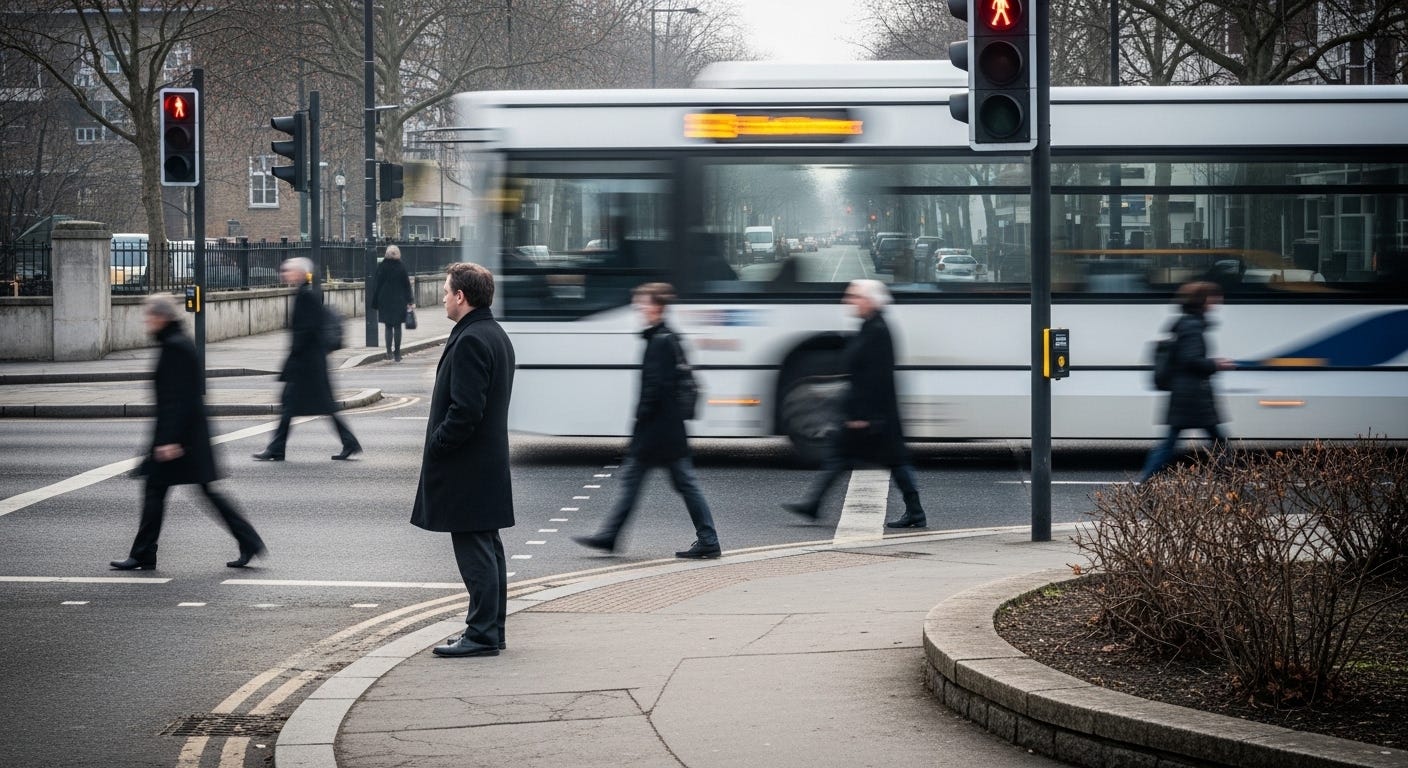
Nothing Pressed
He learned her schedule by accident.
At first, he noticed only that he stopped checking the time. The walk no longer required the small adjustments he usually made. On mornings when he reached the corner and saw her already there, something in him loosened. On mornings when she wasn’t, he slowed, giving the morning a chance to correct itself.
She appeared most weekdays at roughly the same point in his route. Not precisely—some days earlier, some days later—but close enough that his body learned the rhythm before his mind did. He would round the corner with his hands in his pockets and already sense she would be there.
He told himself it was coincidence. Convenience, at most.
Still, he gave himself more room in the mornings. He lingered by the door to lace his shoes properly instead of rushing, and chose the longer route past the low wall and the tired shrubs, where the pavement was less cracked.
His reasoning held. He didn’t press it.
They did not speak. Once—early on—there had been a nod. Nothing deliberate. Just a brief meeting of eyes, a correction of posture, and then it was over. After that, silence. Silence kept the arrangement intact.
Over time, he noticed small differences in his days. On mornings when he saw her, he walked a little farther before turning back. He waited at the crossing instead of darting through. He bought what he needed and nothing more.
It didn’t feel like happiness.
It held better than that.
One morning, she wasn’t there.
There was nothing to mark it. He reached the corner at the usual time and felt the lack of alignment. He slowed, then stopped, one foot hovering at the edge of the kerb.
A cyclist passed close behind him.
He waited longer than made sense.
Not dramatically. Just past the point he could reasonably defend. Long enough that he became aware of himself waiting, and of the space his waiting was taking up. A woman across the street glanced at him, then away.
When he finally moved on, there was a small, awkward recognition—not disappointment exactly, but the realization that he had expected something to happen.
He crossed when the light changed and told himself he must have misjudged the time.
The next morning, he arrived already prepared to see her.
The realization came a beat later. He found himself leaning forward, then caught the motion and let it fall away.
She was not there again.
This time, he adjusted his pace as he walked, slowing, then quickening, as if speed might correct the error. He checked his watch, then put it away. Others stood where she normally did, but the shape of the morning did not re-form itself around them.
On the third day, he waited through two full cycles of the crossing.
A car horn sounded behind him. He stepped back from the kerb, surprised by how close he had come to the edge. When he crossed, he did so with an efficiency that felt slightly overdone.
Understanding did not arrive all at once. It came in pieces, trailing him for days: in how early he reached home, in how little time he spent standing still, in the way his route began to collapse back into the shortest possible line.
He still walked the longer way, sometimes. He told himself there was no reason not to. The air was cooler at that hour. The pavement kinder.
But he no longer lingered at the corner.
Once, he realized he could have asked.
He had never been entitled to the pattern.
He didn’t take the shorter route every day.
At first, he alternated, as if variety might restore something without requiring it to be named. Some mornings he drifted toward the corner before correcting course. Other mornings he avoided it altogether. Neither choice felt quite right.
Weeks passed. The space thinned. The hour loosened its grip.
One day, he found himself at the corner without having intended to be there. He slowed, then stopped. For a moment—no more than that—he prepared.
Then a bus pulled in, blocking the view.
By the time it moved on, the light had already changed.
He crossed late, alone, aware of having missed the moment twice.
On the far side, he adjusted his coat and continued on. The day went on without difficulty.
But the timing did not return.
It did not release him either.
I read a very similar story...the difference being in standing on a balcony looking across the city street into another balcony where a man would come out with his glass of wine in the evenings and the woman would try to time it. A nod and a wave happened...and then the man no longer appeared. I think it interesting how we change our habits almost subconciously... I loved the detail here.