
I don’t know where I am before I know what it is. The air gets in first, freshly mown grass and diesel fumes and something sweeter underneath, and my chest does something I don’t have a word for. My mouth gets there before my mind does: home.
Bracken. A gravel path going nowhere in particular. Trees old enough to have opinions. I am working out where: Nottinghamshire, somewhere close to Sherwood Forest, close enough to taste it. Then a man starts walking toward me from across the clearing, and I decide I’ll ask him.
He’s still fifty yards off when I know. It’s the walk. I stop breathing. I haven’t seen that walk in thirty-three years.
I don’t move. I couldn’t tell you if my legs still work. There are tears on my face before I understand they’re mine.
He sees the state of me before he’s close enough to speak, and his pace changes, no longer a stroll but something with purpose in it. A cigarette burns down between two fingers. I watch it the way you’d watch a wasp.
“Are you alright?”
I have more than half a lifetime of things to say and none of them will come.
“Are you lost?”
I shake my head. That much I can manage.
He doesn’t recognise me. Why would he.
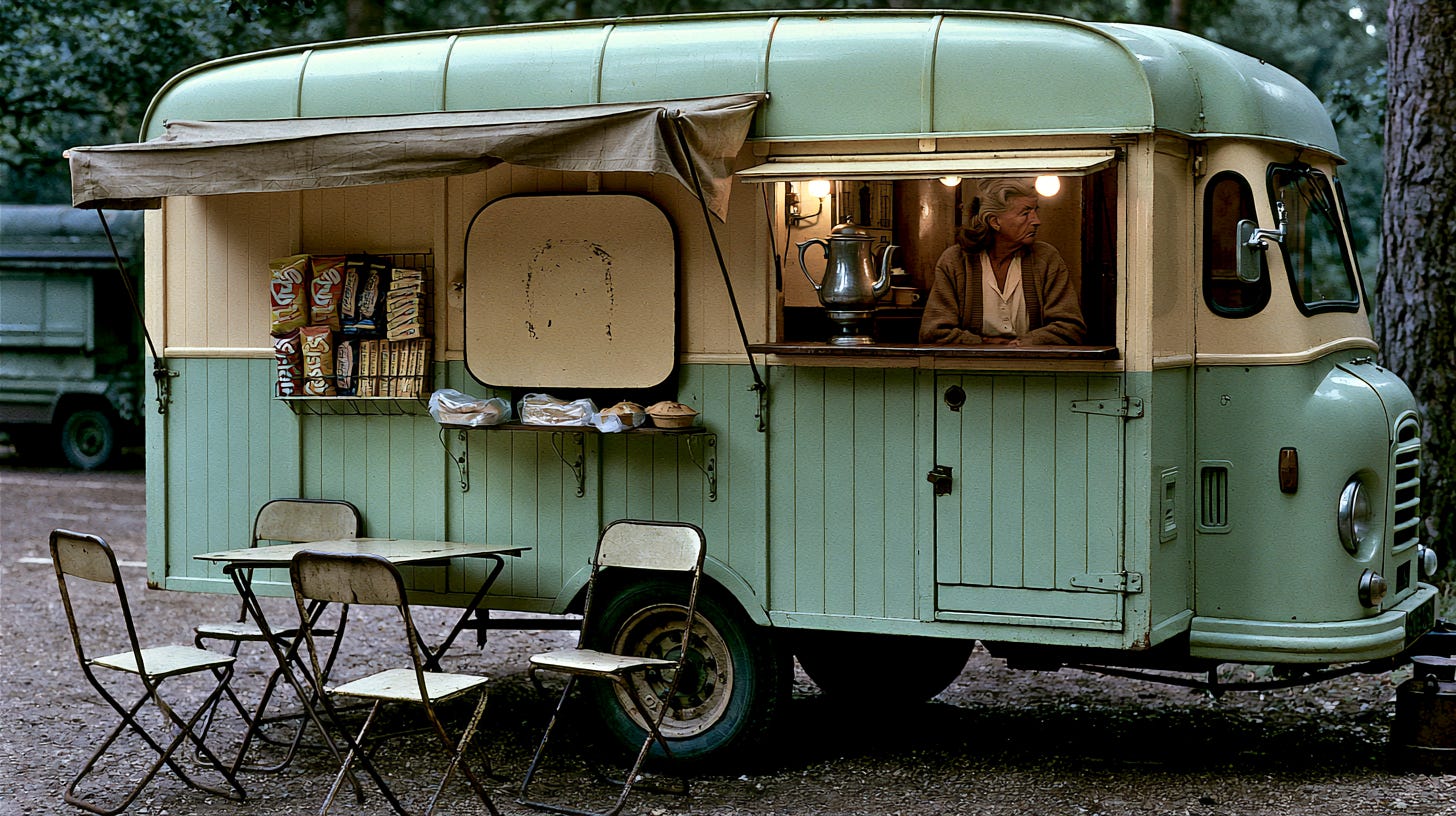
He nods at a caravan across the grass, the mobile kind: tea, sandwiches, and pastries, a couple of flimsy tables with folding chairs that have seen better decades. He puts a hand on my shoulder to steer me toward it.
The hand is exactly the hand. I do nothing, and let him walk me there.
If I tell him who I am, this ends.
“Sit yourself down. I’ll get us a cuppa.”
He goes to the counter. There’s an older woman running the caravan, and within thirty seconds he’s got her laughing, really laughing, the kind that makes her put a hand on her chest and brings colour to her cheeks.
I used to see this constantly. His dream had been to own a corner shop, and within a few years supermarkets put him out of business. His response was, “If you can’t beat them, join them,” and he went to work for one, running one of its stores. He still ran it like a corner shop, though. He knew all the regulars, knew their kids, knew who’d had a bad week. From the age of seven I did my growing up in the aisles, handed round between the till girls like a parcel nobody minded holding. Saturdays from thirteen. Holidays home from college, still stacking shelves for him.
“Sugar?”
“No thanks.”
Two words. First ones I’ve managed. He spoons two heaped sugars into his own and asks the woman for a couple of the Jacob’s Club biscuits, relaying the flavours to me over his shoulder like it’s the most natural thing in the world.
“Orange,” I say. “Orange is my favourite.”
“My lad likes that one.” He says it the way you’d note the weather. Gets two.
I go quiet again. He’s still wrapping up his conversation with the woman at the counter.
He brings the teas over. I put my hand round mine and feel the heat through the chipped mug. As dry as my mouth is, I don’t drink it.
He unwraps his biscuit and takes a bite that has no self-consciousness in it whatsoever.
“So what brings you out to Forest Corner?”
“My dad grew up here.”
“Where’s he now?”
“Not too far away.”
“Where are you from?” he says. “Your accent’s familiar, but there’s something a little off about it, though.”
“I grew up near here, but I’ve been living in the US for the last thirty-one years.”
“That explains it.” He takes a long sip of his tea.
“You like it over there?”
“I do. I miss home, though. Especially my family.”
“Never been myself,” he says. “I’ve only seen it on TV.”
He asks about my family: will I get to see them this trip. I’ll be seeing some cousins nearby, I tell him. And then my brother and my nephew and their families, all in and around London. And then finally up to Edinburgh, to see Hannah. My daughter.
Her name is out before I’ve decided to say it.
“That’s my granddaughter’s name.”
“I’ll be seeing my Hannah in a couple of weeks. She’s the daughter of my youngest, and he’s just moved to South Wales with his job. Company Consolidation. He was hoping to get back close to me.” He shrugs, easy. “But it doesn’t really matter now I’m retired. Time’s the one thing I’ve got plenty of these days. I get to see a lot of him. I get to see a lot of all three of my lads.”
“I’m retired myself now,” I tell him. “I’m trying to get back more, so I can spend as much time with mine as I can, especially with a baby on the way.”
“Your daughter?”
“No, my brother’s youngest. Their baby is due next month.”
“You don’t look old enough to be retired.” He says it kindly. The colour goes from his face. His breath catches somewhere it shouldn’t.
I try, uselessly, to work out the date. Whether there’s still time.
He reaches for his cigarettes.
I can’t help it. Something crosses my face, and he sees it, and the packet goes back on the table unopened, lighter set down beside it.
“Good that you don’t smoke,” he says. “My lads are always on at me about it. Smoked all my life, though. Feels a bit late in the day to stop now.”
He picks his tea back up instead. “What’s your girl do, then?”
“She’s a teacher and house mother. At a private school, the one Tony Blair went to.”
“She’s done well for herself,” he says. “You must be very proud.”
“I am,” I say. “Very.”
He decides on a bacon sandwich, and tries to order one for me. I tell him I don’t eat meat.
“Neither does my youngest, nor his family.”
He goes back to the counter, back to the woman, back to whatever story he was telling her before. I sit and listen. I couldn’t tell you the words.
And then I can’t hear him quite so well.
The edges go soft first. I think I’m going to faint, and some old instinct tells me to close my eyes and breathe, so I do: long, slow, counted breaths, the grass smell already thinning underneath me.
When I open them, he’s gone.
So is Forest Corner.
I’m sitting outside a coffee shop in downtown Chattanooga, and there’s a cup in front of me, still too hot to drink.