

This is an essay about waiting—how it forms, what it teaches, and what it quietly takes with it.
It didn’t always feel like loneliness.
That’s the part that makes it difficult to name. I wasn’t alone in rooms. There was noise, movement, routine. But there was a quieter absence—the kind you notice when you reach outward without quite reaching anywhere.
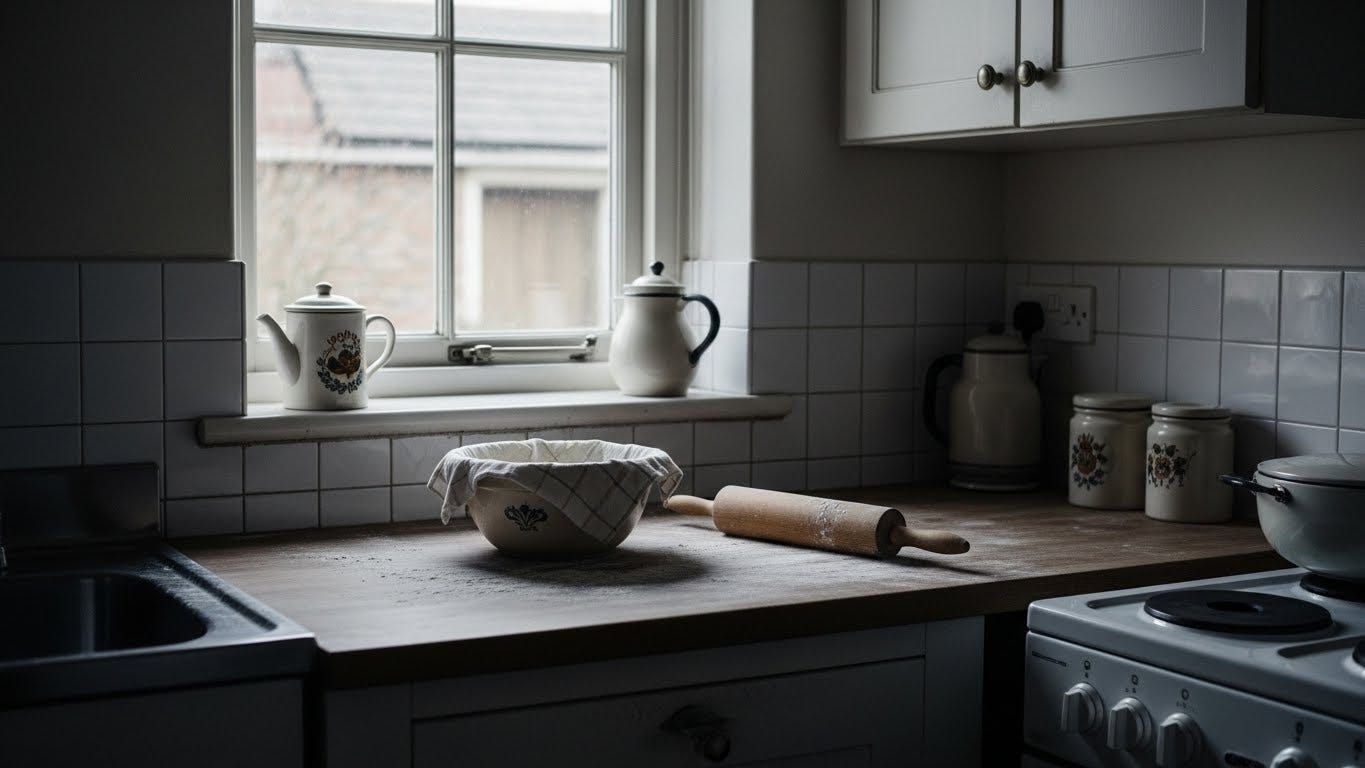
My mum was a gifted pastry cook. At the weekend she made fruit pies, timing them so they came out of the oven just as Sunday lunch finished. The smell filled the house early, butter and fruit and heat. I hovered near the counter, watching her hands work the dough, the practiced economy of it, the way she seemed calm only when something needed doing.
I always asked if I could help.
Not urgently. Just the same question, each time. Could I help?
She would tell me she didn’t have time right now. But next time, she said. Next time I could.
Next time was always close enough to believe in. Just a week away.
So I waited. And the next weekend, I asked again. And again, she said not right now. Next time. It wasn’t a refusal exactly. It was a postponement with an open end, which is harder to argue with. Easier to trust.
I believed her for a long time.
There is a discipline involved in believing something that never quite arrives. You learn how to stand nearby without getting in the way. How to watch without interrupting. How to make yourself useful by not being needed. I didn’t know I was learning these things. I only knew the moment would come if I was patient enough.
Next time never came.
What I remember now isn’t anger. It’s the waiting itself. The way hope could be stretched thin without breaking. The way I learned, early on, to hold wanting one step away from asking too much.
At the time, it felt normal. Just how things were done.
When my uncle Fred died, my parents went to the funeral in North Wales. I was only four, so I didn’t go with them. Instead, my godmother looked after me for the day.
Auntie Ivy was larger than life in every way. Her voice arrived before she did. Her laugh filled rooms. She moved as if there were always more of her to move. Things did not need protecting around her. They needed doing.
She was making pastry when I arrived.
The kitchen was warm. The table already floured. The dough sat in a bowl under a cloth. She took it out and worked it with both hands, unhurried, certain.
I asked if I could help.
She said of course.
She tore off a piece of dough and handed it to me, finding me a child-sized rolling pin. I stood beside her at the table, our shoulders almost touching. She showed me how to roll it out, then went back to what she was doing.
The pastry stuck. It dropped on the floor. I froze. She said it was okay. I picked it up and kept going.
It happened more than once. Each time, it was still okay.
We made jam tarts. She filled the cases and let me spoon in the jam. Some spilled. It didn’t matter.
Years later, I realized I only ate the tarts that hadn’t been on the floor. At the time, it didn’t matter.
What mattered was standing there. Side by side. Being included without instruction. Being allowed to take up space and make small mistakes without the day tightening around them.
I don’t remember asking my mum to help with the pastry after that.
I don’t remember deciding to stop asking.
There was no moment I can point to. It happened the way habits do—by thinning out. By becoming unnecessary. By no longer offering enough return to justify the effort.
At some point, I noticed myself waiting differently. The questions still formed, but they didn’t always reach my mouth. Sometimes I held them there and let the moment pass.
Nothing dramatic followed. No confrontation. Just a series of small adjustments, made repeatedly, until they became the shape of things.
Next time stopped feeling like a promise and started feeling like a way of ending the conversation.
I learned how to stand close without participating. How to be present without needing to be included. It felt sensible. Accurate—the quiet relief of having worked something out.
Only in recent years did I realize what else had been learned alongside it: that wanting too openly required management. That asking carried weight. That it was easier to hold certain hopes quietly than to place them in someone else’s hands.
As I grew older, the caution around me became more visible.
It wasn’t framed as fear. It was framed as care. I was wrapped in it carefully, layers added where other children moved freely. The world beyond the house was treated as something that required limits.
Many of the things other kids wanted to do made my mum uneasy. Climbing too high. Being out of sight. Playing with unsuitable children. Her concern arrived before the risk did, tightening the space around me until it felt safer to stay where I was.
For a long time, I accepted this without protest. It fit what I already knew—that ease could be withdrawn without warning, that it was better to reduce the chances of causing distress in the first place.
I learned how to cooperate with the concern. To anticipate it. To adjust my behaviour before it needed correcting.
From the outside, it looked like self-control. From the inside, it felt like calibration.
Around the age of ten, most of us got our first real bikes.
Mine arrived the same way as everyone else’s. I rode it up and down the lane, learning its balance, its turns.
There was one rule.
I wasn’t allowed past the end of the lane.
The lane was short. At one end, a path led into a wood—expressly forbidden. From the middle, footpaths ran to the local brook and to Waterloo recreation ground, the rec, where the other children gathered. Both were off-limits to me. At the other end, the lane met the main road, which led in quick succession to Warmby’s shop, the post office, the other park—the green, with its football field, swings, and sandpit—and finally my school. All were within a five-minute walk. All lay beyond the boundaries my mother set.
At first, the rule didn’t seem like much. I told myself it was temporary. Sensible.
But the others didn’t wait.
They gathered at the end of the lane, paused long enough for me to catch up, then rode on. I watched them disappear around the corner, the sound of their bikes thinning as the distance grew.
I stayed where I was allowed.
After a while, they stopped waiting.
What formed then wasn’t rebellion. It was an explanation. I began to understand myself as someone who needed limits. Someone more likely to fall, to get hurt, to cause worry.
I rode back and forth along the lane, learning its length exactly.
At some point, I realized I could read my mum.
Not in words, but in shifts—the signs that told me when I was close to becoming too much.
Once I noticed them, I learned how to respond.
If she seemed fragile, I softened. If something I wanted might unsettle her, I found a way to want it less.
This felt like care. It also felt necessary.
The idea that I was fragile took hold quietly. Accident-prone. Stress-inducing. I didn’t argue with it. I adapted.
Being careful became a way of being loved.
By then, it no longer felt like something I was doing. It felt like who I was.
There were advantages to this.
I learned how to notice changes early—shifts in mood, the moment a room tightened. I learned how to listen without interrupting. How to understand before needing to be understood.
People relaxed around me. They talked. They told me things. Understanding became a way of staying connected without needing to be met.
What I didn’t learn was how to take up space without scanning for consequences.
Only later did I notice the imbalance. How often I knew others deeply while they knew me in outline. How familiar it felt to be partially met and to accept that as sufficient.
It wasn’t loneliness. It was something quieter. A way of being accompanied that didn’t extend all the way back.
As an adult, this followed me into relationships.
I didn’t rush toward closeness. I adjusted myself to what was offered. I stayed present without insisting on reciprocity.
I didn’t reach outward when something felt heavy. I thought instead. Reflected. Replayed conversations long after they ended. My inner world had learned to do the work that wasn’t always being done elsewhere.
People described me as steady. They didn’t see the monitoring underneath it.
I had learned how to hold space. I hadn’t learned how to trust that mine would be held.
The end of my second marriage broke that system.
Not theatrically. It reached a point where carefulness could no longer substitute for mutual presence.
What surprised me wasn’t the loss. It was how little of the old strategy survived it.
The people-pleasing fell away. Not as a decision, but as a consequence.
When I rebuilt myself, I didn’t return to vigilance. I spoke more directly. I named what I noticed. I asked instead of absorbing uncertainty in silence.
Each time, there was a flicker of temptation to take the easier path—to pretend not to notice, to downplay what felt unclear.
Sometimes it would be simpler to take it.
But I don’t.
When I choose not to, there’s a cost. I’m often exhausted afterward. The tiredness that comes from staying in the room instead of stepping around its edges.
What surprises me is that the gratitude always outweighs it.
I’m no longer managing myself into absence. I’m no longer waiting for permission to arrive later.
I still notice rooms quickly. I still understand others with a speed that sometimes outpaces expression. Those things remain.
What’s changed is what I do with that knowledge.
I no longer believe that being accepted requires me to be smaller than I am.
If I could speak to the five-year-old standing at the counter, waiting for next time, I wouldn’t tell him to be patient.
I would tell him the truth.
That it was never about him.
That the waiting wasn’t a test he failed or a lesson he missed.
He learned how to survive in the space that was available to him—and he did it well.
He doesn’t have to do it anymore.
This is one of your best work. Keep it up! It’s really good. I saw myself five times over, except that as a kid I rebelled and now I’m self disciplining with care. The other type of discipline never works.