

In the autumn of 1972, David Cassidy was not just popular. He was the thing. The girls at my new school carried his face on their pencil cases and exercise books, cut from magazines that circulated around classrooms in careful hands. He was seventeen in the picture on their bedroom walls. That autumn he was on every radio in the country, asking the same question in that particular voice of his — soft, uncertain, a boy genuinely asking — how can I be sure, in a world that’s constantly changing. He was number one for weeks. As far as I could tell, nobody was in any doubt at all.
Before Deincourt, I’d been at Parkhouse Primary School, a junior school where the teachers called on you because you knew the answer. Other kids were impressed by this, or at least not offended by it. There was no cost to being clever. I’d spent six years there thinking that was simply how school worked — how people were, how the world operated.
Then the comprehensive system arrived. Instead of going to the local grammar school like my older brothers, I was sent to Deincourt Comprehensive, a hastily rebadged secondary modern in the next village.
The building was large and institutional and built for a different kind of child. The kids who were already there — whose older brothers and sisters and cousins had been there — looked at those of us who had arrived from elsewhere the way you look at weather that’s come in from the wrong direction.
In the first week, we sat in a circle. The teacher asked what our fathers did, and what we planned to do when we left school. It went around the room. My dad’s a miner, I’ll probably go down the pit. My dad’s at the plant, same for me most likely. One of the girls said her dad drove lorries but she wanted to work in a bank. A boy laughed. She smiled, absorbed it, moved on. She’d read what was coming and taken the available option.
I was near the end of the circle. I said my dad managed a supermarket. I said I intended to go to university and become a scientist.
There was a pause before the laughter, long enough to count.
The teacher was new and young and he needed them more than he needed me. I watched him make the calculation. He laughed too. Not much. Enough.
A girl in my year had been friendly to me — one of the very few who had. I don’t know what I’d done to earn it, but she’d sought me out a couple of times in those first weeks, talked to me in the way that suggested she didn’t think I was a problem to be managed. I was grateful for it. At eleven, in a building that felt like a mistake, I took it.
A week or so after the circle, she found me at the end of the day. She said there was a girl in the year above who had been asking about me. She wanted me to come round to her house that evening at six o’clock. She gave me the address. She looked pleased for me.
I went home and changed my shirt. I stood in front of the bathroom mirror and spent more time on my hair than usual. In the kitchen, my mum had the radio on. David Cassidy was still asking.
I didn’t think about that. I already was.
It was a mile and a half to her house. I walked it in the early dark — late September tipping into October, coal smoke coming up from the terraced houses at Locko Brook, the particular smell of a Derbyshire evening deciding to become autumn. I was nervous in the way that felt correct, the tightness in the chest before a door opens. I thought about what I was going to say when she answered the door. I rehearsed it quietly to myself.
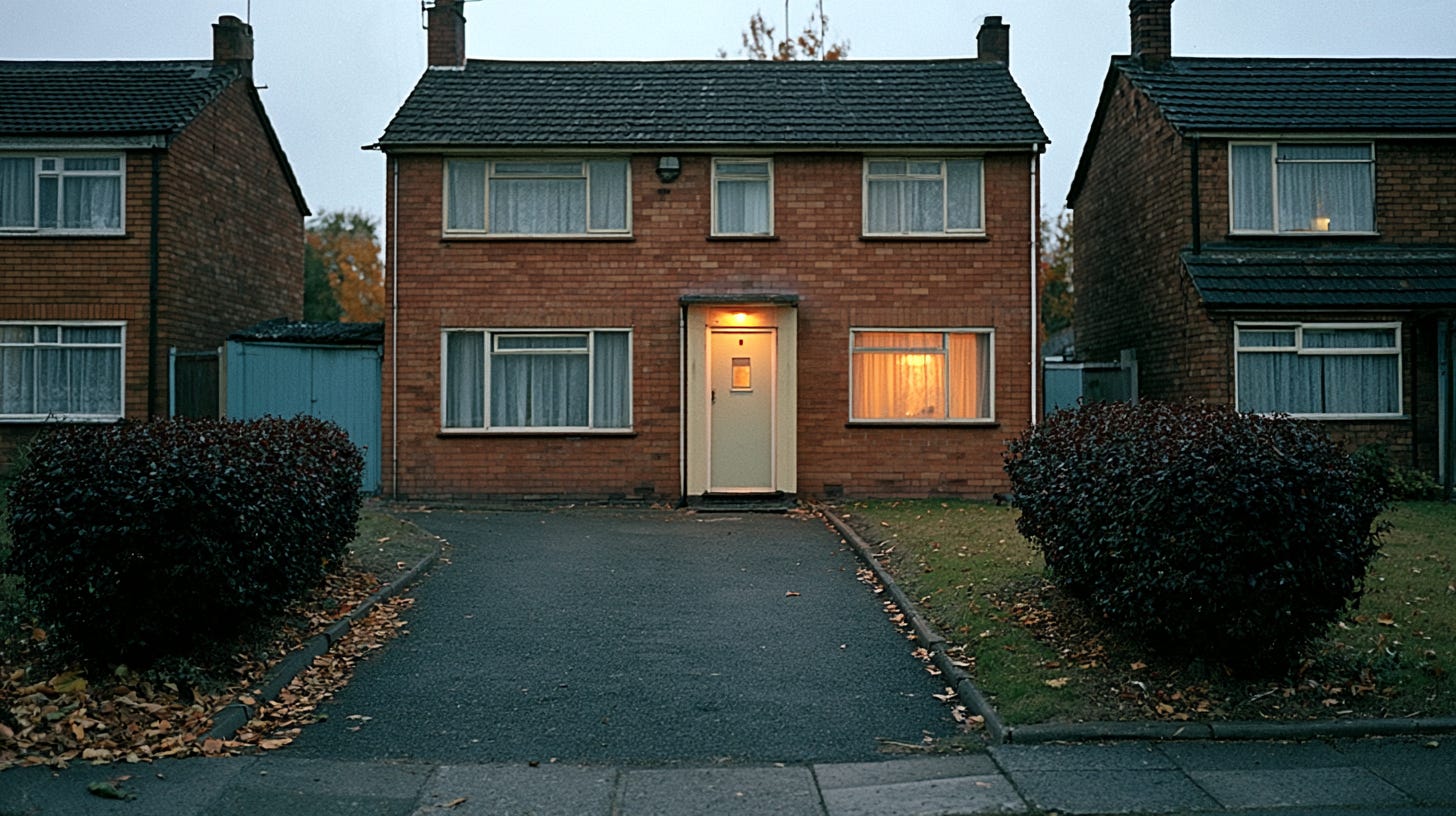
I don’t remember her name. I’ve tried many times. I remember everything else: Hambleton Avenue, the distance, the houses getting larger as I moved further from the main street. The driveway. The plants either side of it — one each, symmetrical, low and very dark-leafed, more formal than the street deserved. The colour of the front door.
Her mother answered. Polite, faintly puzzled. She called upstairs.
I heard footsteps on the landing. The girl came to the top of the stairs and descended slowly, watching me as she came. She stopped at the bottom and looked at me properly for the first time.
Her face was doing several things at once. She looked as if I had misunderstood something everyone else had been born knowing.
*Why are you here?*
I explained. I said someone had told me she’d asked for me.
She said she hadn’t. She closed the door.
Boys came out of the bushes at the end of next door’s drive.
As they did, I understood that the girl from my year had known.
The laughter came first, then the voices, already organized. They followed me the whole mile and a half home. Close enough that I heard every word. Far enough that anyone passing in a car would have seen a group of boys walking home from school.
I didn’t know what to do with my face. I tried to look like someone who was fine, then stopped trying. I looked at the pavement. I counted my steps for a while and then lost count. At some point I stopped rehearsing what I might say to make them stop, because there was nothing to say that would make them stop.
Somewhere along that road — in a lit window, in a front room I didn’t look up at — David Cassidy was still on somebody’s radio.
How can I be sure.
I made it through my own front door before I cried.
Quite the memory.
It is certainly an awkward age, especially in that era.
I myself was eleven in 1972.