

For the Minutes
It began, as these things sometimes do, with nothing more than a leash slipping through her fingers.
Maggie had just turned onto the lane by the crooked gate when Dog pulled hard, nose down, ears forward. He bounded ahead before she could tighten her grip, skidding to a halt at Mavis Holt’s feet.
Mavis, handbag clutched, bent without hesitation. “There you are, lad,” she said. The words waited. Dog pressed against her knees, tail thrashing out of time.
Audrey Crenshaw, just coming from the shop, folded her arms. “Well, that’s unusual. He’s not normally so… indiscriminate.”
Enid suggested loudly that Mavis must be hiding meat in her handbag. Dot added it to the list of reasons the curd tasted the way it did.
Mavis smiled, smoothing Dog’s scruff with slow, certain strokes. “Dogs just know a friendly hand,” she said, tidy as ever.
Maggie said nothing. She had lived with Dog long enough to know his habits: tolerant of strangers, nose to boots, the occasional pause at a noticeboard. But this—this rush of joy—belonged only to Reginald. Maybe to Nell. Never to someone new.
Reginald stood nearby, thermos in hand. He adjusted the cap. He did not speak. Stillness was enough.
At the next WI meeting the story had already grown legs.
Dot insisted it was pastry. “Shortcrust will draw them from three gardens over,” she said, tapping a pencil against her notebook. “We had a spaniel once took to the cooling rack like a parishioner to hymnbooks.”
Audrey declared some people “smell foreign to animals,” then frowned at her own phrasing and began to tidy it. “Not foreign—different. I mean different.”
Enid, in her softest scandalised tone, suggested Dog had simply lowered his standards. “He’s getting on,” she said. “They’ll wag at anything in the end.”
That prompted a flutter—how animals knew more than people; how cats were said to sense illness; whether the postman’s new aftershave had unsettled the spaniels near the allotments. Voices overlapped: Dot listing examples from her cousin’s farm; Enid muttering about standards; two women at the back arguing over whether it had been Thursday or Friday that Dog went to Mavis, which mattered, apparently, because of the market.
Audrey cleared her throat and suggested it go in the minutes—or at least be noted for reference. She looked pleased with the shape of it. “A subheading, perhaps,” she added, writing the word Subheading on her pad and underlining it twice.
Netta, from her corner, murmured that dogs carried memory longer than people did. Nobody asked her to repeat it.
There followed a procedural skirmish: Enid asked if “guidelines” required a motion, and someone at the back misheard “conduct” as “conduit,” leading to an entirely unnecessary detour. Audrey tried to restore order by reading aloud what she had drafted so far, then stopped, glanced at her notes, and adjusted a line before continuing.
Mavis began setting out her raffle jars with too much precision.
Lemon curd again, sweetness instead of answer. She aligned the labels with care, rotating one fractionally so the handwriting sat level. Most women took a jar home. Maggie left hers on the table.
“I’ll note that,” Audrey said, pen hovering.
“No,” Maggie said. “Please don’t.”
Audrey nodded, capped her pen, and made a small mark on her own pad instead, then crossed it out with a tiny line, neat as a seam.
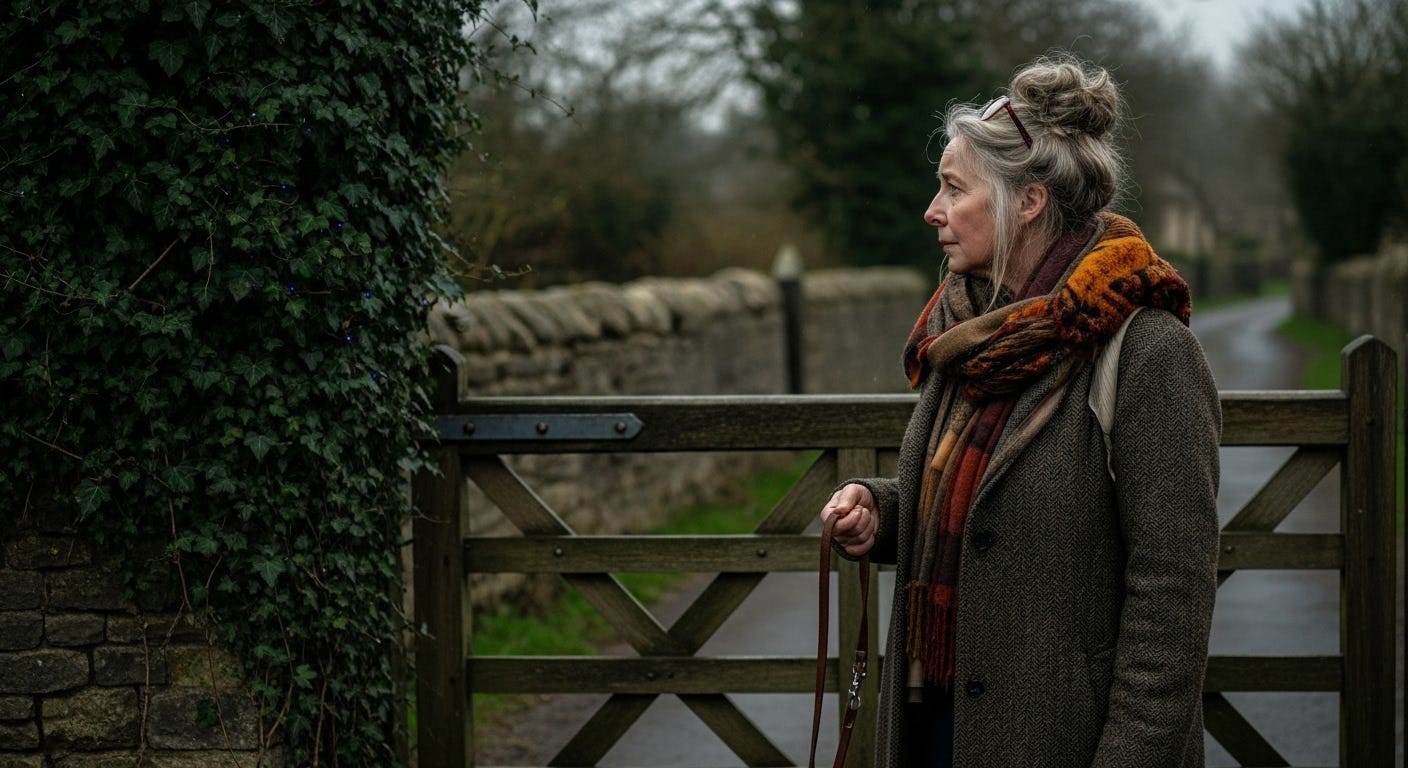
On another walk, Dog paused at Mavis’s gate though she was not there. He pressed his nose to a particular slat, paw lifted once as if waiting. A breeze moved the ivy. The wood smelled of varnish, the grain running beneath her hand. The latch stayed shut under her fingers.
Dog circled once, then again, slower. On the third pass he lay down, nose pressed to the earth, and whined, breath misting. The hinge gave a creak somewhere inside itself—no movement, only the sound a door remembers.
The ivy brushed Maggie’s sleeve as if holding her there.
A sparrow rattled in the hedge and fell quiet. The lane carried the smell of yeast from the shop. Somewhere farther off, a hammer tapped twice and then not again.
Maggie stayed, listening for whatever Dog had already heard.
She thought of the effigy jacket folded too carefully on the bench, shoulders shaped as if by someone who had just stepped away. Of the noticeboard on the green the month they misprinted the poster, a name gone soft in the rain. Of the time Dog lingered at the chalk outline, waiting for a figure that wasn’t there. Of the allotment gate, when he stopped in the gap as if expecting Reginald, though the path was empty.
Effigies mistaken. Notices misnaming history. Chalk that could not hold shape.
But this was Dog. Instinct, where mouths refuse.
When Maggie next saw Mavis in the lane, she met her eyes. Just a flicker. No explanation, no claim. Only silence, folded tight.
The fuss did not die.
On Friday Dot brought her list and added “confectionery” as a possible attractant, citing evidence from a fête in Bakewell. Audrey mentioned she had reviewed the standing orders and believed “animal matters” required a separate appendix. Enid said nothing at all until she leaned forward and asked if anyone else had noticed that Dog’s tail had gone entirely still when Maggie carried her curd home.
Nobody had.
In the shop queue, someone wondered if the swallow brooch pricked with a scent of something dogs liked. “There is no evidence,” Audrey said, in the tone of a woman who would prefer there to be evidence, and soon.
Reginald, carrying a paper parcel and his thermos lid in his pocket, said nothing at all.
Audrey, inevitably, wrote unorthodox dog behaviour on her own pad, drew a small box beside it, and left the box empty.
That evening the kettle on the hob had gone cold. Dog curled at her feet, content, one ear folded, the other listening to something only he could keep.
Maggie tapped her pen against the table once, then opened the grey notebook.
Not for the minutes, but for herself.
She looked at the date. Thought of what the WI recorded: attendance tallies, curd jars, motions half-seconded, words tidied into order. Then thought of what was not recorded: the hush at the gate, ivy brushing a sleeve, the stillness of a tail that once belonged only to Reginald.
Her hand hovered, then scratched.
Casefile #46: For the Minutes
Observation: Some recognitions do not require proof. A tail can name what a mouth will not.
Outcome: Not questioned further.
Additional Note: Memory knows its own scent.