

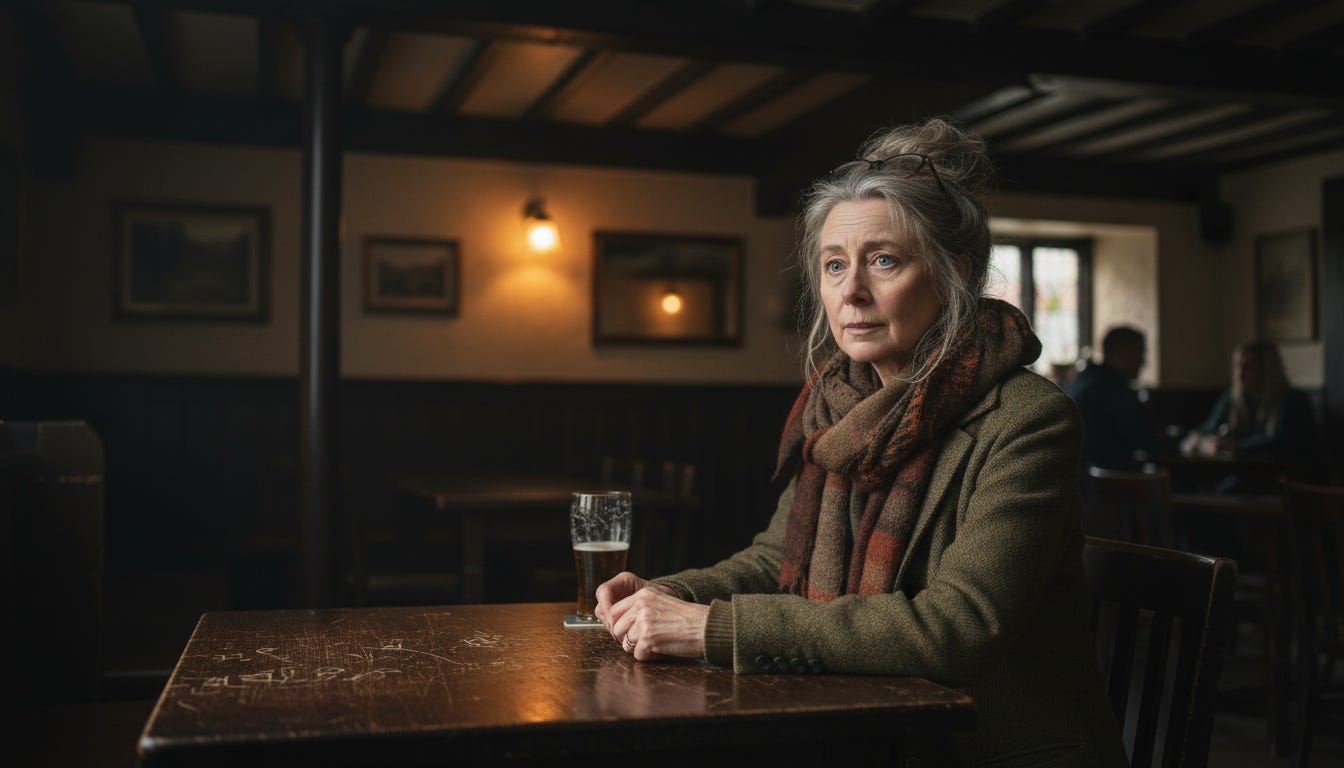
It began, as slow removals do, with a table no one thought to defend.
In the far corner of the pub, beneath the dark beams, it had sat for as long as anyone could remember. The varnish dulled where years of elbows had leaned. Near the edge, a pair of initials, cut shallow but firm. Beneath them, a date blurred enough to be 1964. Or 1984. A ring of darker wood ran along the left side where something had been set down and never wiped.
The new landlord---fond of “standards”---announced he’d be sanding all the tables. He pinned the notice by the fruit machine, typed and laminated. Netta read it standing at the bar. “Bold,” she said, and ordered a half.
Audrey approved. “Character,” she said, “is no excuse for poor presentation.” Dot said the tables had been fine for thirty years and would be fine for thirty more, but she said it to Enid, not to the landlord.
Two evenings later, Maggie passed with her tea and found him at the corner. Late sixties, coat still zipped, palm pressed flat on the wood. He came back the following week. Half a pint, never finished. Sometimes a paper folded on the table. One evening, he finished it. His hand settled in the same place.
He sat with his back to the room. The coat stayed zipped even after the fire had been lit. Once he brought a small cloth bag that he set on the bench beside him and didn’t open. The next week the bag was gone. Nobody asked about it.
Netta noticed him before Maggie did. “Corner table again,” she said one evening, carrying two glasses past. She didn’t slow down.
Dot asked the landlord if the man was local. The landlord said he thought so. Dot said she’d never seen him at the shop, the church, the WI, or the post office. The landlord polished a glass and said some people just came for the pub.
Once, as Maggie passed the bar, she caught a fragment from regulars: *”Sat there near every night that summer... till she stopped coming.”* No names. Just the lowering of voices when they realised she’d heard.
With the pub nearly empty and the dog curled beneath the bench, he looked up. His hand was still pressed flat. He didn’t speak.
The corner was taken---by a young couple with a packet of crisps between them. One of them traced the initials with a fingertip, laughing at something out of earshot. They left a napkin balled on the seat.
The man arrived late. He stood in the doorway. The draught reached the bar. Then he chose another table nearer the window, where the wood was pale and the surface unmarked. He turned the glass once in his hand.
When the couple left, their glasses leaving faint rings on the wood, he stood, took a step toward the corner, then stopped. He sat again. She held her glass. Someone at the bar laughed. The dog shifted along the bench.
He left before last orders. The beermat had been turned over twice. Maggie stayed until the barman collected the empties. He wiped the corner table last. The cloth caught once.
The following week, the workmen came with sanders. They started at the front and moved inward. Regulars shifted to the back, dragging chairs with them. Two tables were done by Tuesday---pale, smooth, stripped of everything that had accumulated. Someone said they looked like hospital furniture.
The corner table wasn’t there. It had been shifted to the back store room, a scrap of paper taped to its edge:
*Wobbly leg. Best left till last.*
The sanding took three days. The pub smelled of varnish and dust. Netta said it smelled like a school corridor. Dot said it smelled like money being wasted. The man came on the second evening, stood at the bar, and left without ordering. The landlord wiped each table down himself with a cloth folded into quarters.
By the time the leg was “fixed,” the sanding was done. The corner came back, lighter than it had been, the grain opened up. One of the initials had been cut through---the line shallow, but it broke the shape. The other held. The ring on the left side was gone. A new drip mat sat in the centre, still in its wrapper.
That evening, Maggie sat at the corner table. The bench dipped. She shifted once, then again. The fire hadn’t been lit yet. Through the window the lane was dark.
She opened the grey notebook.
Casefile #52: Best Left Till Last
Observation: Corner table removed for sanding. Returned.
Condition: Rear leg shorter. Table tilts. One glass ring darker than others.
She closed the book.