

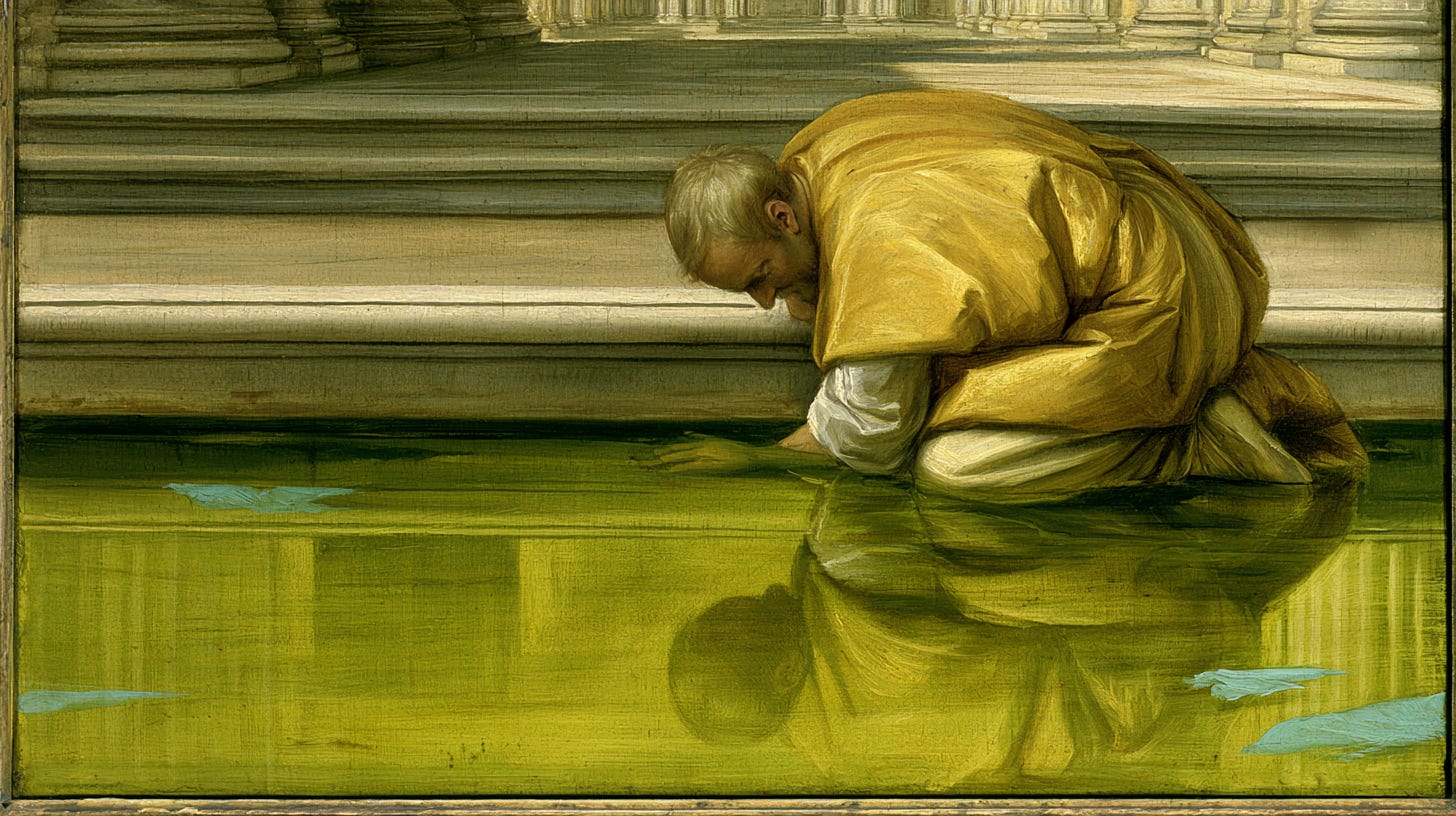
In the age before the nation’s two hundred and fiftieth feast day, there lived a man of gold towers who looked upon the reflecting pool and found it wanting.
The pool had stood since the days of grandfathers’ grandfathers. It had held the sky and the monuments and the faces of the multitudes. It had once held the image of two hundred thousand people gathered at the steps of the marble temple while a prophet told them what he dreamed. The pool had not asked for praise. It reflected what stood before it. This was its nature and its burden.
The man of gold towers looked into it and saw only that the color was wrong.
“It shall be American flag blue,” he decreed.
His priests at the Department of the Interior understood. There was a feast day approaching — one hundred and fifty days hence — and the sacred waters must be worthy of it. There was no time for the ancient rites of competitive bidding. Urgency was invoked. The exemption was granted.
They summoned two craftsmen.
The first was Atlantic Industrial Coatings, a guild from the province of Virginia whose artisans tended culverts, pipes, roofs, and chemical storage tanks. The ruler declared they had worked upon the pools at his estates in Sterling. The chroniclers found no proof. They had never before held a federal commission.
The second was Greenwater, a purification service from the banks of the Ohio. Its master, John of the Cafaro Trust, dwelt within one mile of the man of gold towers in the warm southern province of Palm Beach. The trust had given more than three hundred thousand in tribute. John had pleaded guilty once to bribing a congressman, and again to campaign finance violations. The priests of the Interior professed blindness to these omens. Greenwater received its commission.
The tribute required grew with each passing month.
First came eighteen hundred in silver. Then sixty-nine hundred. Then thirteen thousand and one hundred. Then fourteen thousand and two hundred. Then fourteen thousand seven hundred. With Greenwater’s portion added, the tribute passed sixteen thousand.
The oracle of competitive bidding remained unvisited.
They drained the sacred pool.
They coated it blue.
On the fifth day of June, they filled it back up.
The pool turned green.
Those learned in water were not surprised. The pool was nearly a century old and sat outside beneath the Washington summer. They had warned that haste and uncured coating would bring the green. They warned before the work began. They warned again when it appeared.
The Department sent workers with vacuums and jugs of hydrogen peroxide. The coating — whether paint or sealant the chroniclers could not determine — had begun to peel from the floor of the pool.
The ruler issued a proclamation through Truth Social.
The pool had been vandalized, he proclaimed. Unknown actors — enemies of beauty and of the nation — had used chemicals against the new surface. Jonathan of ABC had been seen at the water’s edge, “sticking his hand into the Pool” and “trying to rip the rubber off of the surface.” Law enforcement had been summoned.
One man had been arrested: he had leapt into the pool and cut a piece of sealant from its floor. The park police took him away.
The algae, the ruler assured the faithful, was seventy-five percent gone. The repairs would be completed early the following week.
The pool remains. It has been here since 1922. When the two hundred and fiftieth feast day arrives, it will reflect whatever stands before it.
A mirror cannot be made to show what is not there.
Brilliant Robert!
Wow! This blew me away, Robert!