
Allowed To Remain
On what’s allowed, what’s tolerated, and the quiet authority of leaving things where they stand.

Allowed To Remain
It began with something that looked, at first glance, like nothing.
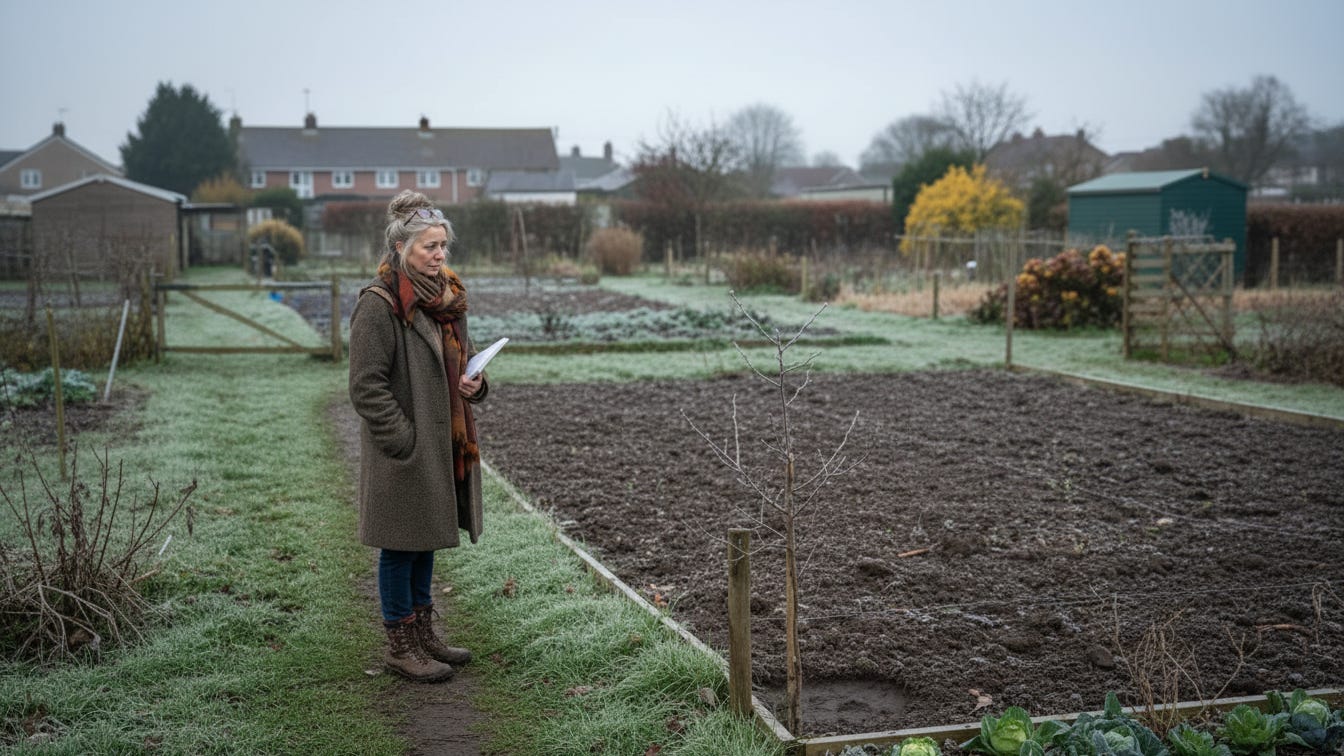
A thin sapling no taller than Maggie’s knee stood at the allotments where Plot 88 met Plot 90—exactly where Reginald Smythe-Harrington believed lines should behave themselves.
Maggie noticed it because her dog did.
He stopped. Nose down. A pause that lasted a second longer than habit. The lead went slack in her hand. Maggie let it.
It wasn’t a dramatic stop. No tug. No insistence. Just the quiet refusal of a body that had decided this small thing needed attention.
Maggie followed his gaze to the sapling. Its bark was pale and slightly rough, the kind that caught at wool. Its leaves were small, serrated, still figuring out their shape. The soil around it looked pressed rather than dug—smoothed in a way that felt careful.
She stood still.
A robin hopped on a shed roof. Somewhere beyond the hedgerow, a car door slammed, then a voice rose and softened again. The communal tap dripped once, twice.
Her dog sniffed again, then lifted his head. He looked up at her.
“Yes,” she murmured.
The sapling had no label. No stake. No protective ring of wire. It simply stood there.
Except it hadn’t.
Maggie had walked this path yesterday. She remembered the fence post on Plot 88 leaning the slightest fraction outward. She remembered the old cane someone had dropped near the boundary.
This was not that stick.
Her dog moved on. Maggie did not.
Plot 88 lay in disciplined rows. Brassicas aligned, soil worked dark and even. Reginald took pride in order.
Maggie saw him at the far end, already bent over his beds, already frowning at something no one else would notice. His back was straight even when it didn’t need to be.
He looked up. He had seen her. He had seen the dog stop. He had seen the sapling.
He did not wave.
Maggie approached at her usual pace.
“Morning,” she said.
Reginald grunted.
She stopped near the boundary.
“That wasn’t there yesterday,” she said.
“No,” Reginald said.
She waited.
He adjusted his gloves. Left. Then right.
“Hawthorn,” Maggie said.
Reginald flicked his eyes toward her.
“You’re sure,” he said.
“It has the look of one,” she said. “Even at that size.”
Reginald returned his gaze to the sapling.
“Not an allotment tree,” he said.
“No.”
Silence gathered.
“Boundary line runs here,” Reginald said, pointing to the invisible divide. “And it’s… at the boundary.”
“Close,” Maggie said.
Reginald made a sound that might have been agreement.
“I didn’t plant it,” Maggie said.
Reginald turned his head slowly.
“Do I look like a man who plants hawthorns,” he said, “at someone else’s boundary.”
“No,” Maggie said.
He faced the sapling again. He stood still, then turned back toward his brassicas.
Maggie remained.
The sapling stood a fraction out of true. Not enough to name. Enough to notice.
She did not comment.
She walked on.
By mid-morning, others had noticed.
Audrey Crenshaw arrived first, or at least positioned herself as such.
“It’s a hawthorn,” she said.
“I thought it was a stick,” Lynn Braithwaite muttered.
“Sticks don’t have leaves.”
“Some do.”
Netta stopped short.
“What’s that doing there.”
Maggie stood slightly back, dog at her heel.
Reginald worked at Plot 88, pointedly busy.
“It’s not on my plot,” Netta said.
“It’s not on mine,” Reginald replied.
“It’s on the line,” Audrey said.
“It is at the line,” Reginald said.
Netta frowned.
“Who planted it.”
No one answered at once.
A man on Plot 12 coughed. “I didn’t.”
Audrey glanced at Maggie, then away again.
“It should be moved,” Netta said. “Before it takes root.”
Reginald disappeared into his shed.
He returned with a small spade, blade down.
He took a step toward the sapling.
At the same moment, Maggie’s dog stood and moved forward. Not pulling. Just going.
Reginald stopped.
He looked down at the dog. Then at Maggie.
The dog sniffed the base of the sapling, then sat beside it.
Reginald’s fingers tightened on the spade handle. He adjusted his gloves. Left. Then right.
He lowered the spade. Rested it against his leg.
“It can stay for today,” he said.
Netta opened her mouth—
“For today,” Reginald repeated.
No one argued.
The group drifted away.
Maggie stayed. Reginald stayed too.
“You won’t compost it,” Maggie said.
“No,” he said.
She nodded.
Then she walked on.
The sapling was still there.
Maggie’s dog turned that way without asking her.
He paused. Maggie waited.
The soil looked unchanged.
Reginald was already at work.
Maggie stepped closer. The dog sat.
She touched the sapling’s trunk. Cold. Alive.
She withdrew her hand.
Her dog looked up at her, eyes clouded at the edges.
She stood.
She walked toward Plot 88.
“It’s still there,” she said.
“Aye,” Reginald said.
He stood with his hands behind his back.
“I’ve been thinking,” he said.
Maggie waited.
“If someone planted it,” he said, then stopped. Adjusted his gloves.
“There’s no mess,” he said. “No damage.”
Maggie nodded.
“It wasn’t a bird,” he added, without conviction.
“What will you do,” Maggie asked.
Reginald looked down at his boots.
“It can stay,” he said.
Maggie nodded.
“It’s a tree,” he added. “It will be what it is.”
Her dog stood and tugged gently.
She followed.
Three days later, frost edged the allotments.
The hawthorn held it differently than the surrounding soil.
The dog stopped. Sniffed once. Then turned away.
Maggie loosened her grip.
Reginald stood near the sapling.
He pressed compost around the base. Carefully.
Then he planted a cabbage seedling slightly out of line, giving the hawthorn more space than it needed.
He stood back.
“Not ideal,” he said.
“No,” Maggie said.
She walked on.
That afternoon, Maggie opened her notebook.
She wrote:
Casefile #37: Hawthorn on Plot 88.
No claimant.
Boundary dispute declined by mutual fatigue.
Roots not visible but assumed.
Reginald allowed the misalignment.
Dog paused. Then did not.